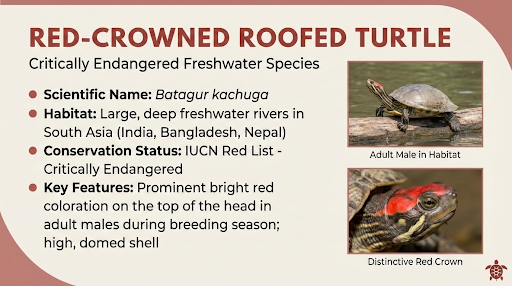
The Red-Crowned Roofed Turtle is a critically endangered freshwater reptile from South Asia. Known for the male's vibrant breeding colours, it faces extinction due to habitat loss and poaching. Its last major stronghold is India's protected Chambal River sanctuary.
Why In News?
The Red-Crowned Roofed Turtle (Batagur kachuga), one of Asia’s most iconic freshwater turtles, is currently facing the threat of extinction.
About Red-Crowned Roofed Turtle
The Red-Crowned Roofed Turtle (Batagur kachuga), also known as the Bengal Roof Turtle, is one of the most endangered freshwater turtle species in the world.
It is one of 24 turtle species endemic to South Asia and is considered a critical bio-indicator of river health.
Geographic Range: Native to India, Nepal, and Bangladesh.
Key Characteristics
Sexual Dimorphism: Females are significantly larger, reaching 56 cm and 25 kg, whereas males are roughly half that size.
Breeding: During the March–April breeding season, males develop brilliant red, yellow, and blue streaks on their necks to attract females.
Specialized Anatomy: Their ridged shell is an adaptation for swimming in strong river currents, while their slightly pointed snout allows for efficient surface breathing.
Diet: They are strict herbivores, fulfilling an ecological role by consuming aquatic plants and algae.
Habitat: They require deep, fast-flowing rivers with adjacent sandy beaches for nesting.
Nesting: Females lay clutches of 11 to 30 eggs in sandbars; these eggs undergo an incubation period of approximately 60–70 days.
Legal and Protection Status
Why is Habitat Declining?
Source: DOWNTOEARTH
|
PRACTICE QUESTION Q. Consider the following statements about the Red-Crowned Roofed Turtle: 1. It is a carnivorous species feeding on small fish. 2. It is listed under Schedule I of the Wildlife Protection Act, 1972. 3. The National Chambal Sanctuary is its only substantial remaining wild habitat. Which of the statements given above are correct? A) 1 and 2 only B) 2 and 3 only C) 1 and 3 only D) 1, 2 and 3 Answer: B Explanation: Statement 1 is incorrect: The Red-Crowned Roofed Turtle (Batagur kachuga) is primarily herbivorous. While some sources mention it may occasionally consume small invertebrates or function as an omnivore, it is not a primarily carnivorous species that feeds on small fish. Statement 2 is correct: It is listed under Schedule I of the Wildlife Protection Act, 1972. This provides it with the highest level of legal protection in India, equivalent to that given to the tiger. Statement 3 is correct: The National Chambal Sanctuary (located across Rajasthan, Madhya Pradesh, and Uttar Pradesh) is currently the only area with a substantial remaining wild population of the species. Historically, it was widespread across the Ganga and Brahmaputra basins, but populations there have declined. |
The Red-Crowned Roofed Turtle (Batagur kachuga) is classified as 'Critically Endangered' on the IUCN Red List due to a massive historical decline in its wild population.
As a strict herbivore, it acts as a keystone scavenger and biological filter in freshwater ecosystems. By consuming decaying organic matter and invasive weeds, it helps maintain river water quality. Its hatching ratios also act as a sensitive indicator of localized climate change.
Domestically, it is protected under Schedule I of the Indian Wildlife (Protection) Act, 1972 (granting it the same protection as the tiger). Internationally, it is listed in Appendix I of CITES, which strictly enforces a global ban on its commercial trade.


© 2026 iasgyan. All right reserved