Project Vayu Baan introduces indigenous Air-Launched Effects to the IAF, enabling helicopters like the Prachand to deploy autonomous drones for scouting and precision strikes. This MUM-T strategy overcomes A2/AD threats, reduces aircrew risk, and boosts India’s asymmetric swarm warfare capabilities.
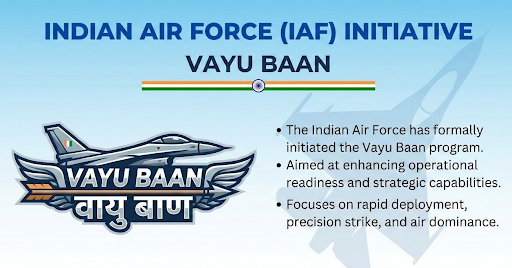
Why In News?
The Indian Air Force (IAF) initiated Project Vayu Baan, an indigenous program to develop Air-Launched Effects (ALE).
What is Project Vayu Baan?
The Vayu Baan (meaning "Air Arrow") is a small, autonomous unmanned aerial system (UAS) specifically designed to be launched from a moving helicopter.
Mechanism: Upon release from the "mother ship," the drone unfolds its wings, activates its propulsion system, and transitions into controlled flight.
Lead Agency: Directorate of Aerospace Design (DAD)
Key Technical Features & Capabilities
Extended Stand-off Range: Travel over 50 km after launch, allowing the helicopter to remain outside the reach of enemy Man-Portable Air-Defense Systems (MANPADS).
Dual-Role Versatility: Functions as an ISR asset (Intelligence, Surveillance, and Reconnaissance) for scouting or as a Kamikaze drone (Precision-Guided Munition) with an onboard warhead.
Electronic Warfare Resilience: Designed for GNSS-denied operations; navigate autonomously even if GPS signals are jammed by the enemy.
Loitering Endurance: Provides approximately 30 minutes of flight time to loiter over a target area, providing real-time data or waiting for the optimal strike window.
Strategic Significance
Force Multiplier & Pilot Safety
Traditional helicopter operations are highly vulnerable to ground-based fire. Vayu Baan acts as a "digital shield," allowing pilots to identify and neutralize threats from a safe distance, significantly minimizing risk to aircrew.
Asymmetric Swarm Warfare
A single Light Combat Helicopter (LCH Prachand) or Dhruv ALH can deploy multiple Vayu Baan drones. This creates a mini-swarm that can overwhelm localized enemy air defences, a tactic increasingly seen in modern high-intensity conflicts.
Strategic Autonomy
By developing ALE technology indigenously, India joins an elite club of nations (including the US and China) possessing air-launched drone capabilities. This reduces dependence on foreign OEMs for high-end loitering munitions.
Tactical Integration (The "Mother Ship" Concept)
Conclusion
Project Vayu Baan represents the future of Manned-Unmanned Teaming (MUM-T). It transforms the helicopter from a direct-attack platform into a sophisticated "carrier" of autonomous intelligence and precision firepower, ensuring the IAF maintains a qualitative edge in contested environments.
Source: NEWINDIANEXPRESS
|
PRACTICE QUESTION Q. The term 'Manned-Unmanned Teaming (MUM-T)', often seen in defense discourse, best describes: a) A training program where pilots mentor drone operators on the ground. b) The synchronized networking of manned platforms with autonomous unmanned systems. c) The replacement of all human fighter pilots with Artificial Intelligence. d) Joint search and rescue operations involving civil and military aircraft. Answer: b Explanation: MUM-T is a tactical concept where human-operated platforms (like fighter jets or helicopters) and unmanned systems (like drones or robotic vehicles) share data and collaborate in real-time to achieve a common mission goal |
Project Vayu Baan is an indigenous Indian Air Force (IAF) program developing Air-Launched Effects (ALE). It involves deploying small, autonomous drones from moving attack helicopters to act as forward scouts or precision kamikaze strikers.
The IAF is optimizing the Vayu Baan system primarily for its indigenous rotary-wing fleet. This includes the Light Combat Helicopter (LCH) Prachand and the Advanced Light Helicopter (ALH) Dhruv/Rudra.
MUM-T is a modern warfare doctrine where manned platforms (like piloted helicopters) work in synchronized networks with unmanned systems (like drones). It allows human pilots to safely command drone swarms from a safe distance to scout or attack enemy positions.


© 2026 iasgyan. All right reserved