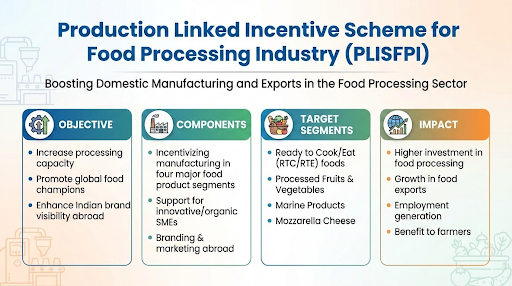
The PLISFPI scheme incentivizes domestic food manufacturing and global branding. It has successfully driven over ₹7,000 Cr in investment and 2.4 lakh jobs, aiming to create global food champions.
Why In News?
The Production Linked Incentive Scheme for Food Processing Industry (PLISFPI) has outperformed expectations, generating 3.29 lakh jobs—31% above its target—alongside Rs 9,207 crore in investments.
What is the PLISFPI?
It is a Central Sector Scheme approved by the Union Cabinet in 2021 with an outlay of ₹10,900 crore.
It is part of the government’s broader "Aatmanirbhar Bharat" initiative to incentivize incremental sales and investments in the food processing sector between FY 2021-22 and FY 2026-27.
What are the Objectives?
Creating Global Champions: Supporting Indian food manufacturing entities to become global leaders.
Strengthening Brands: Enhancing the visibility and acceptance of Indian food brands in international markets.
Boosting Employment: Generating non-farm employment opportunities for nearly 2.5 lakh people.
Ensuring Remunerative Prices: Increasing farmer income by ensuring higher off-take of agriculture produce at better prices.
What are the Key Features of PLISFPI?
The scheme is structured into three distinct categories:
What are the Benefits and Impact?
Jobs Creation: The PLISFPI has generated 3.29 lakh jobs, exceeding its target by 31%. This accounts for 42% of all jobs created under 14 PLI sectors, despite receiving only 8–9% of subsidies.
Investment & Capacity: Approved applicants (including 69 MSMEs) have invested ₹9,207 crore, creating 35 lakh metric tonnes per annum of new processing capacity.
Sectoral Impact: India currently processes only 12–13% of its agricultural produce.
Waste Reduction: Increased processing capacity helps reduce the estimated 15-20% wastage in the fruits and vegetable segment. (Source: FAO)
Future Outlook: If momentum continues, India could emerge as a global food hub, boosting exports and rural incomes. Without sustained policy support, however, gains may plateau.
What are the Challenges?
Supply Chain Inefficiencies: Despite the PLI, high logistics costs (14-18% of GDP) and fragmented cold chain infrastructure remain a bottleneck.
Raw Material Price Volatility: Fluctuations in the prices of agricultural inputs affect the cost-competitiveness of processed goods.
MSME Integration: Small-scale processors struggle to meet the high investment and turnover thresholds required to qualify for incentives. (Source: Standing Committee on Industry Report)
What is the Way Forward?
Focus on R&D: Incentivize innovation in food packaging and preservation to increase shelf life.
Strengthen Infrastructure: Align PLISFPI with the PM Mega Integrated Textile Regions and Apparel (PM MITRA) logic by creating dedicated food processing zones with integrated logistics.
Digital Traceability: Implement blockchain for food safety and traceability to meet stringent EU and US export standards.
Conclusion
The PLISFPI shifts from mere production to a market-driven, competitive ecosystem by linking incentives to sales and global health trends like millet consumption.
Source: PIB
|
PRACTICE QUESTION Q. With reference to the Production Linked Incentive Scheme for Food Processing Industry (PLISFPI), consider the following statements: 1. It mandates the domestic procurement of raw materials, including food additives and edible oils. 2. The scheme includes a targeted sub-scheme for Millet-based products (PLISMBP). 3. It provides financial support for international branding and marketing of Indian food products. Which of the statements given above is/are correct? a) 1 and 2 only b) 2 and 3 only c) 1 and 3 only d) 1, 2, and 3 Answer: b) Explanation: Statement 1 is incorrect: While the PLISFPI emphasizes local raw material procurement to benefit Indian farmers, the scheme guidelines specifically exclude food additives, flavors, and edible oils from the domestic procurement mandate. Statement 2 is correct: The scheme includes a dedicated sub-scheme for Millet-based products (PLISMBP). This component was launched with a specific outlay (utilizing savings from the main PLISFPI) to promote millet production and processing, especially during the International Year of Millets. Statement 3 is correct: One of the three primary components of PLISFPI is to provide financial support for branding and marketing abroad. This aims to help Indian food brands achieve global visibility and acceptance. Approved beneficiaries can be reimbursed for 50% of their expenditure on international branding, subject to certain caps. |
It is a Central Sector Scheme launched under the Aatmanirbhar Bharat Abhiyaan to incentivize large-scale manufacturing, boost global competitiveness, and transition India from a raw material supplier to a manufacturer of global food brands.
By mandating domestic procurement of raw materials, the scheme ensures remunerative prices for farmers at the farm gate. It also encourages value addition, which absorbs surplus agricultural labor and mitigates post-harvest perishability losses.
The scheme targets large entities in high-growth segments like RTE/RTC foods (Category-I), SMEs producing innovative or organic products (Category-II), and entities undertaking international branding and marketing activities (Category-III).

© 2026 iasgyan. All right reserved