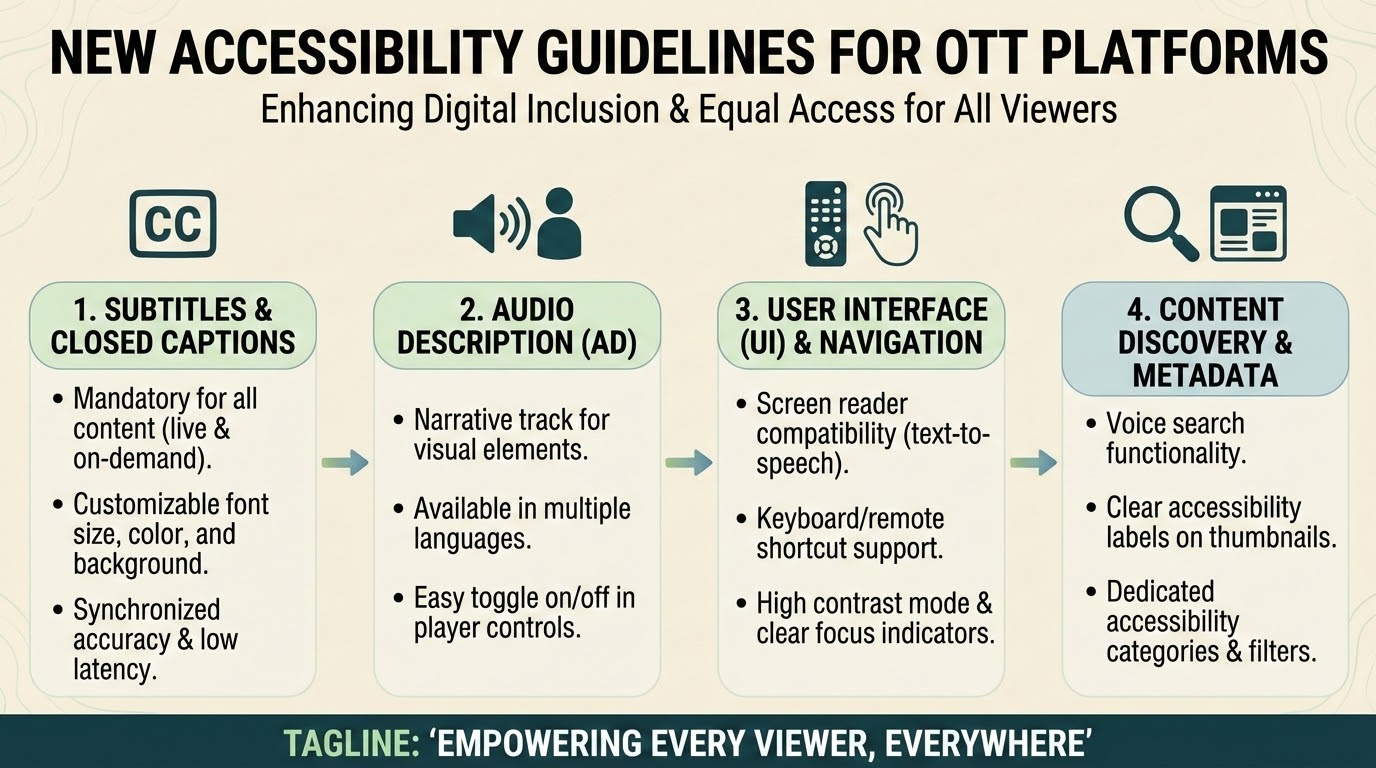
India's MIB now mandates accessibility features—like audio descriptions and captioning—on OTT platforms. Aligning with the RPwD Act 2016 and Article 21, these 2026 guidelines ensure digital inclusivity and equal entertainment access for Persons with Disabilities
Why In News?
The Ministry of Information and Broadcasting (MIB) notified the "Guidelines for Accessibility of Content on Platforms of Publishers of Online Curated Content (OTT Platforms) 2026".
|
Read all about: REGULATION OF OTT CONTENT IN INDIA l REGULATORY MECHANISMS FOR OTTS l GOVERNMENT REGULATIONS FOR OTT PLATFORM l SELF-REGULATION CODE FOR OTT CHANNELS |
Details About The New OTT Guidelines
The new guidelines operationalize the mandate of the Rights of Persons with Disabilities (RPwD) Act, 2016, which guarantees equal access to information and entertainment.
This move bridges the gap between traditional broadcast media (which already has accessibility norms) and the rapidly growing OTT sector, ensuring that millions of users with disabilities are not excluded from the digital entertainment boom.
Key Features of the Guidelines
Mandatory Accessibility
Implementation Schedule (The 3-Year Roadmap)
User Interface (UI) Accessibility
Exemptions & Flexibility
Recognizing technical constraints, the government has exempted certain categories from these immediate mandates:
Enforcement & Grievance Redressal
The guidelines introduce Three-Tier Mechanism to ensure compliance:
Reporting: Platforms must submit an "Accessibility Conformance Report" every quarter, starting after the 36-month transition period.
Significance
Rights-Based Approach: This move shifts accessibility from "charity" to a legal right, aligning with the UN Convention on the Rights of Persons with Disabilities (UNCRPD), to which India is a signatory.
Economic Impact: While this increases production costs (for captions, ISL, and audio descriptions), it opens up a significant untapped market of users with disabilities, increasing subscriber bases.
Way Forward
The 2026 Guidelines represent a shift towards an "Accessible Digital India." Success will depend on the collaborative efforts of OTT platforms, technology providers, and the disability community to ensure these features are not just "compliant" but genuinely "usable."
Source: DDNEWS
|
PRACTICE QUESTION Q. Digital accessibility is no longer an option but a necessity for social inclusion. Discuss. 150 words |
These guidelines mandate Over-The-Top (OTT) platforms to provide accessibility features such as closed captions, audio descriptions, and Indian Sign Language (ISL) interpretation for newly released content to assist users with visual and hearing impairments.
The 'Purple Economy' refers to the purchasing power and economic potential of households that include Persons with Disabilities (PwDs). Making digital content accessible allows platforms to tap into this massive, globally significant consumer base, driving subscriber growth.
Key challenges include the high financial costs of retrofitting legacy content, a severe lack of localized linguistic expertise for vernacular captioning across 22 scheduled languages, and a lack of technological standardization across different devices and third-party screen readers.


© 2026 iasgyan. All right reserved