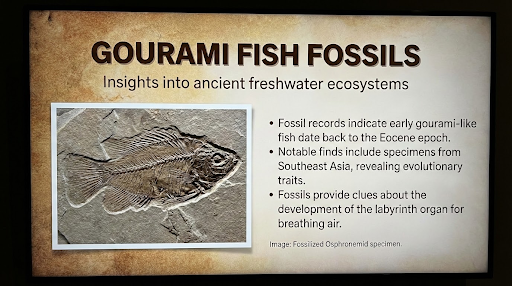
Gouramis are freshwater fishes from the Osphronemidae family, native to Asia. They possess a unique labyrinth organ for breathing atmospheric air, enabling survival in oxygen-poor waters. Recent Shivalik fossils of their ear bones (otoliths) prove ancient India hosted lush, tropical wetlands
Why In News?
Scientists from the Wadia Institute of Himalayan Geology (WIHG) have unearthed 4.5-million-year-old Gourami Fish Fossils in the Mohand area, near the Uttarakhand border.
About the Discovery
Geological Era: The fossils date back to the Eocene Epoch (approx. 34–56 million years ago), a period shortly after the Indian plate collided with the Eurasian plate.
Preservation: The fossils show intricate skeletal details, including the opercular bones and fin rays, preserved in lignite mines and shale deposits.
The Gourami fossil is particularly rare; it is the first-ever recorded presence in India and only the second globally, following a discovery in Sumatra
What are Gourami Fish?
Gouramis are a diverse group of freshwater perciform fishes belonging to the family Osphronemidae.
They are native to East, South, and Southeast Asia and are highly regarded in both evolutionary biology and the aquarium trade.
Key characteristics
Labyrinth Organ: They possess a specialized suprabranchial organ that allows them to breathe atmospheric oxygen. This adaptation enables them to survive in stagnant, oxygen-depleted waters where other fish might perish.
Feelers (Modified Fins): Many species, such as the Pearl or Honey Gourami, have pelvic fins modified into long, thread-like tactile receptors (feelers) used to sense their environment in murky waters.
Reproduction: Most gouramis are bubble-nest builders; the male blows bubbles at the water surface to create a nest for the eggs and provides parental care.
Diverse Sizes: They range from the Dwarf Gourami (approx. 5-8 cm) to the Giant Gourami, which can grow up to 70 cm and is a food fish in parts of Asia.
Significance
Paleo-Climate Reconstruction: The presence of Gourami fossils in himalayan regions like Uttrakhand proves that these areas were once lush, tropical, and characterized by perennial freshwater bodies and high rainfall.
The "Terrestrial-Aquatic" Link: While the Shivaliks are famous for vertebrate fossils (like the Sivapithecus or ancient elephants), this discovery fills a critical gap in scientific understanding of the aquatic biodiversity of the era.
Biogeographical Bridge: Link between the Uttarakhand fossils and those in Sumatra (Indonesia) suggests a shared climatic and ecological corridor between South and Southeast Asia during the Pliocene, influencing how species migrated across the continent.
Indicator of Wetland Ecosystems: Their presence suggests that the Eocene landscape of Himalayas was dominated by swamps, marshes, and riverine networks, contrary to its present mountain state.
Source: NEWINDIANEXPRESS
|
PRACTICE QUESTION Q. Consider the following statements regarding the recent fossil discovery in the Shivalik foothills:
Which of the statements given above is/are correct? A) 1 only B) 2 only C) Both 1 and 2 D) Neither 1 nor 2 Answer: C Explanation: Statement 1 is correct: The discovery is reported as the first time aquatic life fossils (specifically freshwater fish) have been identified in this specific region of the Shivalik foothills, which was previously known almost exclusively for terrestrial animal remains. Statement 2 is correct: The fossils discovered and analyzed are primarily "Otoliths" or ear bones of three distinct freshwater fish groups: snakehead (Channa), goby, and gourami. |
The discovery of 4.5-million-year-old Gourami fossils in the Shivalik foothills acts as a biological indicator of past paleo-environments, proving that the now-elevated region once possessed lush, stable freshwater ecosystems. It also validates the Continental Drift theory and the Out-of-India hypothesis.
The Labyrinth organ is a highly specialized biological adaptation found in fishes like the Gourami. It allows them to extract and breathe atmospheric oxygen directly, making them uniquely capable of surviving in stagnant, slow-moving, or oxygen-depleted waters.
The "Out-of-India" hypothesis suggests that certain biological lineages, including ancestors of modern Asian freshwater fish, evolved in isolation on the Indian landmass as it drifted northwards. Following India's collision with the Eurasian plate, these species dispersed across Southeast Asia.



© 2026 iasgyan. All right reserved