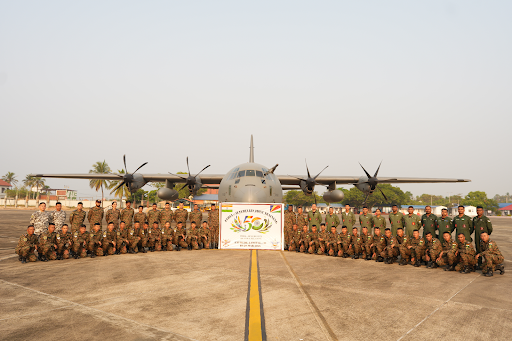
LAMITIYE-2026, the 11th India–Seychelles joint exercise, includes a tri-service Indian contingent for the first time. It boosts interoperability and reinforces India’s SAGAR vision as a net security provider in the IOR, while highlighting opportunities to expand cooperation into blue economy and climate action.
Copyright infringement not intended
Picture Courtesy: PIB
Context
The Exercise Lamitiye 2026 between India and Seychelles aimed at strengthening maritime security held in the Indian Ocean region.
What is Exercise Lamitiye ?
It is a biennial joint military training exercise conducted between the Indian Armed Forces and the Seychelles Defence Forces (SDF).
The name "Lamitiye" translates to "Friendship" in the Creole language, reflecting the spirit of defense cooperation between the two nations.
The most recent, Lamitiye 2026, is being held from March 9 to March 20, 2026, at the Seychelles Defence Academy.
Why is Seychelles Strategically Important for India?
Maritime Security and Geopolitics
Strategic Location: Seychelles sits along major Sea Lines of Communication (SLOCs) that facilitate global trade between Asia, Africa, and Europe.
Countering Influence: It provides India with a n opportunity to balance the growing presence of extra-regional powers, particularly China, in the Indian Ocean Region (IOR).
Net Security Provider: India acts as a "first responder" for Seychelles, providing assets like coastal surveillance radars, patrol boats (e.g., PS Zoroaster), and conducting joint surveillance to combat piracy, illegal fishing, and narcotics trafficking.
Assumption Island: India has an agreement to develop a naval facility on this island, which would offer a vantage point to monitor the Mozambique Channel and the wider region.

Strategic Policy Frameworks
SAGAR & MAHASAGAR: Seychelles is central to the SAGAR (Security and Growth for All in the Region) vision and the MAHASAGAR initiative, which focuses on holistic security and economic advancement.
Colombo Security Conclave (CSC): In February 2026, Seychelles became a full member of the CSC, institutionalising its role in a regional security bloc alongside India, Sri Lanka, Mauritius, and the Maldives.
SESEL Vision: In 2026, both nations adopted the SESEL (Sustainability, Economic Growth and Security through Enhanced Linkages) framework to deepen cooperation in digital governance, health, and climate resilience.
Economic and Cultural Ties
Blue Economy: With a vast Exclusive Economic Zone (EEZ), Seychelles is a key partner for India in sustainable fisheries, marine research, and ocean governance.
Trade: In the 2022-23 fiscal year, India's trade with Seychelles showed a significant surplus, with exports totaling US$ 64.88 million and imports valued at US$ 8.96 million.
Indian Diaspora: Approximately 10% of the Seychellois population is of Indian origin, providing a strong "soft power" bridge and cultural connection between the two nations.
Development Partnership: India provides significant assistance, including a recent $175 million Special Economic Package (2026) for infrastructure, housing, and digital transformation.
Source: PIB
|
PRACTICE QUESTION Q. Exercise LAMITIYE-2026 is a joint military exercise between India and which country? A. Maldives B. Seychelles C. Mauritius D. Sri Lanka Answer: B Explanation: Exercise LAMITIYE-2026, the 11th India-Seychelles biennial joint military exercise, held in Seychelles Defence Academy. |
Exercise LAMITIYE is a biennial joint military training exercise between the Indian Armed Forces and the Seychelles Defence Forces (SDF). Named after the Creole word for 'Friendship,' it aims to enhance interoperability in sub-conventional operations, build military relations, and share best practices.
Seychelles is strategically vital due to its location at the crossroads of Asia and Africa, near major shipping lanes in the Indian Ocean. It is a key partner for India in monitoring maritime threats like piracy and trafficking, central to India's SAGAR (Security and Growth for All in the Region) doctrine, and crucial for balancing the influence of other global powers like China in the region.
The SAGAR Doctrine, enunciated in 2015, outlines India's vision for the Indian Ocean Region. It focuses on cooperative measures for sustainable development and maritime security, emphasizing capacity building of coastal neighbours, collective action for security, and working towards a secure, stable, and prosperous maritime region.


© 2026 iasgyan. All right reserved