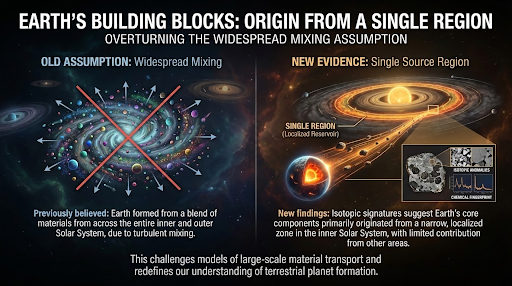
New research suggests Earth formed from a single local reservoir in the inner Solar System, rather than a "cosmic mix." Jupiter’s gravity acted as a shield, blocking outer-system material and implying Earth’s water was indigenous.
Why In News?
A study published in Nature Astronomy suggests that Earth was formed almost entirely from material within the Inner Solar System.
What are the Key Highlights of the Report?
The Old Theory: The "Cosmic Mix" Model
The New Discovery: The "Single Reservoir" Model
The new study, led by researchers Paolo Sossi and Dan Bower, presents new perspectives.
Key Implications for Planetary Science
The "Great Jupiter Barrier"
The findings reinforce the theory that Jupiter formed very early and grew rapidly.
The Mystery of Water
If Earth didn't get its water from outer-system comets, where did it come from?
Implications for Exoplanets
If rocky planets like Earth can form and sustain water using only "local" materials, it increases the probability of finding habitable Earth-like planets in other star systems, even in zones previously thought to be too dry.
Source: SCITECHDAILY
|
PRACTICE QUESTION Q. According to the new classification of celestial materials, "Non-Carbonaceous" meteorites are characterized by which of the following?
Select the correct answer using the code given below: A) 1 only B) 1 and 3 only C) 2 and 3 only D) 1, 2, and 3 Answer: B Statement 1 is Correct: These are "local" building blocks. Statement 2 is Incorrect: It is the Carbonaceous meteorites that are rich in water and carbon. Statement 3 is Correct: The study concludes Earth is made of non-carbonaceous material. |
It is a newly proposed scientific model proving that Earth formed almost entirely from indigenous material within the Inner Solar System. It overturns the traditional view that Earth's materials were a "cosmic mix" of inner and outer solar system rocks.
The Late Veneer theory suggested that an initially dry Earth received essential life-sustaining volatiles like water and carbon via a late influx of outer-system meteorites and comets. The Single Reservoir model disproves this, showing that Earth accreted its water natively from the inner solar system, meaning water was "baked in."
The Great Jupiter Barrier refers to the concept that Jupiter formed very early in the solar system's history. Its massive gravitational force acted as a shield, preventing outer solar system material (like carbonaceous meteorites) from crossing over and mixing with the inner solar system during Earth's formation.



© 2026 iasgyan. All right reserved