The Supreme Court ordered a nationwide CBI probe into the ₹3,000 crore “digital arrest” scams targeting seniors. It allowed investigation without state consent, directed action against fraudsters and mule-account bankers, and pushed coordination with Interpol and AI-based tracking, tightening accountability for telecom and online intermediaries.

Copyright infringement not intended
Picture Courtesy: THE HINDU
The Supreme Court directed the Central Bureau of Investigation (CBI) to launch a comprehensive, pan-India investigation into the escalating menace of 'digital arrest' scams.
|
Read all about: Digital Arrest l Curbing Cyber Frauds in Digital India l APK Scam and Cyber Fraud l Indian Cybercrime Coordination Centre |
A 'digital arrest' is a form of cyber extortion where fraudsters impersonate officials from law enforcement agencies like the CBI, Police, or Enforcement Directorate, or regulatory bodies like the RBI.
They trap victims by creating a sense of panic and urgency through fabricated criminal charges.
The surge in cybersecurity incidents from 10.29 lakh in 2022 to 22.68 lakh in 2024 reflects the growing scale and complexity of digital threats in India. (Source: PIB)
As of February 2025, the National Cyber Crime Reporting Portal (NCRP) has received reports of cyber fraud totaling ₹36.45 lakh. (Source: PIB)
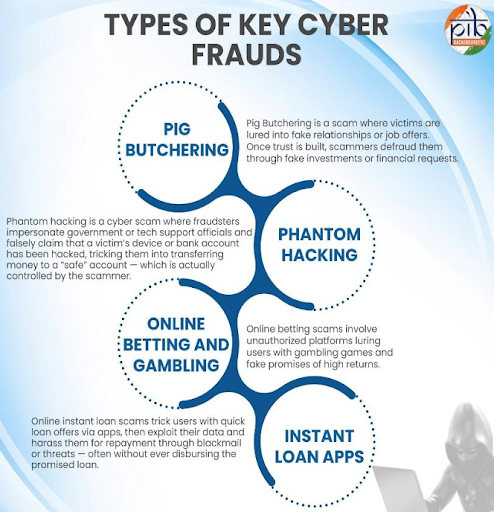
The Supreme Court directed the CBI to investigate 'digital arrest' scams and associated mule accounts, granting the agency a "free hand" to probe cybercrime-linked accounts.
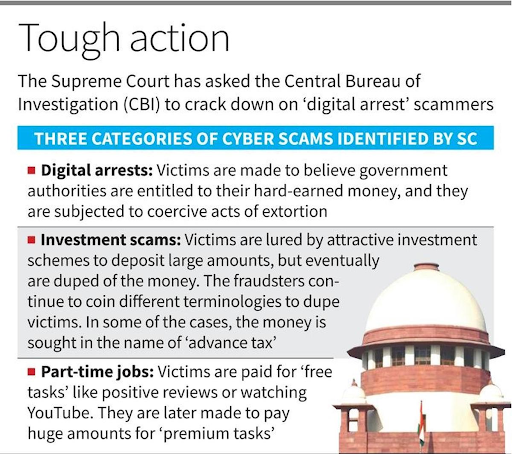
Key Reasons for Choosing CBI
Inter-State & International Jurisdiction: The CBI is equipped to investigate crimes that span multiple states and countries, which is a common feature of digital arrest scams originating from call centers in Southeast Asia.
Central Coordination Role: The SC appointed the CBI as the nodal agency to streamline intelligence sharing and joint operations among state police, central agencies (CERT-In), and financial institutions.
Resource Superiority: The CBI has better technical and forensic capabilities to handle complex digital evidence and trace money trails across borders.
India has a multi-layered framework to combat cyber threats, led by the Ministry of Home Affairs.
|
Institution/Framework |
Key Function |
|
Acts as the nodal agency under the MHA to coordinate a comprehensive response against cybercrime. |
|
|
A centralized portal (cybercrime.gov.in) for citizens to report all types of cybercrimes online. |
|
|
National Helpline Number 1930 |
A 24x7 toll-free helpline for immediate reporting of financial cyber fraud to help block transactions. |
|
Information Technology Act, 2000 |
The primary legislation that provides the legal framework for dealing with cybercrimes and electronic commerce. |
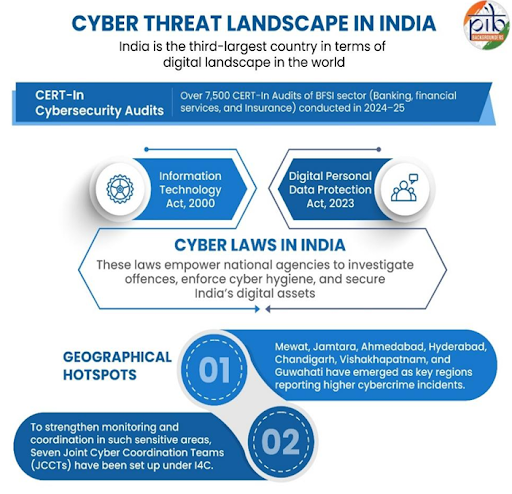
Technical Challenges
Administrative Challenges
Legal Challenges
Strengthening India's defense against these scams requires a combination of policy reforms, institutional capacity building, technological upgrades, and public awareness.
Policy Reforms
Institutional Reforms
Technological Reforms
The Supreme Court has expanded the CBI's authority to combat cybercrime, emphasizing that tackling these borderless digital offenses requires centralized coordination, strong inter-agency cooperation, rapid technological adaptation, and public awareness to ensure a secure digital India.
Source: THE HINDU
|
PRACTICE QUESTION Q. The term 'Digital Arrest', recently in the news, refers to: (a) A legal procedure for arresting individuals who commit crimes using digital evidence. (b) A government initiative to monitor and restrict the online activities of suspected criminals. (c) A form of cybercrime where fraudsters impersonate officials and extort money by confining victims to online calls. (d) A feature in new-age policing software that allows for the virtual detention of suspects during interrogation. Answer: C Explanation: The term 'Digital Arrest', which has been in the news recently, refers to: (c) A form of cybercrime where fraudsters impersonate officials and extort money by confining victims to online calls. In this scam, perpetrators use psychological manipulation and technology to trick victims into believing they are genuinely in legal trouble (e.g., for money laundering or drug trafficking) |
A 'digital arrest' is a type of cybercrime where fraudsters impersonate officials from agencies like the CBI, ED, or police. They create a sense of fear by accusing the victim of a serious crime and then extort money by forcing them to stay on a continuous video call, effectively placing them under "digital house arrest."
Established under the Ministry of Home Affairs, I4C is the central agency to deal with cybercrime in India. It coordinates with law enforcement agencies, provides technical expertise.
'Mule accounts' are bank accounts, often opened using fraudulent documents, that are used by criminals to receive and quickly transfer stolen money. This process, known as layering, makes it extremely difficult to trace the financial trail and recover the extorted funds.




© 2026 iasgyan. All right reserved