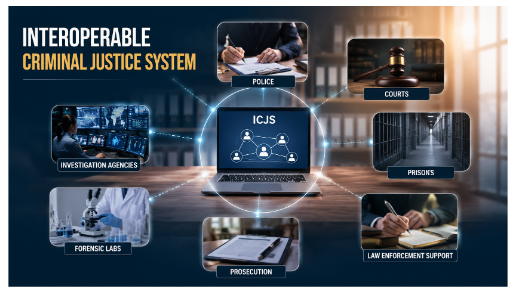
The CAPF Bill 2026 reignites the generalist-specialist debate by favoring IPS leadership, potentially overriding SC rulings on OGAS status. A hybrid leadership model is essential to resolve career stagnation, financial disparity, and the disconnect between combat risk and decision-making.
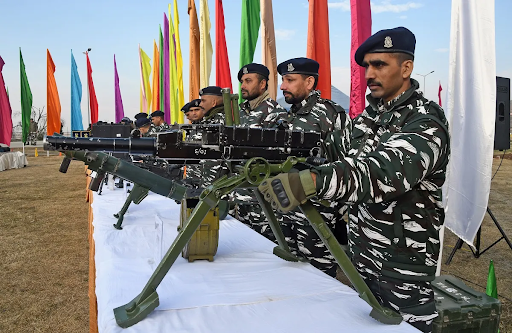
Copyright infringement not intended
Picture Courtesy: INDIANEXPRESS
Why In News?
The Union Cabinet has approved the Central Armed Police Forces (General Administration) Bill, 2026, to regulate the administration of CAPFs.
What are the Key Provisions of the Bill?
The Bill codifies recruitment, promotion, and service conditions for Group-A General Duty Officers.
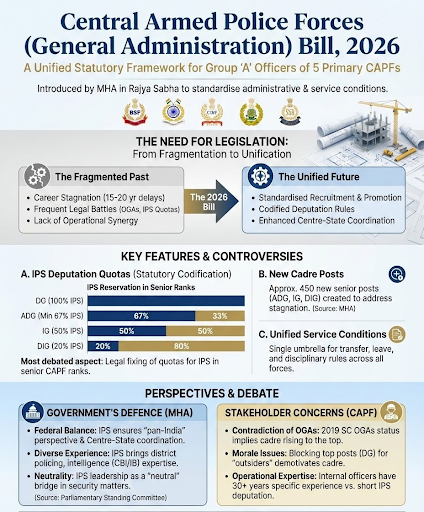
Arguments For and Against the Bill
The Bill has intensified the long-standing debate between proponents of generalist administration (IPS) and specialist cadres (CAPF officers).
Government's Rationale (Supporting IPS Leadership)
Federal Balance
IPS leadership ensures that Central forces maintain a "pan-India" perspective and better coordination with State Police during law-and-order duties.
Diverse Experience
IPS officers bring varied experience from district policing, intelligence, and investigative wings (CBI/IB), which benefits CAPF operations.
Neutrality
Senior IPS leadership is seen as a "neutral" bridge in inter-force or inter-state security matters.
CAPF Officers' Concerns (Opposing IPS Dominance)
Mismatch in Risk and Leadership
Dominance of deputationists in strategic posts creates a leadership disconnect, as cadre officers take the highest operational risks while being excluded from top-level decision-making.
Contradiction of OGAS Status
In 2019, the Supreme Court granted Organised Group ‘A’ Service (OGAS) status to CAPF officers, which implies that the cadre should rise to the top of its own hierarchy.
Morale Issues
Veterans argue that blocking the top 100% of posts (DG rank) for "outsiders" (IPS) demotivates battle-hardened cadre officers who spend their entire lives in conflict zones.Operational Expertise
Critics point out that internal officers have 30+ years of specific border or counter-insurgency experience that an IPS officer on a 3-year deputation might lack.
Way Forward
Implementing a hybrid leadership model that balances IPS strategic oversight with merit-based cadre promotion at DIG/IG levels is essential to resolve career stagnation and bolster operational morale.
Source: INDIANEXPRESS
|
PRACTICE QUESTION Q. The "One Border, One Force" principle, aimed at improving India's border management, was recommended by which of the following committees? a) Punchhi Commission b) Sarkaria Commission c) Kargil Review Committee d) Narsimham Committee Answer: c Explanation: The "One Border, One Force" principle was a key recommendation of the Kargil Review Committee (KRC), which was chaired by K. Subrahmanyam in 1999 following the Kargil conflict. The committee proposed this model to ensure that a single designated force is responsible for the entire stretch of a specific international border to prevent overlapping jurisdictions and coordination gaps between different security agencies. |
The CAPF (General Administration) Bill, 2026, is a draft legislation cleared by the Union Cabinet to create an overarching legal framework for regulating recruitment, promotion, and service conditions in CAPFs. It reserves top leadership roles exclusively for IPS officers on deputation.
CAPF officers strongly oppose the Bill because the top-heavy presence of IPS officers causes severe career stagnation for specialized cadre officers. They also argue the Bill denies them legally promised financial parity (NFFU) by excluding DoPT rules and creates a severe mismatch between combat risk-taking and strategic leadership.
This debate centers on whether CAPFs should be led by IPS officers (Generalists) who bring macro-level civilian policing and Centre-State coordination experience, or by CAPF cadre officers (Specialists) who possess deep domain expertise in jungle warfare, border management, and counter-insurgency.

© 2026 iasgyan. All right reserved