The Union Cabinet extended the IVFRT Scheme to 2031 with ₹1,800 crore to support the Immigration and Foreigners Act, 2025. While boosting security and medical tourism, the digital overhaul must balance seamless mobility with DPDP Act privacy protections.
Why In News?
The Cabinet approved the continuation of the Immigration, Visa, Foreigners Registration & Tracking (IVFRT) Scheme for five more years (2026–2031) to modernize border control, with the financial outlay of ₹1,800 Crore.
What is the IVFRT Scheme?
The Immigration, Visa, Foreigners Registration & Tracking (IVFRT) is a "Mission Mode Project" under the National e-Governance Plan (NeGP).
Core Objective: To develop a secure and integrated service delivery framework that facilitates legitimate travelers while strengthening national security.
How Does It Work?
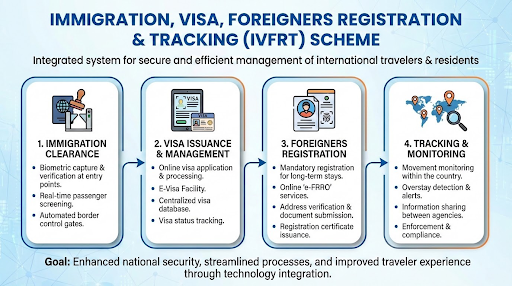
The scheme integrates multiple stakeholders into a single digital loop, tracking a foreigner's lifecycle from "Visa Application" to "Exit."
Key Pillars of the 2026-2031 Phase
This phase aligns the scheme with the newly enacted Immigration and Foreigners Act, 2025, providing the necessary technological infrastructure to enforce the new legal framework.
Fast Track Immigration-Trusted Traveller Programme (FTI-TTP)
100% Faceless & Contactless Service
Advanced Data Analytics
Passenger Name Record (PNR): The scheme integrates airline PNR data to perform "risk analysis" before a flight even lands, allowing agencies to identify high-risk travelers in advance.
Significance
Overstay Detection: By integrating the entry and exit logs in real-time, the system automatically flags "overstayers," addressing a major gap in previous manual systems.
National Security: Prevents the entry of blacklisted individuals by cross-referencing biometric data with global terror databases instantly at the visa stage itself.
Ease of Doing Business: A seamless visa regime is critical for attracting FDI. Long immigration queues are often cited as a non-tariff barrier to trade and tourism.
Medical Tourism: The specialized "Medical Visa" processing under IVFRT has been a key enabler for India's rise as a medical value travel hub.
Conclusion
The IVFRT Scheme is a classic example of "Minimum Government, Maximum Governance." By replacing the "iron curtain" of bureaucracy with a "digital bridge," it secures India's borders while keeping its doors open to the world.
Source: THEHINDU
|
PRACTICE QUESTION Q. Consider the following statements regarding the Immigration, Visa, Foreigners Registration & Tracking (IVFRT) Scheme: 1. It was launched under the National e-Governance Plan (NeGP). 2. The Ministry of External Affairs is the nodal ministry for managing the IVFRT project. 3. It interlinks Immigration Check Posts (ICPs) and Foreigners Regional Registration Offices (FRROs) into a centralized national database. Which of the statements given above is/are correct? a) 1 and 2 only b) 1 and 3 only c) 2 and 3 only d) 1, 2, and 3 Answer: b Explanation: Statement 1 is Correct: The IVFRT (Immigration, Visa, Foreigners Registration & Tracking) project is indeed one of the Mission Mode Projects under the National e-Governance Plan (NeGP) aimed at modernizing and interlinking immigration services. Statement 2 is Incorrect: The Ministry of Home Affairs (MHA) is the nodal ministry for the IVFRT project. While the Ministry of External Affairs (MEA) is a key stakeholder (managing the visa issuance at Indian Missions abroad), the overall project management and the Bureau of Immigration (BoI) fall under the administrative control of the MHA. Statement 3 is Correct: The core objective of IVFRT is to create an integrated, centralized national database that interlinks Indian Missions abroad, Immigration Check Posts (ICPs), and Foreigners Regional Registration Offices (FRROs) to track the entire lifecycle of a foreigner—from visa application to stay and final exit. |
The Immigration, Visa, Foreigners Registration & Tracking (IVFRT) Scheme is a mission-mode e-governance project that digitizes and centralizes India’s immigration, visa issuance, and foreigner registration processes into a single national database.
The IVFRT Scheme is managed and implemented by the Ministry of Home Affairs (MHA), Government of India, working closely with the Bureau of Immigration (BoI).
FTI-TTP is a biometric-enabled initiative operating at major Indian airports. It uses automated e-gates to reduce immigration clearance times from 3 minutes to just 30 seconds for pre-verified, trusted travelers.



© 2026 iasgyan. All right reserved