

Copyright infringement not intended
Picture Courtesy: THE HINDU
Context
India can learn from China's quick and effective pollution control strategies to develop its own model, while adapting them to its democratic structure and avoiding previous mistakes.
China's Pollution Crisis & Response
In the early 2010s, China faced a severe environmental crisis. In 2013, the average annual PM2.5 concentration in its cities was 61 µg/m³, with Beijing’s levels often exceeding 500 µg/m³, a phenomenon dubbed the "airpocalypse". (Source: UNEP)
The crisis severely threatened public health and stability, leading the government to launch a "War on Pollution" in 2014.
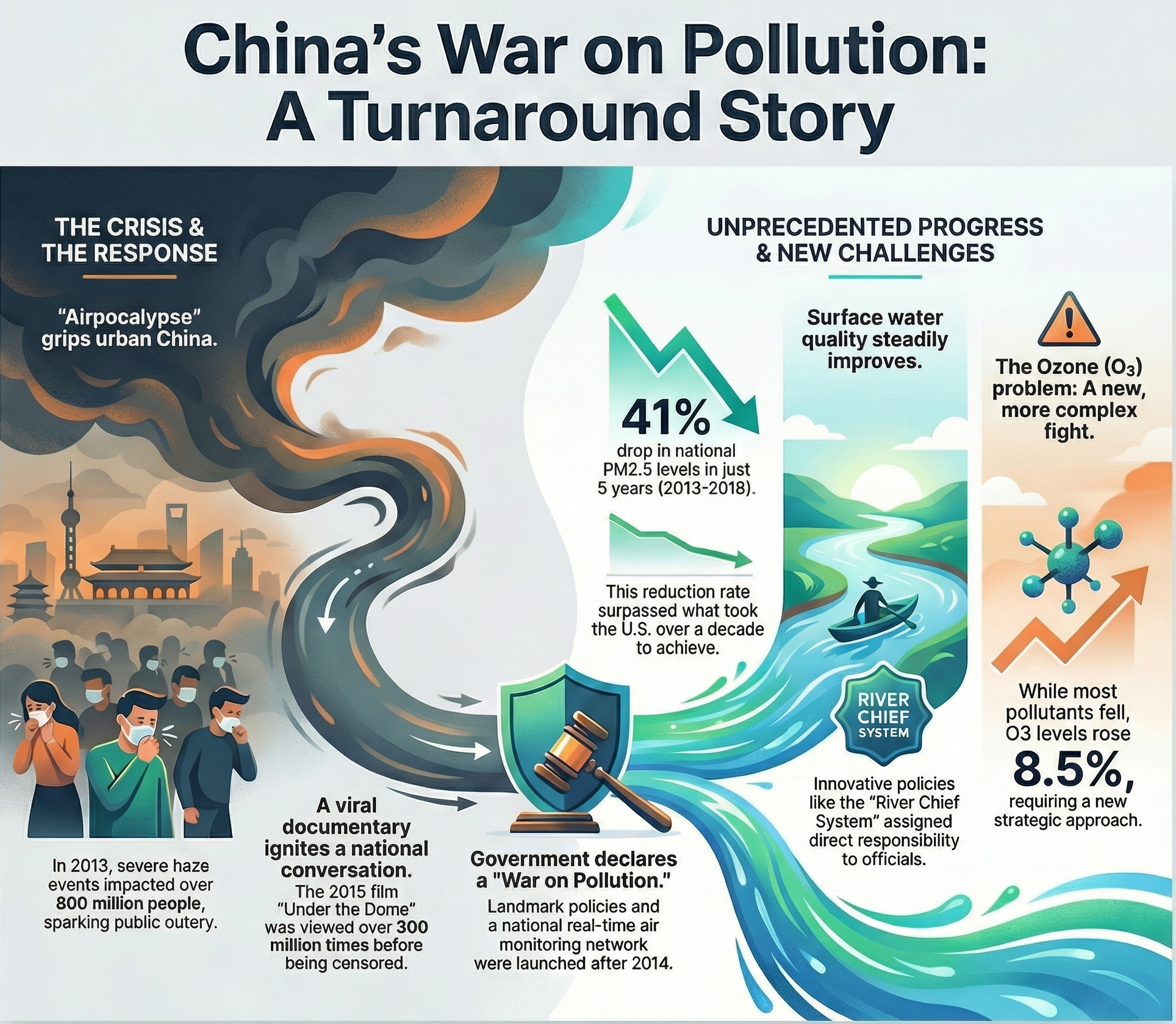 Key Pillars of China's Strategy
China's success was built on a multi-pronged strategy that combined technology, stringent enforcement, and systemic restructuring of its economy.
Technology-Driven Monitoring & Data Transparency
Energy and Industrial Restructuring
Strict Enforcement & Accountability
While China's model provides a powerful template, India must adapt these lessons to its democratic and federal structure. A simple "copy-paste" approach is neither feasible nor desirable.
Strategies India Can Adapt
Technology-Led Monitoring
Expand India's real-time monitoring network under the National Clean Air Programme (NCAP) and ensure data is publicly accessible and easy to understand, similar to China’s model.
City-Specific Action Plans
Focus on robust, well-funded, and legally enforceable action plans for India's most polluted cities, a core strategy of the NCAP.
Promoting Clean Transport
Accelerate EV adoption through consistent policies (like FAME), support for charging infrastructure, and electrifying public transport fleets.
Cooperative Federalism
While avoiding China's top-down coercion, the Centre can encourage competition and collaboration among states by linking financial incentives (like Finance Commission grants) to environmental performance.
Strategies India Should Avoid
Forced Shutdowns
Abrupt and large-scale factory shutdowns, as seen in China, would be disastrous for India’s large informal sector and could lead to widespread job losses without a social safety net.
Excessive Centralisation
A highly centralised, top-down enforcement model undermines the role of State Pollution Control Boards (SPCBs) and local governments. India needs to strengthen these institutions, not bypass them.
Lack of Public Participation
China's approach lacked public consultation. In India, a successful strategy must involve citizens, civil society, and industry stakeholders in the decision-making process to ensure buy-in and long-term success.
India's journey towards cleaner air requires a balanced approach rooted in its democratic ethos.
China shows rapid pollution control is possible with political will and technology, but with social costs; India should adapt its own democratic, federal, and socially sensitive approach to balance growth and environment.
Source: THE HINDU
|
PRACTICE QUESTION Q. India’s air pollution challenge is less about absence of laws and more about weak governance. Critically analyze. 150 words |
Launched in 2019, the NCAP is a flagship initiative to improve air quality in 131 "non-attainment" cities. Its goal was recently revised to achieve a 40% reduction in particulate matter (PM10) levels by 2025–26 compared to 2017 baselines.
GRAP is an emergency framework primarily used in the Delhi-NCR region to combat episodic air pollution. It has four stages:
Pollution is linked to over 2 million premature deaths annually in India. Common health issues include chronic respiratory diseases (asthma, COPD), cardiovascular problems, and developmental delays in children. Recent studies in 2025 also highlighted a potential decline in children's IQ in high-pollution zones.
© 2026 iasgyan. All right reserved