

Copyright infringement not intended
Picture Courtesy: THE HINDU
India is adopting a dynamic trade strategy, finalized modern agreements with the UK, Oman, New Zealand, and the EU in 2025-26, which include new provisions on environment, labor, and digital trade.
Modern international trade agreements are shifting from tariff-focused "goods-only" Regional Trade Agreement (RTA) to comprehensive strategic partnerships that include digital trade, supply chain resilience, and environmental standards.
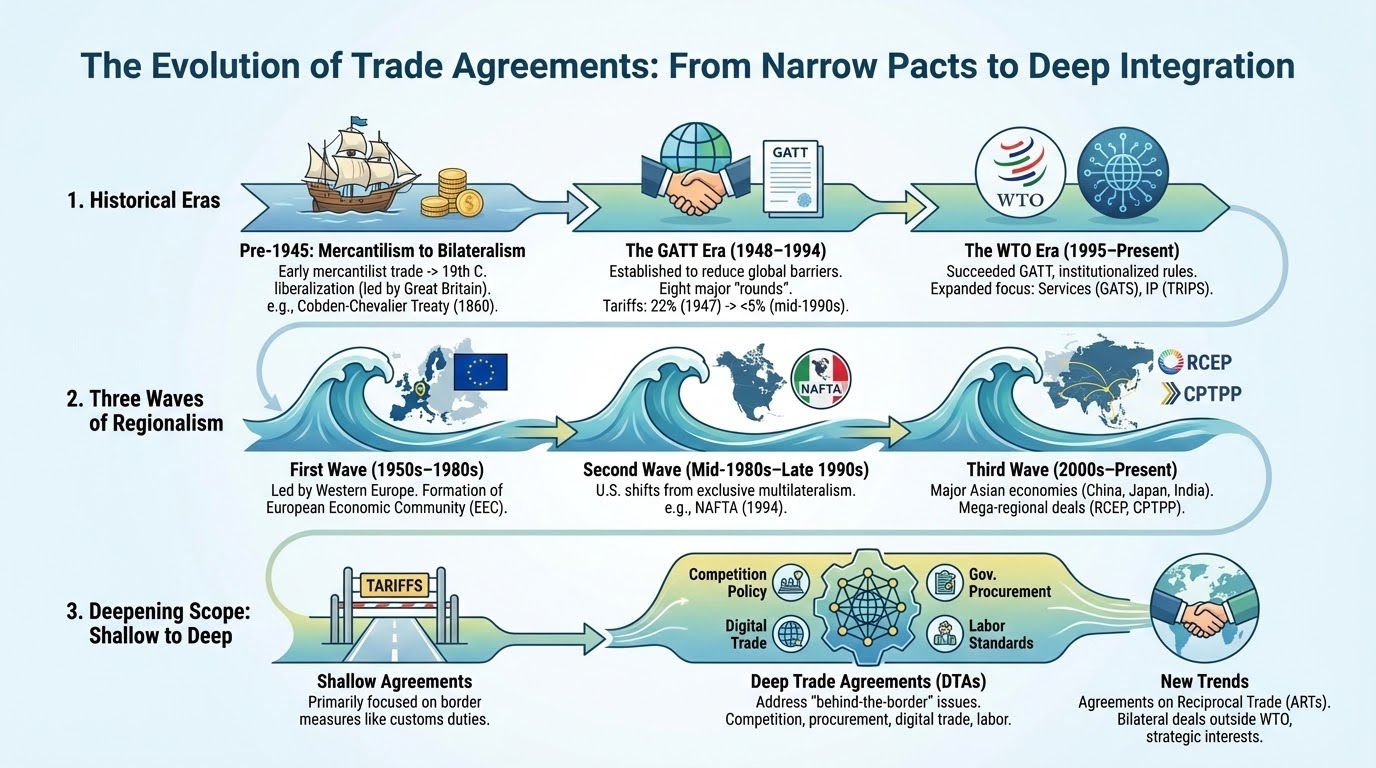 The Historical Arc of Global Trade Pacts
The nature of trade agreements has evolved through three distinct phases, moving from simple market access to deep, strategic integration.
|
Era |
Primary Focus |
Key Characteristics & Examples |
|
Era 1: Post-WWII (GATT/Early WTO) |
Reducing Border Barriers |
|
|
Era 2: Deep Integration (Late 1990s - 2010s) |
Beyond-the-Border Integration |
|
|
Era 3: The Current Pivot (Post-2020) |
Sovereign Resilience & Values |
|
Digital Trade and AI Governance
As the global economy digitizes, rules governing data are becoming a central part of trade negotiations. Key areas include:
Sustainability and Labour Standards
Trade is increasingly being used as a tool to promote environmental and social goals. These "green clauses" include:
Supply Chain Resilience
The pandemic exposed the vulnerabilities of hyper-efficient global supply chains. The focus has now shifted from:
Integration of Small and Medium Enterprises (SMEs)
To make growth more inclusive, new agreements often include specific chapters dedicated to helping SMEs participate in global trade. This is achieved through:
India’s Trade Strategy in New Global Order
India’s trade strategy underwent a "proactive and strategic" re-orientation, transitioning from a historically protectionist stance to becoming a leader in global economic integration.
Shift to "New-Age" Bilateralism
India has moved away from massive regional blocs (like RCEP) in favour of deep, comprehensive bilateral agreements with developed economies.
Trade as a Geopolitical Tool
Trade agreements are no longer just about economics; they are now instruments of Strategic Autonomy.
Domestic Enablers & Sectoral Focus
To support the global outreach, the government has launched several domestic "force multipliers":
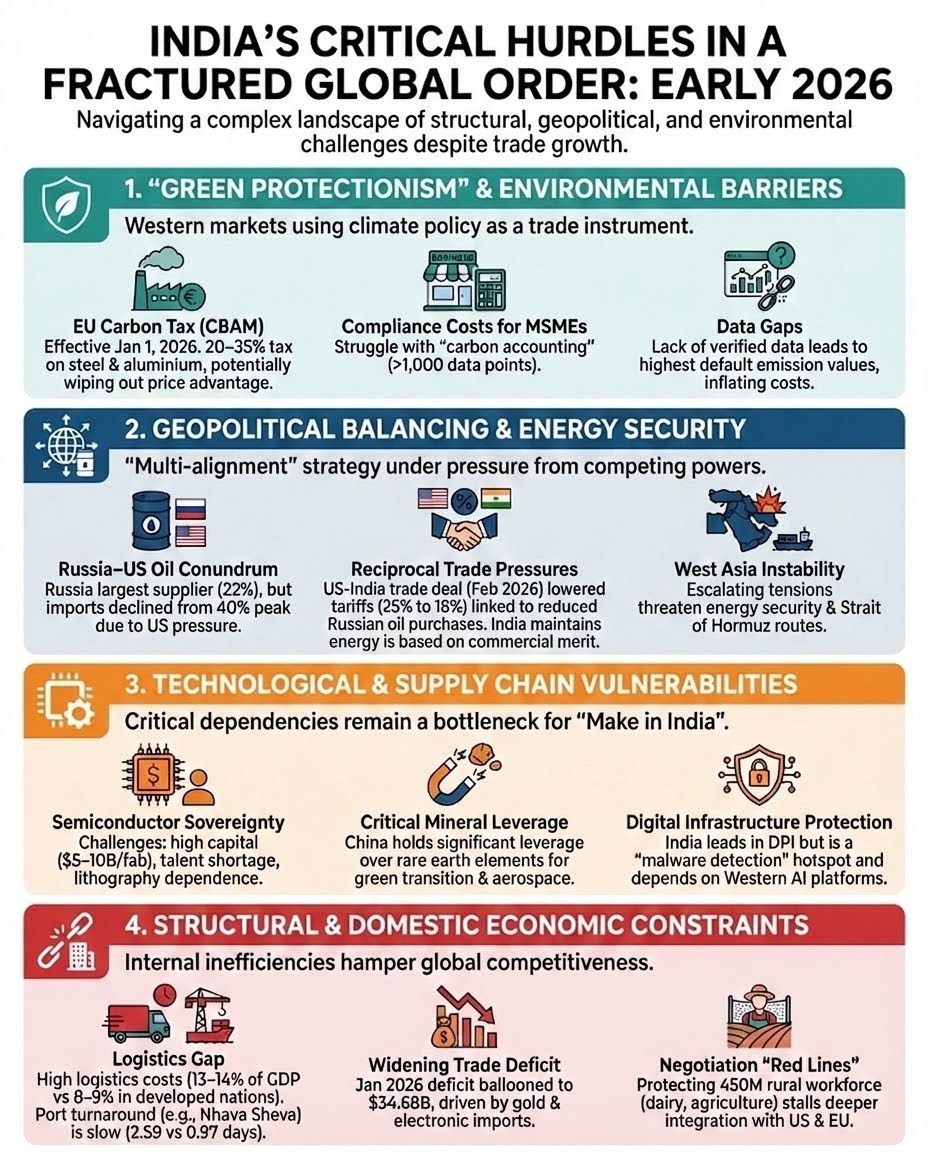
What are the Challenges for India in the New Global Order?
India's "New-Age" FTAs are hampered by complex regulatory barriers and domestic structural issues, preventing their full utilization.
"Green Protectionism" & Non-Tariff Barriers (NTBs)
The primary external roadblock is the shift from high tariffs to complex environmental and social regulations.
Carbon Border Adjustment Mechanism (CBAM): This EU "carbon tax" could impose an additional 20–35% duty on Indian exports like steel, aluminium, and cement. This effectively neutralises the 0% tariff gains won in the India-EU FTA.
Regulatory Onslaught: Rules like the EU Deforestation Regulation (EUDR) and Corporate Sustainability Due Diligence (CSDDD) require small Indian farmers and MSMEs to provide geotagging and traceability data, creating an unaffordable compliance burden.
Sanitary & Phytosanitary (SPS) Measures: Stringent safety standards in the US and EU lead to high rejection rates for Indian agri-products, often acting as "hidden protectionism".
The "Import-Dependent Export" Trap
Value Addition Gap: In mobile phone manufacturing, domestic value addition is only 23%, meaning a spike in exports to the West automatically increases component imports from China.
Inverted Duty Structure: In sectors like electronics and chemicals, raw materials are often taxed higher than finished goods, making it cheaper to import final products than to manufacture them locally.
Asymmetric Utilization & Widening Deficits
Low Utilization Rates: Indian exporters utilize only about 25% of available FTA benefits, compared to 70–80% in developed nations. This is largely due to complex Rules of Origin (RoO) and a lack of awareness among MSMEs.
Surging Imports: Agreements with ASEAN and the UAE have led to a widening trade deficit as imports grow faster than exports (e.g., the deficit with ASEAN expanded to $44 billion by 2023).
Domestic Structural Bottlenecks
Logistics Inefficiency: India still relies on road transport for 71% of freight, leading to higher costs compared to competitors like China, who utilize more efficient rail networks.
MSME Credit Gap: A massive ₹30 lakh crore credit gap prevents small firms from upgrading technology to meet the stringent quality standards of Western markets.
Information Asymmetry: Many small-scale exporters remain unaware of the specific concessions and procedural requirements of new-age FTAs.
Geopolitical & Strategic Frictions
Data Sovereignty: Disagreements over data localisation and cross-border data flows remain a sticking point in negotiations with the EU and US.
Strategic Autonomy vs Alignment: Pressures from the US to reduce Russian oil imports or align on specific sanctions create diplomatic irritants that can stall broader trade frameworks.
 Way Forward For India
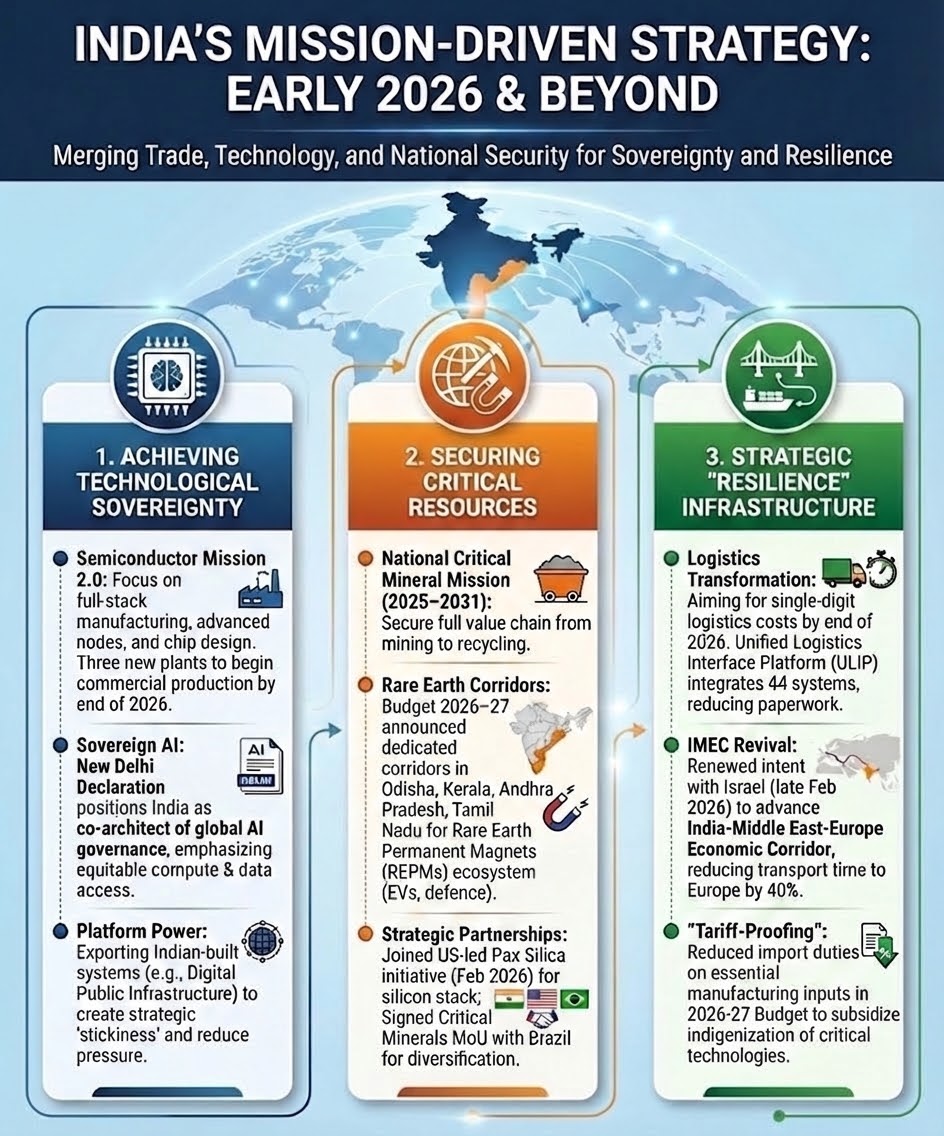
The global trade paradigm has shifted from "Efficiency at any cost" to "Resilience at all costs." For India, trade is no longer a search for the cheapest supplier, but a tool to secure national interests, technological sovereignty, and economic stability.
Transition from "Just-in-Time" to "Just-in-Case"
De-risking: India must reduce dependence on adversarial nations for critical inputs (like APIs for pharma or rare earth minerals for EVs).
Trusted Geography: Trade must be conducted through "Friend-shoring," prioritizing agreements with nations that share democratic values and security interests (e.g., the India-EU FTA and India-Australia ECTA) over those offering merely cheap goods.
Trade as a Shield for "Sovereign AI"
Data Sovereignty: India must enforce clauses in trade deals that protect its right to store and process data locally. This ensures that AI models serving rural India (like BharatGen) are trained on indigenous data, preventing "data colonization".
Securing the "Brains": India needs to leverage coalitions like Pax Silica (2026) to secure semiconductor supply chains, ensuring that its AI-driven agriculture and healthcare sectors are immune to external "chip blockades".
Exporting "Digital Trust" (DPI)
India should use its trade policy to export its Digital Public Infrastructure (DPI)—such as UPI and Aadhaar—as a global standard.
DPI as Soft Power: By helping other Global South nations adopt the "India Stack," India creates a "technological sphere of influence" that bypasses Western financial intermediaries and reduces transaction costs.
Interoperability: Trade agreements should push for the acceptance of Indian digital standards, allowing an Indian MSME to receive payments from a buyer in France or Singapore instantly and cheaply.
"Deep" Manufacturing over Assembly
To achieve true autonomy, India must move up the value chain.
Component Independence: The focus of schemes like PLI (Production Linked Incentive) must shift from final assembly (e.g., putting phones together) to manufacturing the core components (e.g., display screens, sensors) domestically. This reduces the "import intensity" of exports.
Critical Minerals: India must secure assets abroad (e.g., Lithium mines in South America/Africa) to ensure it controls the raw materials needed for its Green Energy transition.
Strengthening Trade for Climate Leadership
Green Autonomy: India must invest in Green Hydrogen and renewable technology to ensure its exports can bypass Western "Carbon Taxes" (like the EU's CBAM).
Energy Independence: Trade policy should facilitate the acquisition of technology that accelerates India's transition away from imported oil, reducing the rupee's vulnerability to global price shocks.
 Conclusion
India must use trade to build such deep domestic capabilities and global digital linkages that it becomes a rule-maker in the global economy, rather than just a price-taker.
Source: THE HINDU
|
PRACTICE QUESTION Q. "Mechanisms like the EU’s Carbon Border Adjustment Mechanism (CBAM) represent a new form of 'Green Protectionism' that could neutralise the gains of India’s recent trade pacts." Analyze. 250 words |
Unlike older FTAs that focused solely on reducing import duties (tariffs), "New-Age" agreements are comprehensive. They include binding chapters on Digital Trade, Environmental Standards, Labor Laws, and Government Procurement. A prime example is the India-EFTA TEPA, which includes a $100 billion investment commitment.
Strategic Autonomy means India no longer joins massive trade blocs (like RCEP) that might lead to a flood of cheap imports. Instead, it chooses bilateral partners (like the UAE, Australia, and the UK) to secure critical supply chains in semiconductors and energy while protecting its sensitive rural sectors.
"Friend-shoring" is the practice of diverting trade and supply chains to countries that share similar geopolitical values. India is positioning itself as a "Trusted Partner" for the West to reduce global dependence on adversarial nations, particularly in electronics and pharmaceuticals.
© 2026 iasgyan. All right reserved