

Copyright infringement not intended
Picture Courtesy: THEHINDUBUSINESSLINE
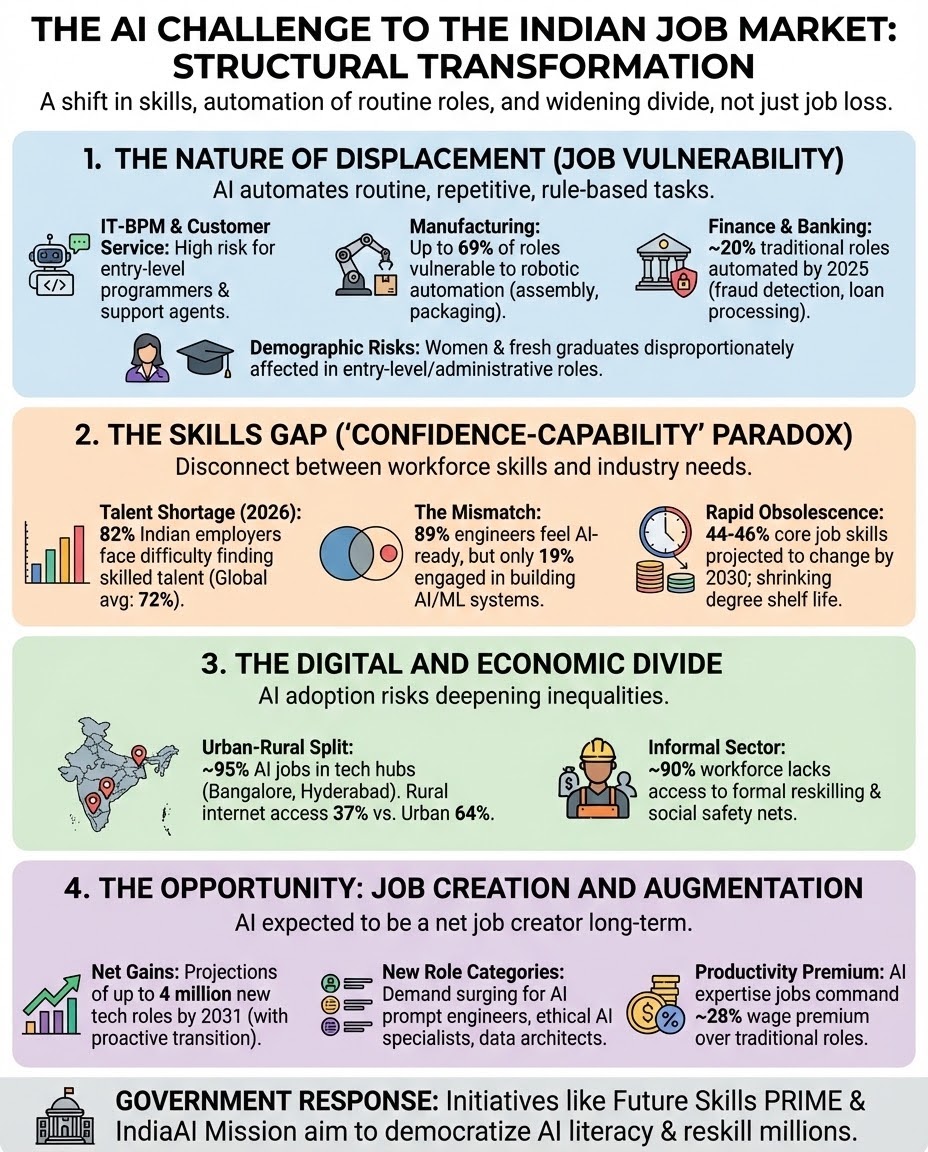
The rise of Artificial Intelligence threatens millions of jobs in the Indian IT sector, necessitating an urgent overhaul of the education and skilling ecosystem.
Job Displacement in the IT Sector
AI's automation of routine tasks threatens the traditional labour-based revenue model of Indian IT companies, putting numerous entry-level engineering graduate roles at high risk.
An estimated 15% to 20% of revenue from these entry-level jobs is at risk of being replaced by automation (Source: Forbes India).
Hiring patterns have shifted, with entry-level hiring declining to just 15% of total demand in 2025, as companies now prefer experienced, "productivity-ready" talent. (Source: Quess Corp)
Stagnating Real Wages
Despite nominal wage increases, high inflation has eroded the purchasing power of workers.
Average real wage growth was a mere 0.7% year-on-year in the first quarter of FY25, with regular salaried workers seeing just a 0.4% increase. (Source: PLFS)
The threat of AI could further suppress wages for low-skill, repetitive tasks.
Skills Mismatch & Graduate Unemployment
There is a growing gap between the skills taught in academic institutions and the skills demanded by the AI-driven industry.
The India Skills Report 2025 found that only 47% of engineering graduates were considered "employable" in the tech sector.
This leads to the paradox of high unemployment among tech graduates even as demand for specialized AI skills surges.
 Why Can't AI Completely Replace Human Workers?
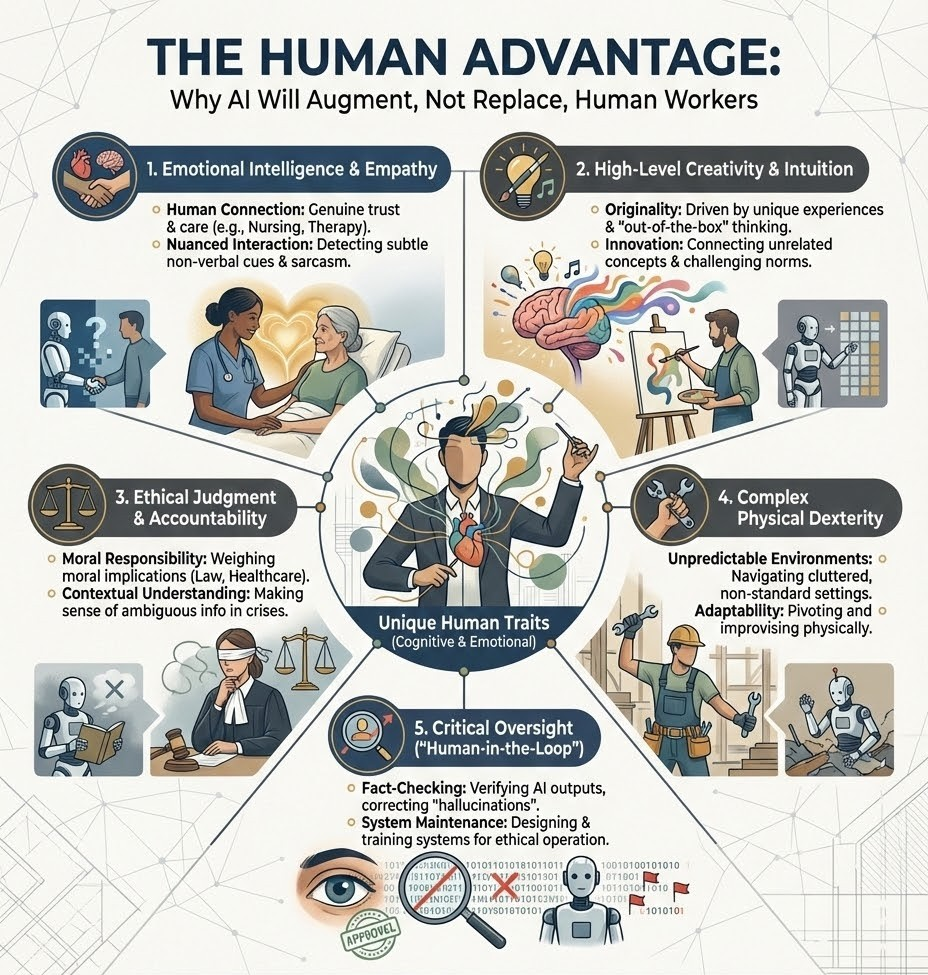
The future of work is not about humans versus machines but about human-AI collaboration. AI and human intelligence have complementary strengths, making a "human-in-the-loop" model the most effective approach.
|
|
Human Intelligence |
Artificial Intelligence (AI) |
|
Core Strength |
excels in understanding context, nuance, and ambiguity. Possesses intuition and creativity. |
Thrives on processing vast datasets, identifying patterns, and performing tasks at scale with speed and consistency. |
|
Limitation |
Limited processing capacity and prone to fatigue and bias. |
Struggles with situations not present in historical data; lacks true understanding or consciousness. |
|
Ideal Role |
Focus on strategic thinking, problem-solving, creativity, and empathetic interaction. |
Handle data-intensive, repetitive, and analytical tasks to augment human capabilities. |
 What are the Gaps in India's Current Response?
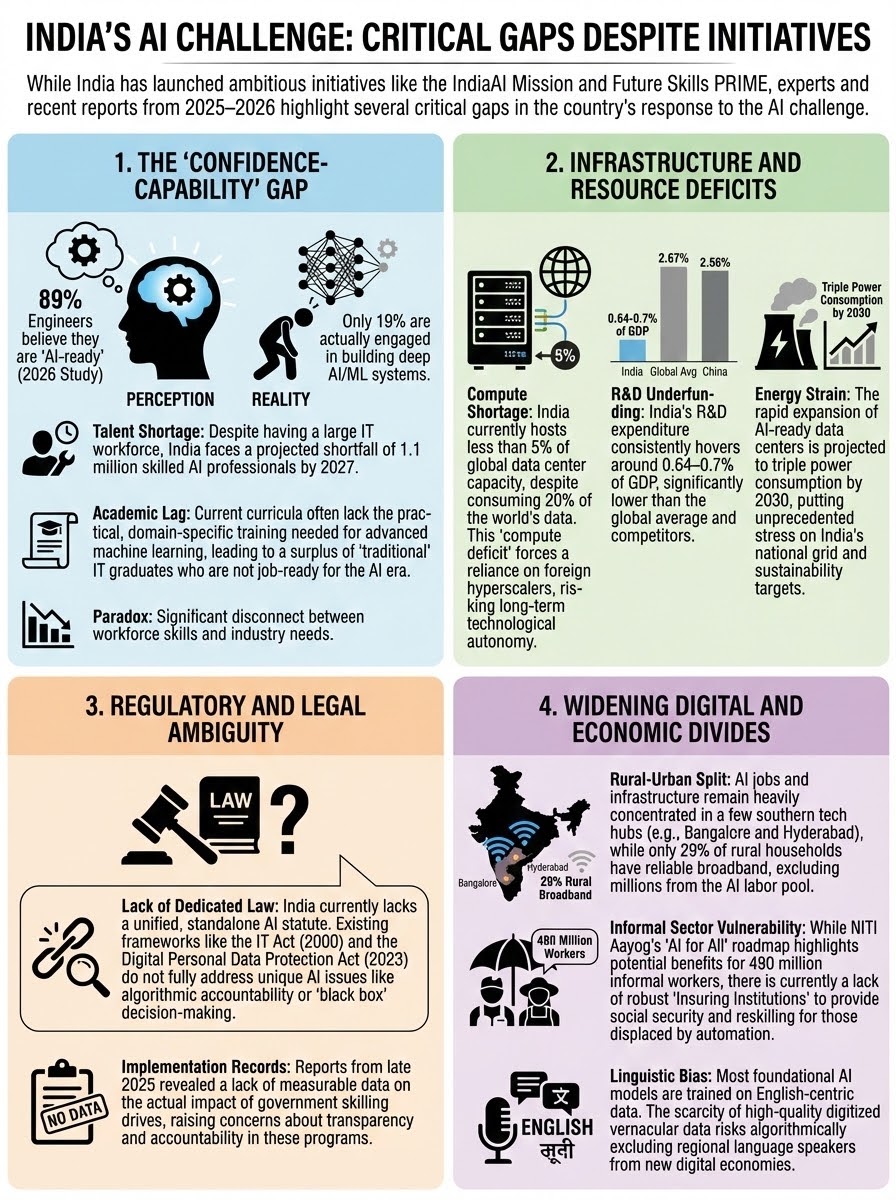
Insufficient R&D Investment
India's Gross Expenditure on R&D (GERD) is stagnant at around 0.64% of GDP, compared to the US (3.48%) and China (2.43%). (Source: Economic Survey 2025-26)
The private sector contributes only 41% of R&D spending in India, far below the 75%+ in leading economies.
Inadequate Education Funding
Public expenditure on education falls short of national policy goals.
The combined education expenditure by the Centre and states was 4.64% of GDP in 2020-21, below the 6% of GDP recommended by the National Education Policy (NEP) 2020. (Source: PRS India).
Outdated Curriculum & Faculty Training
The education system is slow to adapt to new technological demands.
Many engineering colleges have not yet integrated full-time courses on AI, data science, or machine learning.
A critical gap exists in faculty preparedness, with few having hands-on experience with modern generative AI tools.
IndiaAI Mission
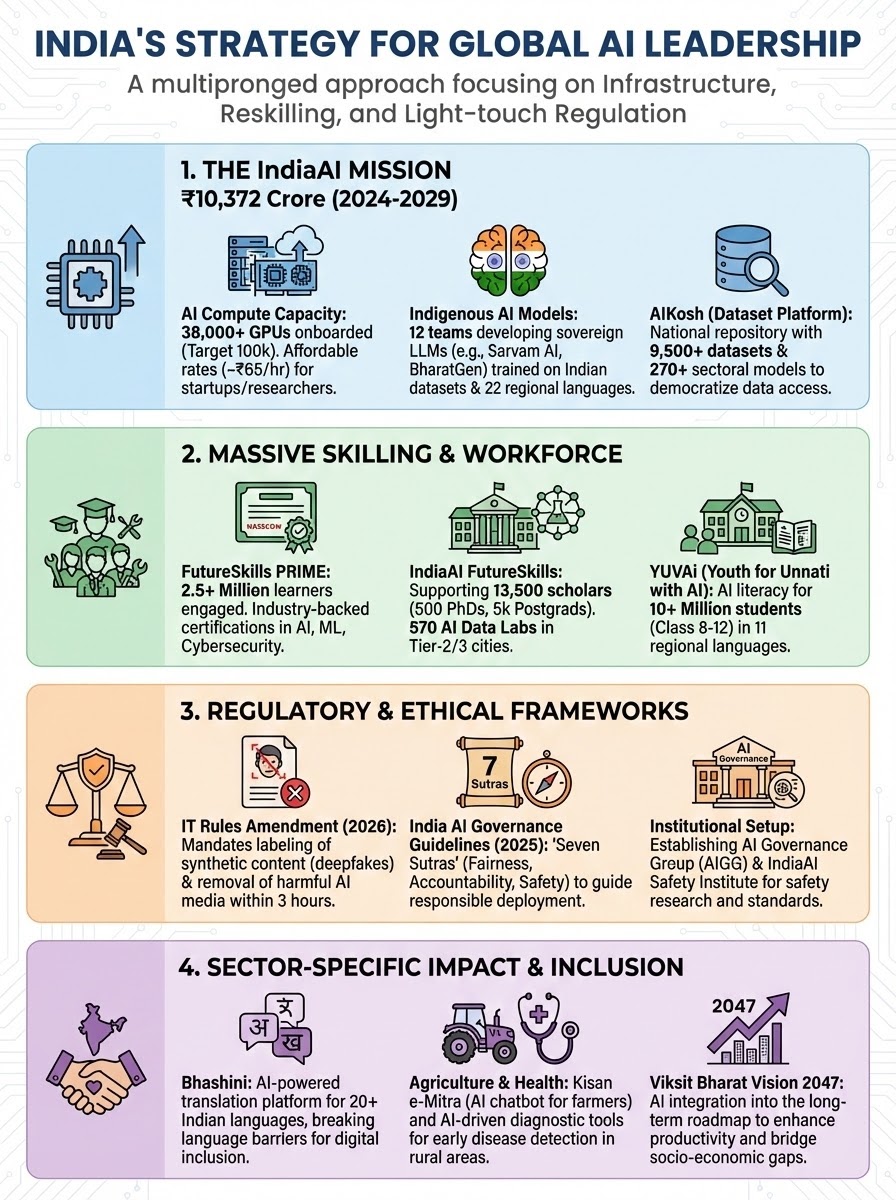
It is a government initiative launched in March 2024 with a budget of ₹10,371.92 crore to position India as a global AI leader.
Indigenous AI Models: Shortlisted 12 teams to develop sovereign Large Language Models (LLMs), such as Sarvam AI and BharatGen, trained on Indian datasets and 22 regional languages to ensure cultural and linguistic relevance.
AIKosh (Dataset Platform): Established a national repository hosting over 9,500 datasets to democratize data access for Indian innovators.
Skilling and Workforce Transformation
FutureSkills PRIME: A joint venture with NASSCOM that has engaged over 2.5 million learners, offering industry-backed certifications in AI, ML, and cybersecurity.
IndiaAI FutureSkills: Supporting scholars (including PhDs and postgraduates) and establishing a network of AI Data Labs in Tier-2 and Tier-3 cities to build grassroots AI talent.
YUVAi (Youth for Unnati with AI): Aimed at school students (Classes 8–12), this program has introduced AI literacy to over 10 million citizens in 11 regional languages.
Regulatory and Ethical Frameworks
IT Rules Amendment (2026): Mandate prominent labeling of synthetic content (deepfakes) and require platforms to remove harmful AI-generated media within a strict 3-hour window.
India AI Governance Guidelines (2025): Establish "Seven Sutras" (principles) like Fairness, Accountability, and Safety to guide responsible AI deployment.
Institutional Setup: Establishing an AI Governance Group (AIGG) and the IndiaAI Safety Institute to conduct safety research and define national AI standards.
Sector-Specific Impact and Inclusion
Bhashini: An AI-powered translation platform breaking language barriers for digital inclusion in over 20 Indian languages, facilitating access to governance for non-English speakers.
Agriculture & Health: Launched tools like Kisan e-Mitra (AI chatbot for farmers) and AI-driven diagnostic tools for early disease detection in rural areas.
Viksit Bharat Vision 2047: AI is integrated into the national long-term roadmap to enhance productivity and bridge socio-economic gaps.
 How Should India Reform its Education and Skilling Ecosystem?
Modernize Curriculum and Policy
The government, through bodies like UGC and AICTE, must mandate curriculum redesign to emphasize STEM, critical thinking, and AI fluency, in line with the NEP 2020 framework.
Use frameworks like the National Institutional Ranking Framework (NIRF) to incentivize universities to adapt to AI-related demands and improve employability outcomes.
Scale Up Reskilling Initiatives
Expand government programs like the Skill India Mission and the IndiaAI Mission. Initiatives such as 'YUVAi' for school students must be scaled effectively.
Promote deep industry-academia collaboration, such as the Microsoft-MSDE partnership to offer micro-degrees in AI skills at National Skill Training Institutes (NSTIs).
Learn from Global Best Practices
India can draw lessons from the United Kingdom's AI Skilling Strategy, which includes an "AI Skills Hub" offering free foundational courses to all adults and funding for specialized postgraduate courses to create a large pool of industry-ready talent.
India must strategically shift to human-AI collaboration, driven by educational reform and R&D investment, to empower the workforce and lead the AI-driven global economy.
Source: THEHINDUBUSINESSLINE
|
PRACTICE QUESTION Q. Critically analyze the role of the National Education Policy (NEP) 2020 in mitigating "educated unemployment" caused by AI. 150 words |
The primary threat is large-scale job displacement, especially in entry-level roles. AI's capability to automate routine and repetitive tasks undermines the traditional labour-based revenue model of Indian IT services, which historically absorbed a vast number of engineering graduates.
AI excels at processing vast datasets and performing repetitive tasks with speed and accuracy. However, humans remain superior in areas requiring contextual understanding, intuitive judgment, creativity, and complex problem-solving. The future of work lies in a human-AI collaboration model where technology augments human capabilities.
India's investment in R&D is critically low, remaining stagnant at around 0.64% of its GDP. This is significantly lower than innovation-driven economies like the US (3.48%) and China (2.43%), which hinders indigenous innovation and competitiveness in the AI race.
© 2026 iasgyan. All right reserved