The 2026 WTO E-commerce Moratorium lapsed at MC14 after 26 years. Developed nations sought stability, but developing countries like India blocked extension to reclaim tariff revenues. This allows digital duties but threatens TRIPS safeguards, requiring urgent WTO reforms.
Why In News?
Following the failure to reach a consensus at the World Trade Organization’s (WTO) 14th Ministerial Conference (MC14) in March 2026, a 26-year-old global moratorium on imposing customs duties on electronic transmissions has officially lapsed.
What is the E-commerce Moratorium?
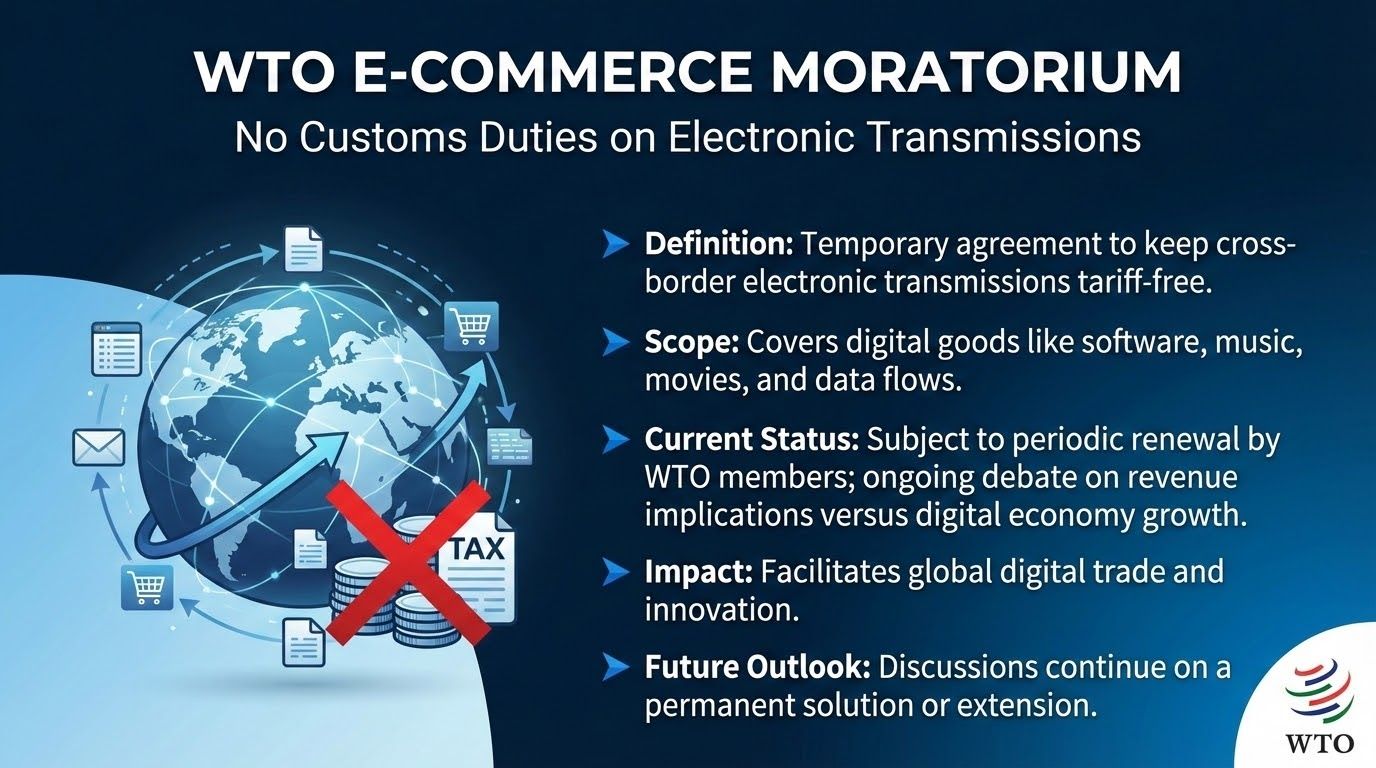
Definition: A global agreement that prohibited member countries from applying customs duties (import taxes) on cross-border electronic transmissions.
Scope: This covered intangible digital products like software, e-books, streamed music and movies, and online video games.
Origin: First adopted in 1998 at the WTO’s Second Ministerial Conference to promote the growth of the nascent digital economy.
Nature: It was a temporary measure, renewed every two years at subsequent Ministerial Conferences until its recent lapse at MC14.
Divergent Stances: Developed vs Developing Nations
|
Developed Countries' View (Pro-Moratorium) |
Developing Countries' View (Anti-Moratorium) |
|
|
Fiscal Impact |
Argue that global tariff revenue losses are negligible (around $280 million) and can be offset by domestic taxes like VAT or GST. (Source: OECD E-Commerce Impact Study) |
Claim massive revenue foregone, estimated at $10 billion in 2017 for developing countries. (Source: UNCTAD) |
|
Policy & Regulation |
Advocate for a permanent ban to ensure a stable and predictable regulatory environment for tech businesses, preventing internet fragmentation and protecting MSMEs. |
Contend that the moratorium restricts their sovereign policy space to regulate a rapidly growing digital economy and raise funds for domestic infrastructure. |
|
Trade Dynamics |
Believe imposing digital tariffs would slow down digital trade flows, negating any potential revenue gains. |
Highlight asymmetric trade, where they are net importers of high-value digital products. For example, India's digital service imports reached $116.9 billion by 2024. (Source: NITI Aayog) |
|
Market Structure |
Focus on enabling cross-border digital trade for all enterprises, including small businesses. |
Argue the moratorium facilitates "digital colonialism" by entrenching the market dominance of Big Tech giants from developed nations. |
India’s Stance
India has been a vocal critic of the indefinite extension of the moratorium.
What are the Implications of the Moratorium's Lapse?
Erection of Digital Tariff Walls: For the first time since 1998, nations now have the legal right to impose customs duties on software, algorithms, and streaming services, potentially leading to a fragmented global digital market.
Collapse of TRIPS Safeguards: The lapse also caused the expiration of the safeguard against "non-violation complaints" under the TRIPS agreement.
Shift Towards Plurilateralism: Due to the lack of multilateral consensus, 66 WTO members have endorsed a separate 'E-Commerce Agreement' (ECA).
Trade Wars: No global consensus on what constitutes an "electronic transmission".
Way Forward
At MC14, the WTO E-commerce Moratorium's expiration forces a critical balance between global data flows and India’s fiscal sovereignty, requiring a new technical framework to tax digital imports without harming the domestic IT sector.
Source: THEHINDU
|
PRACTICE QUESTION Q. Consider the following statements regarding the WTO E-Commerce Moratorium: 1. It banned member countries from applying customs duties to cross-border physical goods purchased through e-commerce portals. 2. It was originally adopted at the 1998 WTO Ministerial Conference in Geneva. Which of the statements given above is/are correct? a) 1 only b) 2 only c) Both 1 and 2 d) Neither 1 nor 2 Answer: b Explanation: Statement 1 is incorrect: The WTO e-commerce moratorium bans member countries from applying customs duties to electronic transmissions (e.g., digital downloads, streaming), not physical goods purchased through e-commerce portals. Physical goods (like a physical book or CD) are already subject to tariffs, whereas their digital equivalent (e-book or music stream) is duty-free under this moratorium. Statement 2 is correct: The moratorium was first adopted at the 1998 WTO Ministerial Conference in Geneva as part of the Declaration on Global Electronic Commerce. |
It was a global trade agreement initiated in 1998 that temporarily banned countries from imposing customs duties (import taxes) on cross-border electronic transmissions. This included intangible goods like software downloads, e-books, streaming services, and video games.
The moratorium officially lapsed at the 14th Ministerial Conference (MC14) in March 2026 because member states could not reach a consensus on extending it. Developed nations wanted a permanent extension, while developing nations opposed it.
India opposed it due to substantial tariff revenue losses (estimated at $2 billion annually for India), asymmetric digital trade dynamics where high-value digital imports heavily outweigh exports, and concerns that the moratorium entrenches "digital colonialism" by allowing U.S. and EU Big Tech monopolies to dominate.



© 2026 iasgyan. All right reserved