To combat the 2026 West Asian oil crisis, India slashed excise duties to lower consumer costs and reinstated windfall taxes on fuel exports. This strategy effectively checks inflation, prevents domestic shortages, and generates revenue to fund critical energy subsidies.
Why In News?
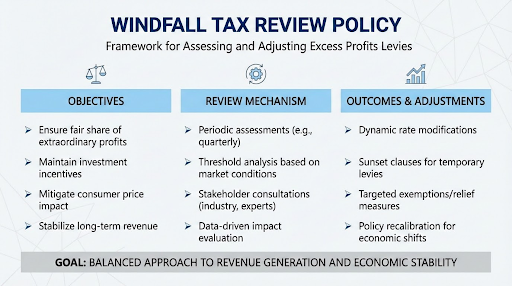
The Union Government reimposed the Windfall Tax (Special Additional Excise Duty) on the export of diesel and Aviation Turbine Fuel (ATF).
What is a Windfall Tax?
A Windfall Tax is a higher tax rate levied by a government on specific industries when they experience unexpected, "supernormal" profits.
These profits are not the result of a firm's internal efficiency or innovation, but rather external factors such as:
Objective: To redistribute "unearned" excess profits from corporations to the public exchequer for social welfare or to curb inflation.
Mechanism of Implementation in India
In India, this tax is implemented through the Special Additional Excise Duty (SAED).
Evolution of India’s Windfall Tax Policy
|
Feature |
2022 Regime (Scrapped Dec 2024) |
2026 Regime (Current) |
|
Trigger |
Russia-Ukraine War |
Middle East Tensions & Fiscal Balancing |
|
Scope |
Domestic Crude + Product Exports |
Product Exports Only (Diesel/ATF) |
|
Primary Goal |
Taming Inflation & Revenue |
Funding Excise Cuts & Domestic Supply |
|
Impact |
Hit Upstream (ONGC) & Downstream |
Hits Downstream Exporters (Reliance, Nayara) |
|
Domestic Crude |
Taxed (peaked at ₹23,250/tonne) |
Zero / Exempt |
Rationale Behind the Reversal
Financing the Excise Cut: Government slashed excise duties to protect Indian consumers from global price shocks. This creates a revenue hole (estimated at ₹7,000 crore loss). The Windfall Tax on exports is expected to recover approx. ₹1,500 crore per fortnight to offset this.
Domestic Supply Security: With global prices rising, private refiners have a higher incentive to export fuel for better margins. The high export tax (₹21.5 - ₹29.5/litre) acts as a barrier, forcing them to sell in the Indian market first.
Global Volatility: Continued instability in the Middle East has kept refining margins (cracks) high, justifying the state's claim to a share of these "windfall" margins .
Strategic Significance
Fiscal Balancing Act
The windfall tax acts as a fiscal stabilizer. When global oil prices rise, the government cuts regular excise duties to keep fuel prices stable for citizens. The revenue lost from these cuts is then recovered by taxing the high profits of oil exporters.
Ensuring Domestic Supply
By taxing exports of Diesel and ATF (Aviation Turbine Fuel), the government makes exporting less lucrative. This incentivizes private refiners (like Reliance) to supply the domestic Indian market first, preventing local fuel shortages.
Social Equity
From a governance perspective, it aligns with the principle that "excessive profits" gained from global crises should be shared with the state to fund welfare schemes.
Key Challenges
Policy Uncertainty: Frequent "on-off" changes in tax regimes can deter Foreign Direct Investment (FDI) in the capital-intensive energy sector.
Impact on Upstream Investment: If domestic crude production is taxed heavily (as in 2022-23), it may discourage companies like ONGC and Vedanta from investing in new exploration and production.
Double Taxation Concerns: Industry experts argue that since companies already pay Corporate Tax and Royalties, an additional windfall tax is a form of double taxation.
Export Competitiveness: High export levies may make Indian refined products less competitive in Asian and European markets compared to refiners from the Middle East.
Way Forward
The Windfall Tax is a pragmatic, but controversial, tool for managing a volatile energy economy. For India, it serves as a shield against global price shocks.
However, for long-term Viksit Bharat goals, the government must balance immediate revenue needs with the necessity of a stable tax environment to attract energy investments.
Source: THEHINDU
|
PRACTICE QUESTION Q. The reimposition of the Windfall Tax in 2026 highlights the tension between fiscal stability and policy predictability. Critically analyze. 150 words |
A windfall tax is a higher tax levied by the government on specific industries, such as oil refining, that generate sudden, unexpected, and above-average profits due to external market conditions rather than internal innovation. In India, it is collected as the Special Additional Excise Duty (SAED).
Due to the West Asian crisis, global crude prices surged. Private refiners found it more profitable to export fuel rather than sell it locally. The government reinstated the windfall tax to curb this export arbitrage, ensure domestic fuel availability, and generate revenue to offset domestic excise duty cuts.
India imports roughly 87.8% of its crude oil. Geopolitical tensions in West Asia threaten key supply routes like the Strait of Hormuz and trigger global price spikes. This leads to domestic inflation, macro-economic shocks, and massive under-recoveries for Indian Oil Marketing Companies (OMCs).


© 2026 iasgyan. All right reserved