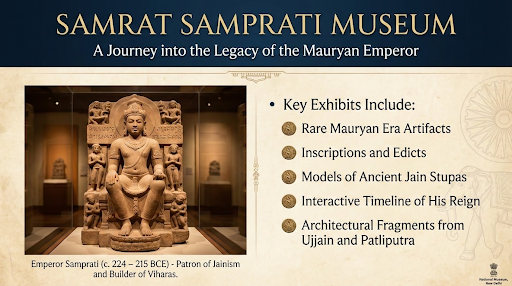
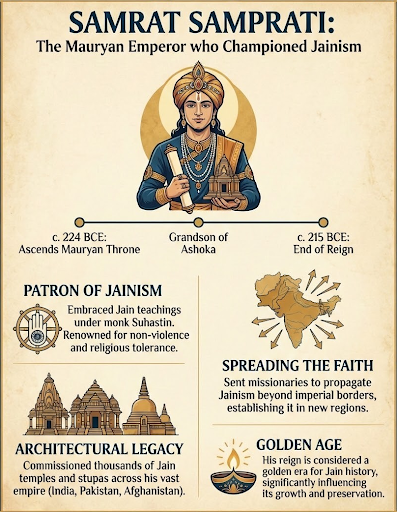
Samrat Samprati (c. 224–215 BCE) was the grandson of Emperor Ashoka and a Mauryan ruler from Ujjain. Known as the "Jain Ashoka," he is credited with spreading Jainism across Western and Southern India.
Why In News
The Prime Minister inaugurated the Samrat Samprati Museum at Koba Tirth in Gandhinagar, Gujarat.
About the Samrat Samprati Museum
Who was Samrat Samprati?
Dynasty: Samrat Samprati was a ruler of the Mauryan Dynasty (reigned c. 224–215 BCE).
The "Jain Ashoka": Religious Patronage
Historians refer Samprati as the "Jain Ashoka" due to his efforts in propagating Jainism, mirroring his grandfather’s devotion to Buddhism.
Contributions to Art, Culture & Governance
Manuscript Tradition: Samprati is regarded as an early patron of manuscript culture. The newly inaugurated museum in his name houses nearly 2,000 rare artefacts and ancient palm-leaf manuscripts, highlighting his role in preserving India’s literary heritage.
Ethical Statecraft: His governance model integrated the Jain concept of Sewa (Service). He established Panjrapols (animal shelters) and food distribution centres, demonstrating that a ruler’s power is a tool for public and ecological welfare.
Economic Stability: During his reign, Ujjain emerged as a major commercial hub, linking the trade routes of the Silk Road with the Deccan, facilitating both economic and cultural exchange.
Source: THEHINDU
|
PRACTICE QUESTION Who among the following Mauryan rulers is traditionally referred to as the "Jain Ashoka" for his extensive efforts in propagating Jainism across Western and Southern India? (a) Dasharatha Maurya (b) Kunala (c) Samrat Samprati (d) Salisuka Answer: c Explanation: Samrat Samprati (the grandson of Emperor Ashoka) is referred as the "Jain Ashoka" due to his extensive patronage and propagation of Jainism throughout Western and Southern India. |
Samrat Samprati was a Mauryan Emperor who ruled from approximately 224 to 215 BCE. He was the grandson of Emperor Ashoka and is historically renowned for his massive patronage of Jainism, earning him the title of the "Jain Ashoka".
Historians draw a parallel between Samprati and his grandfather, Ashoka, due to their massive missionary zeal. Just as Ashoka sent emissaries to spread Buddhism globally, Samprati actively patronized and spread Jainism deeply into Western India (Rajasthan and Gujarat) and South India.
Samprati treated governance as Sewa (service) and utilized the Jain principle of Ahimsa (non-violence). He established thousands of Panjrapols (animal shelters) across his empire, making the Mauryan state one of the earliest recorded administrations to institutionalize animal welfare.



© 2026 iasgyan. All right reserved