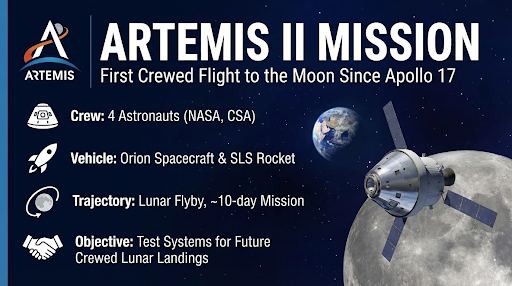
NASA's Artemis II mission is the first crewed flight of the Orion spacecraft and Space Launch System (SLS) rocket. Scheduled for April 1, 2026, the 10-day mission will carry four astronauts on a lunar flyby, testing deep-space life-support systems.
Why In News
NASA is set to launch Artemis II, the first crewed mission to the Moon's vicinity since the Apollo 17 mission in 1972.
What is the Artemis II Mission?
Artemis II is the second scheduled flight of the Artemis program and the first crewed test flight of NASA's deep-space exploration systems.
Objective: To perform a lunar flyby (looping around the Moon without landing) to test the Orion spacecraft's life-support systems, communication capabilities, and heat shield integrity under deep-space conditions.
Launch Vehicle: Space Launch System (SLS) – the most powerful rocket NASA has ever built, designed specifically for deep-space missions.
Spacecraft: Orion, which serves as the command module for the astronauts.
Duration: Carry four astronauts on a 10-day journey around the Moon.
Trajectory: The mission utilizes a "hybrid free-return trajectory."
Strategic Significance
Stepping Stone to Mars: The Artemis program is explicitly designed to test technologies (like radiation shielding and deep-space habitats) required for an eventual crewed mission to Mars.
Gateway Station: It paves the way for the Lunar Gateway, a planned space station in lunar orbit that will serve as a transit hub for astronauts landing on the Moon's South Pole.
Lunar South Pole: Future missions (Artemis III and beyond) aim to land on the South Pole, a region believed to contain water ice.
Source: INDIANEXPRESS
|
PRACTICE QUESTION Q. With reference to the current global space exploration frameworks, consider the following statements: 1. The Artemis Accords are a legally binding treaty led by the United Nations for lunar resource extraction. 2. The International Lunar Research Station (ILRS) is a joint space exploration initiative led by China and Russia. 3. India is a signatory to both the Artemis Accords and the ILRS. Which of the statements given above is/are correct? a) 1 and 2 only b) 2 only c) 1 and 3 only d) 2 and 3 only Answer: b Explanation: Statement 1 is incorrect: The Artemis Accords are a set of non-binding principles led by the United States (specifically NASA and the U.S. Department of State), not the United Nations. Statement 2 is correct: The International Lunar Research Station (ILRS) is indeed a joint space exploration initiative led by China (CNSA) and Russia (Roscosmos), aimed at building a permanent lunar base. It serves as a parallel and often competing framework to the U.S.-led Artemis program. Statement 3 is incorrect: India is a signatory to the Artemis Accords (having signed in June 2023) but is not a signatory to the International Lunar Research Station (ILRS). |
Planned for April 2026, Artemis II is a historic NASA mission that will send a crew of four astronauts on a 10-day journey around the Moon. It serves as a vital proving ground for future missions aimed at establishing a permanent human presence on the lunar surface.
The Artemis Accords are a US-led, non-binding multilateral framework designed to guide peaceful space exploration and resource utilization. Based on the 1967 Outer Space Treaty, the Accords have been signed by 61 nations, including India, as of early 2026.
Targeted for October 2027, Chandrayaan-4 is a highly complex lunar sample-return mission. With a budget of ₹2,104 crores, it aims to collect 3 kg of lunar soil from the Moon's South Pole, practice in-orbit docking, and return the sample to Earth.



© 2026 iasgyan. All right reserved