Description
Disclaimer: Copyright infringement not intended.
Context
A rare astronomical phenomenon known as the "Super Blue Moon"
Details
- The moon's orbit around Earth is elliptical, taking 27.3 days.
- A super moon occurs when the moon is near its perigee (closest point to Earth) during a full moon.
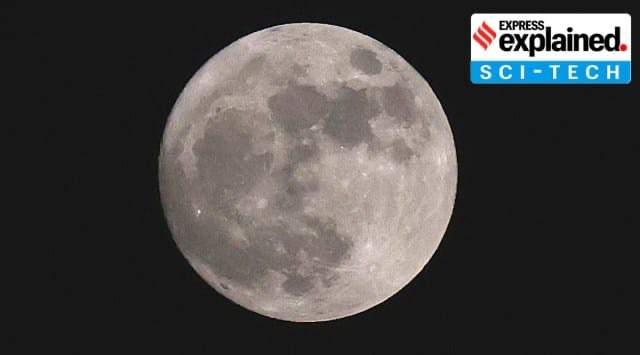
- The moon's illuminated side is fully visible during a full moon, creating a bright circle in the sky.
- Super moons also occur during new moons, but they are not visible.
Blue Moon and Its Definition
- A "blue moon" refers to the occurrence of two full moons within a single month.
- The lunar cycle is 29.5 days, occasionally leading to a second full moon at the end of a month occasionally.
- NASA supports this definition, and it happens every two to three years.
August 2023 Scenario
- The first full moon occurred on August 1, which was a super moon.
- The second full moon, on August 30-31, will be even larger due to its proximity to perigee.
Moon's Color and Atmosphere
- Moon appears more yellow/orange near the horizon due to longer travel through the atmosphere.
- Shorter, bluer wavelengths are scattered, leaving longer, redder wavelengths.
- Dust or pollution can intensify the moon's reddish hue.
Size and Brightness of Super Moon
- A super moon (at perigee) is about 14% larger and 30% brighter than a "micro moon" (at apogee).
- The difference in size may not be noticeable to most people.
- Brightness could be more discernible, influenced by factors like the "Moon illusion," cloud cover, and pollution.
|
PRACTICE QUESTION
Q) Which of the following statements is true about super blue moons?
A) A moon that appears blue in color due to atmospheric conditions.
B) A term used to describe a moon that is exceptionally large and bright.
C) The occurrence of two full moons within a single month.
D) A rare alignment of a full moon with Earth's perigee.
Answer: C
|

https://indianexpress.com/article/explained/explained-sci-tech/super-blue-moon-8916383/