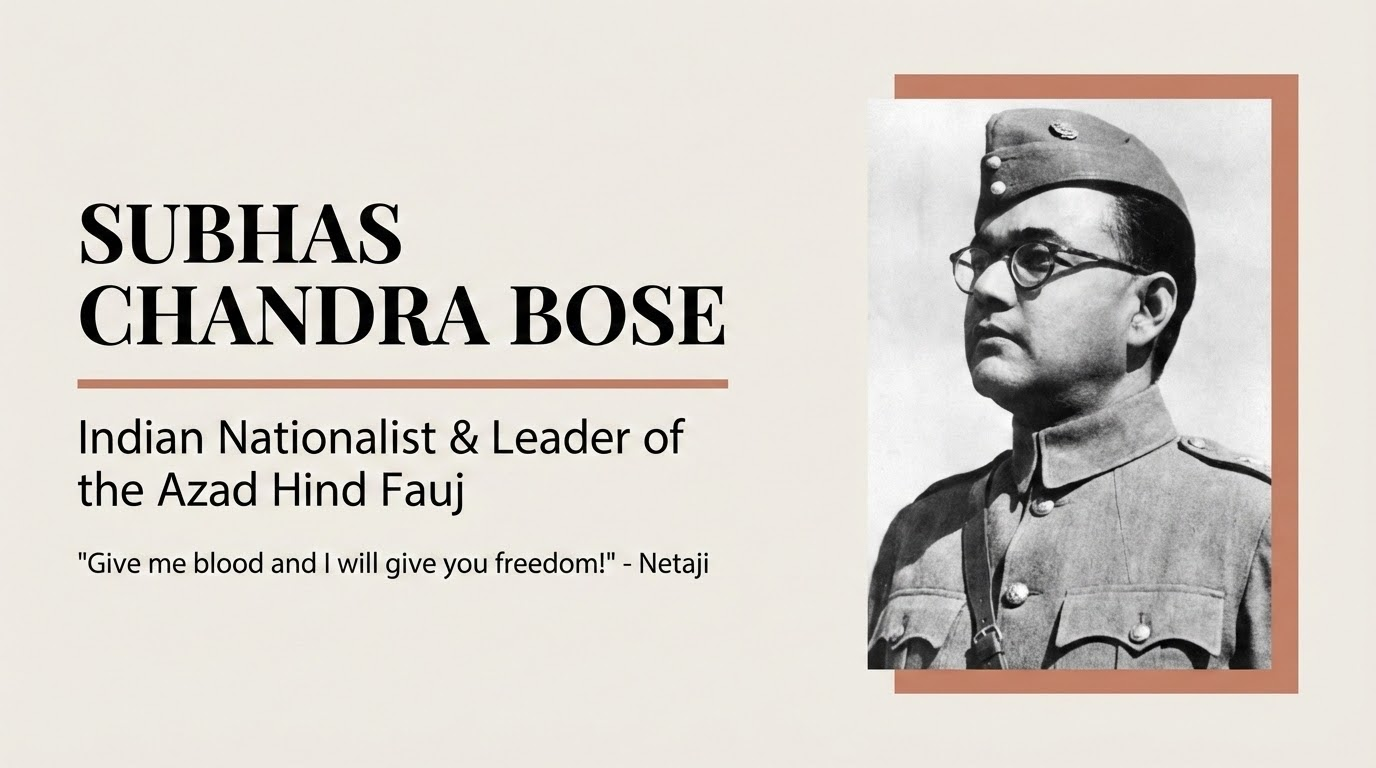
Subhas Chandra Bose, founded the Azad Hind Fauj to achieve independence through armed struggle. His defiant patriotism and revolutionary leadership, epitomised by the slogan "Jai Hind," remain a powerful symbol of sacrifice in the freedom movement.
Why In News?
On April 14, 1944, Subhas Chandra Bose's Indian National Army marked its first major victory on mainland India by hoisting the tricolour and establishing its headquarters at Moirang, Manipur.
Who was Subhas Chandra Bose?
Subhas Chandra Bose (1897–1945), popularly known as Netaji, was a revolutionary nationalist leader, best known for leading the Indian National Army (INA) or Azad Hind Fauj and for his slogans "Jai Hind" and "Give me blood, and I shall give you freedom".
He served as the President of the Indian National Congress (INC) twice, in 1938 (Haripura) and 1939 (Tripuri).
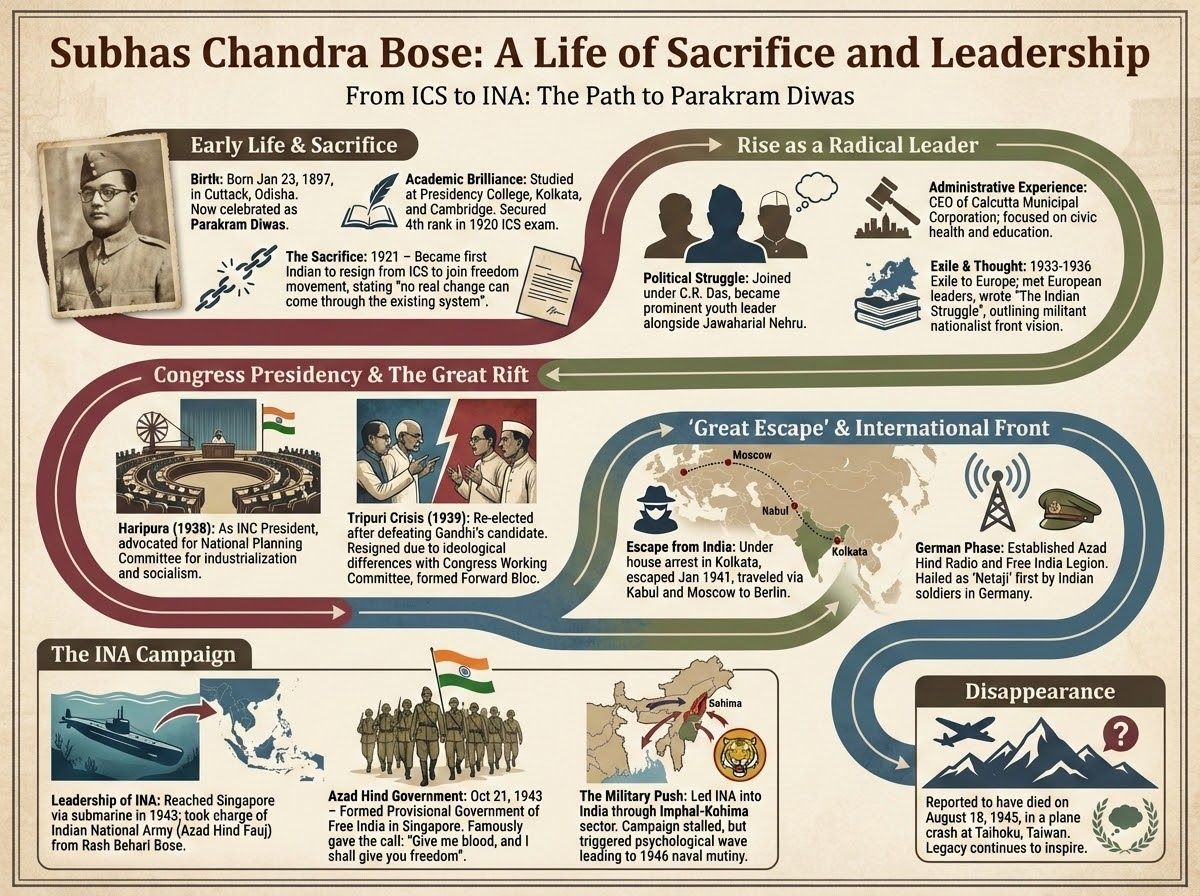
What shaped the early life and ideology of Bose?
Spiritual Roots: Inspired by Swami Vivekananda, Bose viewed national liberation as a spiritual mission rooted in service and dignity.
ICS Resignation (1921): He resigned from the Indian Civil Service despite ranking 4th, believing non-cooperation was vital to ending colonial rule.
Political Mentorship: Mentored by Chittaranjan Das, Bose adopted "uncompromising militancy" and gained administrative expertise as CEO of the Calcutta Municipal Corporation.
Socialism and Planning: At the Haripura Session (1938), he established the National Planning Committee to promote socialist development and industrialization.
Pragmatic Internationalism: His "Samyavada" ideology sought a middle path for Indian independence by strategically exploiting global political shifts.
Why did Bose adopt a radical approach to the Indian freedom struggle?
Non-Cooperation Critique: Bose labeled the 1922 withdrawal of Non-Cooperation a "national calamity," demanding relentless pressure for independence.
Economic Urgency: Influenced by "Drain Theory," he sought a radical overthrow to end British economic exploitation.
World War II Opportunity: Viewing the war as a "God-sent opportunity," Bose argued "Britain’s difficulty is India’s opportunity," diverging from Gandhi’s ethical stance.
Belief in Military Discipline: He believed a disciplined military would secure freedom and ensure a stable, united post-independence India.
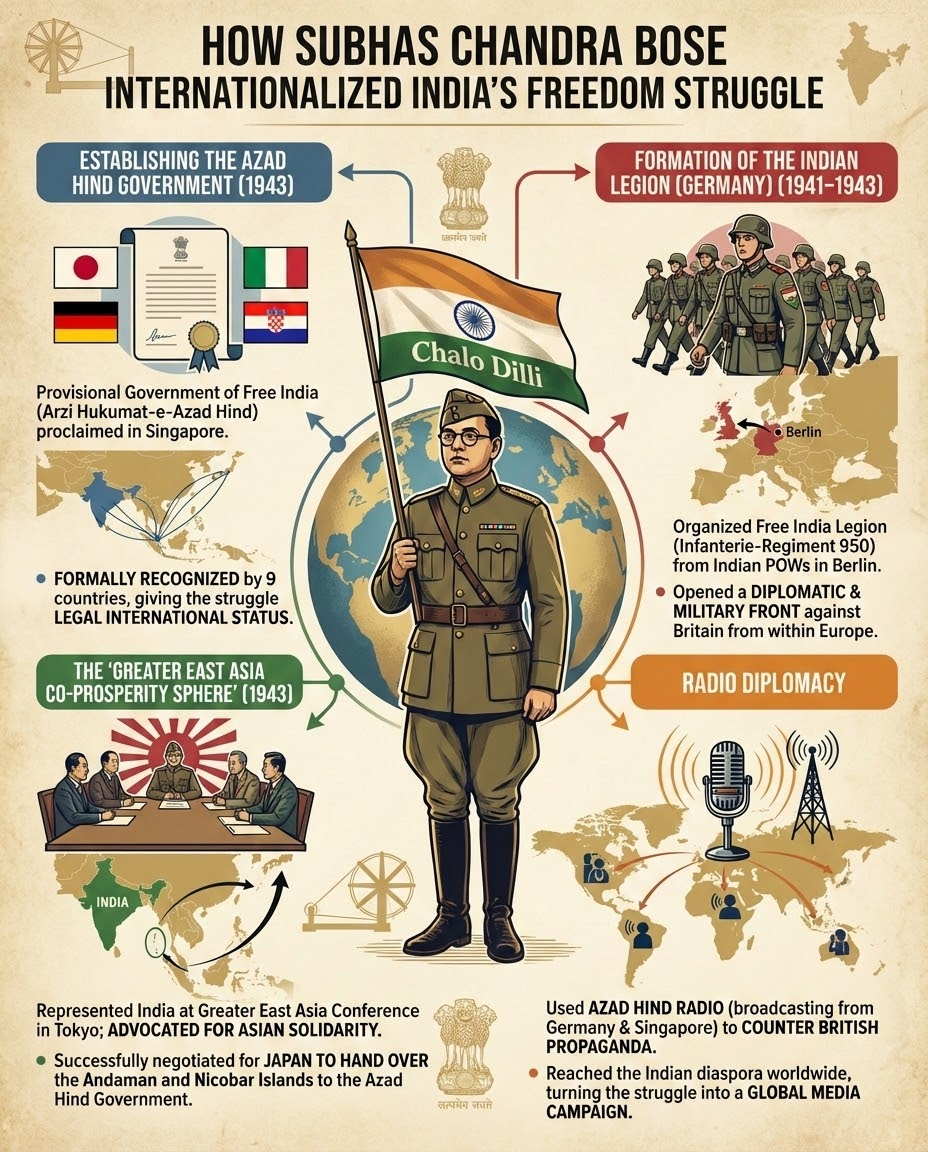
What was his role in the INA and Azad Hind Government?
Supreme Commander of the INA (Azad Hind Fauj)
Bose revived the INA (it was originally formed by Captain Mohan Singh), and restructured it into a professional army upon his arrival in Singapore in July 1943.
Head of the Provisional Government (Arzi Hukumat-e-Azad Hind)
On October 21, 1943, Bose proclaimed the formation of the Provisional Government of Free India in Singapore to give legitimacy to the armed struggle.
Military Campaigns and Impact
Comparison with Other Freedom Fighters
Subhas Chandra Bose’s approach was distinct because it combined International Realpolitik with Militaristic Nationalism, setting him apart from the mainstream leadership.
Bose vs Mahatma Gandhi: While both shared the goal of Purna Swaraj, their means were polarized.
Bose vs. Jawaharlal Nehru: Both were young radicals who pushed the Congress toward Socialism and Economic Planning.
Bose vs. Revolutionary Nationalists (e.g., Bhagat Singh): Like Bhagat Singh, Bose believed in the efficacy of force.
What is the contemporary relevance of Subhas Chandra Bose?
Strong National Identity: His slogan "Jai Hind" serves as the Indian Armed Forces' formal greeting and a unifying salute across all barriers.
Aatmanirbhar Bharat: Bose was the first to institutionalize the idea of a National Planning Committee (1938). His vision of a technologically advanced, industrialized India is reflected in current policies of Make in India initiative.
Diplomatic Realism: India’s "multi-aligned" policy, prioritizing national interest over blocs, mirrors Bose’s Realpolitik in engaging diverse powers for sovereign goals.
Gender Empowerment: His Rani of Jhansi Regiment pioneered women in combat, a vision realized today through permanent commissioning in the Armed Forces.
Conclusion
Subhas Chandra Bose, popularly known as Netaji, was a charismatic nationalist leader who transformed the Indian National Army (INA) into a formidable force against British rule, leaving a lasting legacy as a symbol of militant patriotism and revolutionary sacrifice for India's independence
Source: THEHINDU
|
PRACTICE QUESTION Q. The formation of the Azad Hind Fauj (INA) marked a significant shift from constitutional agitation to armed struggle. Discuss its impact on the Indian freedom movement. 150 words |
Bose cleared the prestigious ICS examination in 1920, securing the fourth rank. However, driven by a commitment to national liberation over personal comfort, he resigned in 1921. He believed that the national edifice could only be built on the "soil of sacrifice and suffering."
The Forward Bloc was founded by Bose in 1939 following the Tripuri Congress session. After proposing a six-month ultimatum to the British for independence—which the moderate Gandhian faction rejected—Bose resigned from the Congress presidency and formed the Forward Bloc to consolidate radical and leftist forces.
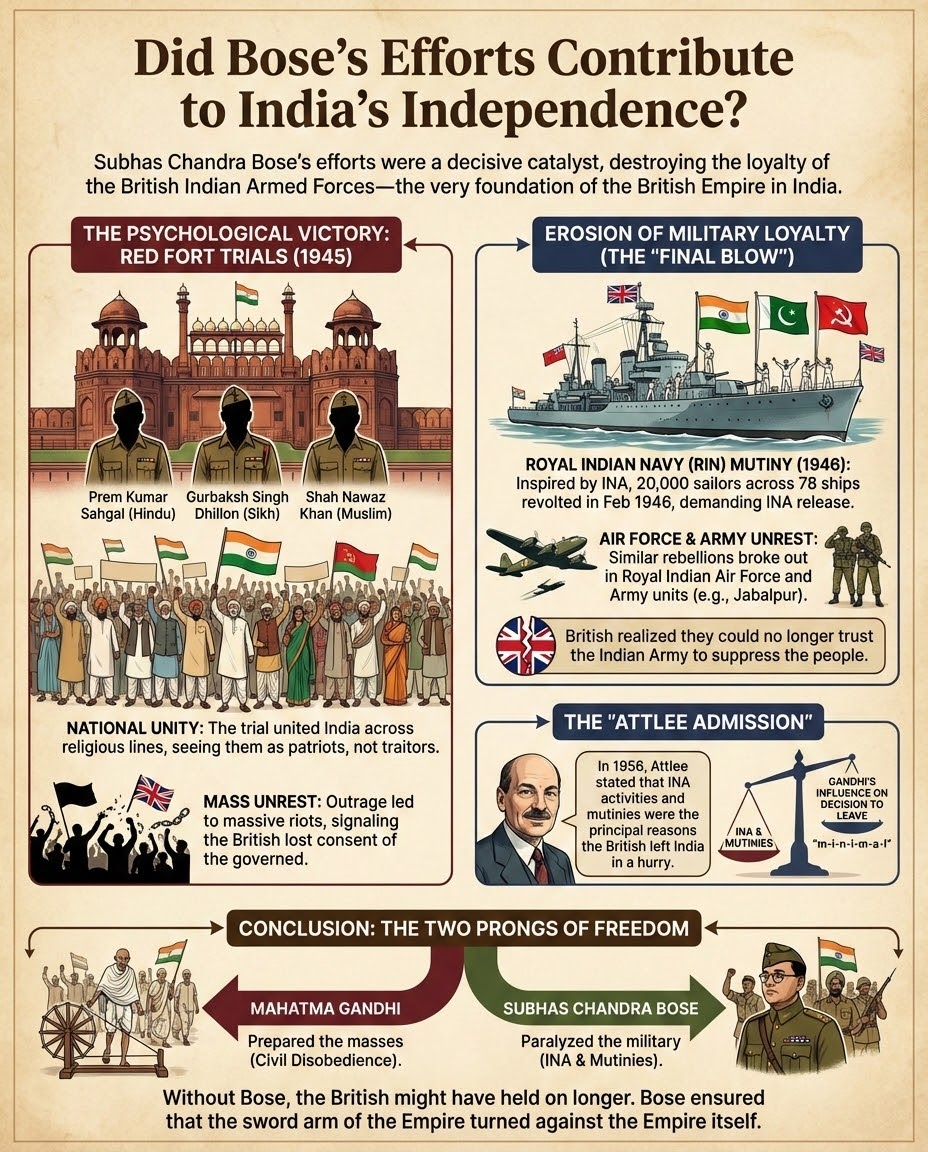
The Red Fort Trials of INA commanders ignited massive civilian uprisings across India. Crucially, they destroyed the British illusion that they could rely on Indian soldiers to suppress Indian citizens, directly inspiring the 1946 Royal Indian Navy Mutiny and hastening the British exit.



© 2026 iasgyan. All right reserved