The Snowy Owl is a majestic Arctic predator known for its striking white plumage and brilliant yellow eyes. Unlike most owls, it is often active during the day. These nomadic hunters primarily prey on lemmings across the open tundra.
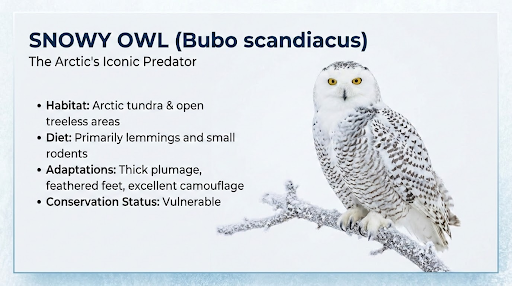
Why In News?
The Snowy Owl (Bubo scandiacus) was officially granted international protection under the U.N. Convention on the Conservation of Migratory Species of Wild Animals (CMS).
About Snowy Owl
Physical Characteristics
The Snowy Owl is one of the largest and most distinct owl species in the world.
Scientific Name: Bubo scandiacus
Sexual Dimorphism: Unlike many birds, males are almost pure white, while females and juveniles have more extensive dark spotting or "barring".
Diurnal Nature: Most owls are nocturnal, but the Snowy Owl is diurnal (active during the day), an adaptation to the 24-hour daylight of the Arctic summer.
Habitat
Range: They have a circumpolar distribution, breeding in the Arctic tundra of North America, Europe, and Asia.
Irruption: In years when their primary food source (lemmings) is scarce, these owls migrate further south than usual—an event known as an "irruption".
Behavior
Specialized Predator: They are highly dependent on Lemmings. A single owl may eat more than 1,600 lemmings in a year.
Keystone Species Role: By controlling the population of small rodents, they prevent overgrazing of tundra vegetation, maintaining the delicate Arctic ecological balance.
Conservation Status
IUCN Status: Currently listed as Vulnerable
They are listed in Appendix II of CITES, which regulates international trade.
Primary Threats:
Source: THEHILL
|
PRACTICE QUESTION Q. Consider the following statements regarding the Snowy Owl: 1. It is strictly a nocturnal predator adapted to the dark Arctic winters. 2. Its current conservation status on the IUCN Red List is 'Vulnerable'. Which of the above statements is/are correct? A) 1 only B) 2 only C) Both 1 and 2 D) Neither 1 nor 2 Answer: b Explanation: Statement 1 is Incorrect: While most owls are nocturnal, the Snowy Owl is diurnal (active during the day) or cathemeral (active at various times). This is a critical adaptation to the Arctic summer, where there is 24-hour daylight above the Arctic Circle. Statement 2 is Correct: The Snowy Owl listed as 'Vulnerable' on the IUCN Red List. |
An indicator species reflects the overall health of its ecosystem. The Snowy Owl's declining population highlights broader, accelerating ecological crises in the Arctic, including climate change, tundra degradation, and global chemical pollution.
Bergmann’s Rule is an eco-geographical principle stating that populations of a species in colder climates tend to possess larger body masses to minimize heat loss. The Snowy Owl exemplifies this by weighing up to 2.5 kg and possessing incredibly thick plumage for insulation.
Tundra browning refers to the degradation of Arctic vegetation due to rapid warming. This warming causes irregular "rain-on-snow" events that freeze into hard ice crusts, trapping lemmings (the owl's primary food source) underground and leading to mass starvation.



© 2026 iasgyan. All right reserved