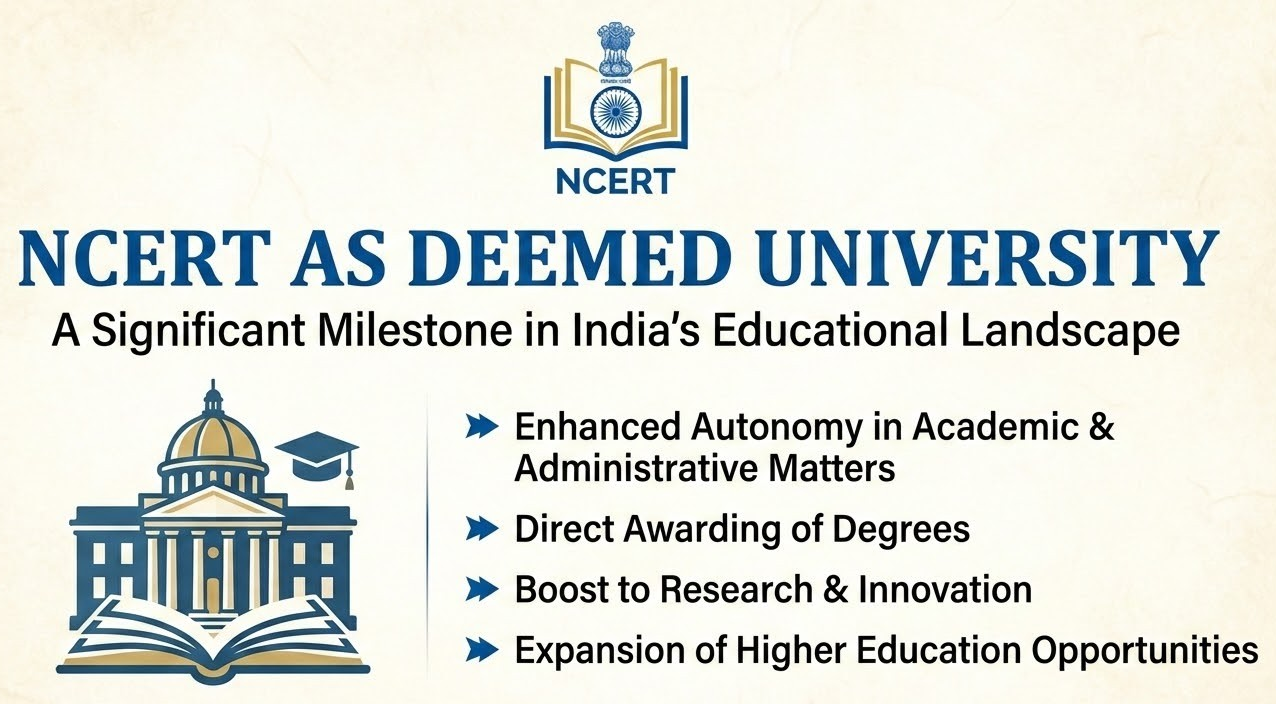
NCERT’s "Deemed to be University" status transitions it to a degree-granting body, aligned with NEP 2020 teacher-training mandates. Success depends on balancing academic autonomy with UGC metrics while empowering Regional Institutes of Education through indigenous pedagogical research.
Why In News
The National Council of Educational Research and Training (NCERT) has been granted the status of a “Deemed to be University”.
What 'Deemed to be University' Status Means for NCERT?
"Deemed to be University" status is granted by the Central Government (Ministry of Education) on the advice of the University Grants Commission (UGC).
This status, granted under Section 3 of the UGC Act, 1956, fundamentally alters NCERT's mandate and operational structure. The key changes include:
Rationale: Why This Step Is Taken?
Implementing NEP 2020 on Teacher Education
NEP 2020 mandates that by 2030, the minimum qualification for teachers will be a 4-year integrated B.Ed. degree offered only by multidisciplinary institutions. As a university, NCERT can now directly offer and standardize this program.
Addressing Poor Quality of Teacher Training
The Justice J.S. Verma Commission (2012) highlighted a crisis where thousands of Teacher Education Institutes (TEIs) were merely "selling degrees." NCERT's university status aims to create a "gold standard" for teacher training to benchmark quality nationwide.
Promoting Indigenous Educational Research
By offering Ph.D. programs, NCERT can now strengthen India-centric pedagogical research, moving away from a reliance on Western educational theories and creating solutions tailored for Indian classrooms.
Following Global Best Practices
This move is inspired by successful international models like Singapore's National Institute of Education (NIE), which acts as a unified hub for teacher training and curriculum development, ensuring seamless integration between research and practice.
What are the Potential Challenges?
Dilution of Autonomy
Faculty and critics have cautioned that moving under the UGC's regulatory framework (governed by the UGC Act, 1956) may lead to a loss of NCERT's historical academic freedom.
Risk of 'Mission Creep'
Concern that the focus on higher education metrics—such as research publications, Ph.D. programs, and national rankings like NIRF—could distract NCERT from its primary mission of developing school curricula and textbooks.
Regulatory Mismatch
UGC parameters, designed for traditional universities (e.g., patent counts, corporate outreach), may not align with an institution focused on school-level pedagogical research, leading to potentially unfair assessments.
Administrative and Financial Hurdles
Aligning NCERT’s massive publishing wing with strict "non-profit" university regulations requires complex restructuring.
Infrastructure Deficits
Transitioning to multidisciplinary models requires significant investment in smart classrooms, modern laboratories, and digital libraries that many existing institutions currently lack.
Way Forward
Granting of 'Deemed to be University' status to NCERT aims to integrate school education with advanced teacher training and research, but its ultimate success depends on a regulatory framework that balances accountability with the flexibility needed to fulfill the NEP 2020 mandate of transforming classrooms.
Source: INDIANEXPRESS
|
PRACTICE QUESTION Q. With reference to the 'Deemed to be University' status in India, consider the following statements: 1. It is granted by the Ministry of Education on the advice of the University Grants Commission (UGC). 2. The statutory provision for granting this status is derived from the Right to Education Act. 3. Institutions with this status are exempted from participating in the National Institutional Ranking Framework (NIRF). Which of the statements given above is/are correct? a) 1 only b) 2 and 3 only c) 1 and 3 only d) 1, 2, and 3 Answer: a) Explanation: Statement 1 is Correct: The Central Government (Ministry of Education) declares an institution as "Deemed to be University" on the advice of the UGC. Statement 2 is Incorrect: The statutory provision for "Deemed to be University" status is derived from Section 3 of the University Grants Commission (UGC) Act, 1956, not the Right to Education (RTE) Act. The RTE Act (2009) primarily focuses on free and compulsory elementary education for children aged 6 to 14. Statement 3 is Incorrect: Under the UGC (Institutions Deemed to be Universities) Regulations, 2023, it is mandatory for these institutions to participate in the National Institutional Ranking Framework (NIRF) annually. |
It transforms NCERT from an advisory and curriculum-designing body into a fully functioning higher education institution. NCERT is now legally authorized to directly award its own undergraduate, postgraduate, and doctoral (Ph.D.) degrees under the regulatory ambit of the UGC.
The status was granted under Section 3 of the University Grants Commission (UGC) Act, 1956. This section allows the Central Government, on the advice of the UGC, to confer university-level academic privileges upon high-performing institutions.
Key concerns include the potential dilution of NCERT's historic academic autonomy due to strict UGC regulations, a risk of "mission creep" that might distract the body from its primary duty of designing school curricula, and the structural challenge of meeting generic UGC evaluation metrics (like engineering-focused research or corporate outreach).



© 2026 iasgyan. All right reserved