The 2026 Nalanda stampede, claiming nine lives, exposes failures in administrative oversight and NDMA adherence. Transitioning from reactive policing to AI-driven crowd logistics, like the Tirupati model, is essential to prevent future tragedies and ensure public safety during festivals.
The recent stampede at the Sheetla Mata Temple in Nalanda, Bihar, resulted in the tragic death of 9 devotees, is a stark reminder of a persistent governance failure in India.
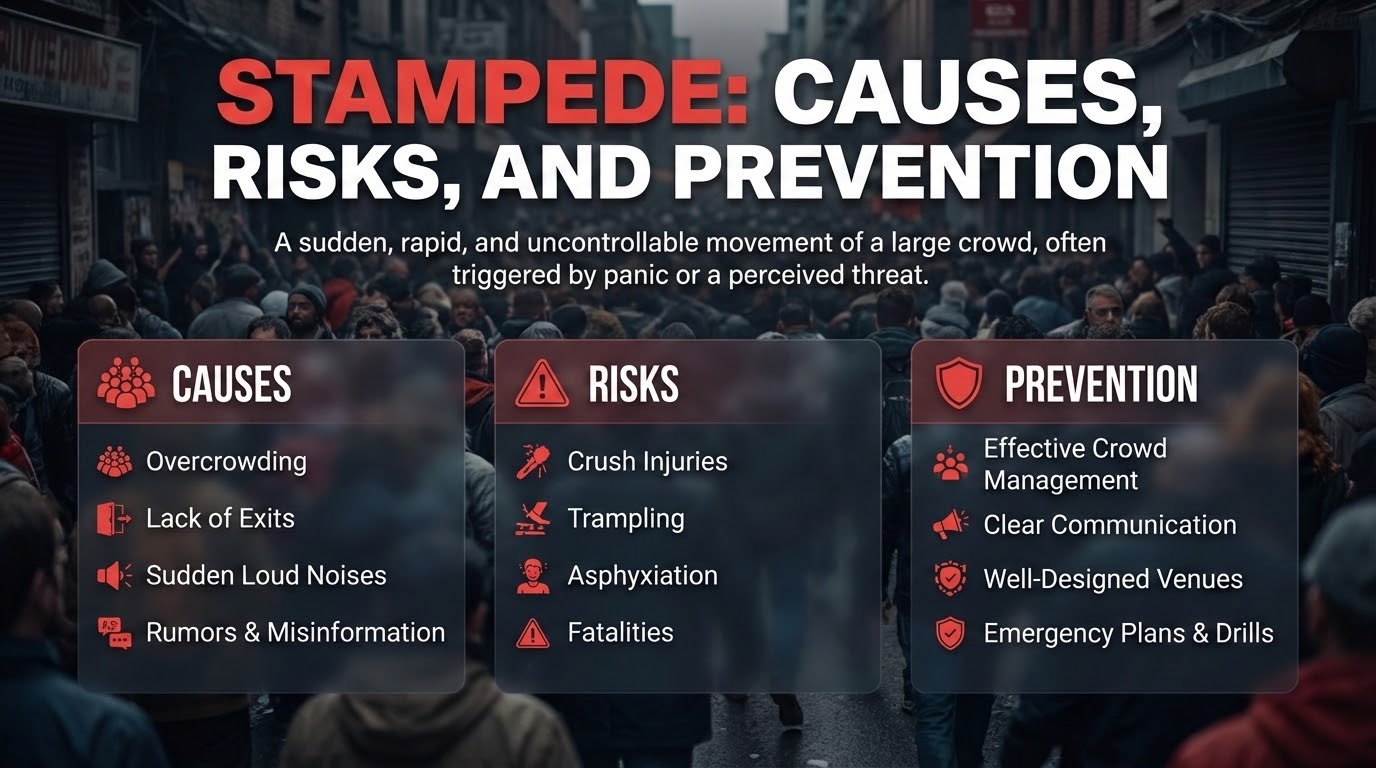
Stampedes are human-induced disasters characterized by the uncontrolled movement of a large crowd, leading to injuries and fatalities from crushing and suffocation.
Unlike natural calamities, they are largely preventable and stem from failures in planning, infrastructure, and crowd management.
Mechanism of Death
Crowd Density: When crowd density surpasses 5 persons per square meter, individuals lose control over their movements and are pushed by the force of the crowd behind them. This phenomenon is often termed "crowd turbulence."
Crowd Crush vs Panic: Most fatalities in stampedes are caused by compressive asphyxia (crowd crush), where people are squeezed so tightly they cannot breathe. Panic is a secondary reaction, not the primary cause of death.
Domino Effect: In a dense crowd, the fall of a single person can trigger a chain reaction, leading to a pile-up where people at the bottom are crushed under the weight of others.
Types of Stampedes
|
Type |
Trigger |
Common Scenario |
|
Panic-induced Stampede |
Fear-driven, often by a perceived threat like a fire, explosion, or a structural collapse rumor. |
Sudden rush towards exits in enclosed spaces like cinemas, stadiums, or during emergencies. |
|
Competitive Stampede |
Desire-driven, where people rush towards a specific goal. |
Religious gatherings (to get 'darshan'), distribution of free goods, or entry into a venue. |
|
Crowd Crush (Progressive) |
Occurs due to extreme density and pressure build-up in a confined space, often without a specific panic trigger. |
Overcrowded entry/exit points, narrow passages, and spaces where crowd flow is obstructed. |
Stampedes in India
High population density and the scale of religious and cultural gatherings make India vulnerable to stampedes.
Fatalities: Between 2001 and 2022, a total of 3,074 deaths were recorded due to stampedes.. (Source: NCRB)
Victim Demographics: Around 70% of the victims are men. (Source: NCRB)
Location: 79% of stampedes occur at religious gatherings. (Source: International Journal of Disaster Risk Reduction study)
Notable Incidents
1954 Kumbh Mela Stampede: One of India's worst disasters, resulting in an estimated 800 deaths.
2005 Mandhardevi Temple Stampede (Maharashtra): A fire and subsequent panic on a narrow temple path led to nearly 340 deaths.
2024 Hathras Stampede (Uttar Pradesh): A religious congregation resulted in the tragic death of approximately 121 people due to overcrowding.
Structural Factors
Bottlenecks: Sudden narrowing of paths or "dead ends" that create a funnel effect.
Inadequate Exits: Locked or blocked emergency exits (e.g., the Uphaar Cinema Tragedy).
Terrain Challenges: Steep slopes or slippery surfaces at hilltop shrines.
Organizational & Process Failures
Exceeding Capacity: Ignoring the "holding capacity" of a venue in favor of political or religious optics.
Lack of Segmentation: Failing to use "holding pens" or barricades to break a massive crowd into smaller, manageable units.
Poor Communication: Absence of a synchronized Public Address (PA) system to manage rumors.
Behavioral Triggers
The "Craze": A rush toward a celebrity, a VIP, or free distribution of goods.
The "Flight": Panic triggered by a perceived threat, such as a rumor of a bridge collapse or a short circuit.
Administrative Lapses
Lack of Inter-agency Coordination: Poor communication between local police, medical teams, and event organizers.
VIP Culture: Diverting security resources to protect dignitaries, leaving the general public unmanaged.
National Disaster Management Authority (NDMA): The apex body for disaster management has issued comprehensive Guidelines on Crowd Management to help state and local authorities plan and conduct safe events.
State/District Disaster Management Authorities (SDMA/DDMA): Responsible for implementing guidelines and managing disasters at the state and district levels.
The Police and Local Administration: The first responders and primary agencies responsible for on-ground crowd control.
Lack of Accountability: Gap exists in fixing responsibility for administrative lapses after a tragedy occurs.
Resource Constraints: Shortage of trained personnel, funds, and modern equipment for crowd management.
Political Interference: Decisions regarding event permissions and safety measures are often influenced by political considerations rather than safety protocols.
Ad-hoc Planning: Many events are planned without scientific risk assessment or professional crowd management expertise.
Strict Enforcement and Accountability
Make compliance with NDMA guidelines mandatory for all large gatherings.
Establish clear legal accountability for event organizers and administrative officials in case of negligence.
Technology Integration
Use AI-based video analytics and drones for real-time crowd density monitoring and flow analysis.
Implement digital ticketing and QR-code based entry systems to regulate capacity.
Utilize public address systems and mobile alerts for communication.
Infrastructure and Planning
Conduct a safety audit of all major religious sites and public venues to identify and rectify structural flaws.
Incorporate crowd management principles into urban planning and architectural design.
Capacity Building and Awareness
Provide specialized training in crowd management to police, private security, and event volunteers.
Conduct regular mock drills for emergency evacuation.
Run public awareness campaigns to educate citizens on responsible behavior in crowded places.
Preventing stampedes requires shifting from viewing them as "accidents" to treating them as preventable governance failures that must be addressed through tech-driven crowd management, strict legal accountability for organisers, and robust infrastructure planning.
Source: THE HINDU
|
PRACTICE QUESTION Q. "Stampedes are a failure of crowd management rather than a disaster of chance." Analyze this statement in the light of NDMA guidelines and recent incidents. 150 Words |
The tragedy was caused by overcrowding beyond the venue's safe carrying capacity, inadequate police deployment, the collapse of temporary barricades, structural constraints like narrow pathways, and a complete breakdown of queue discipline during a sudden surge of devotees.
The NDMA guidelines mandate scientific crowd size estimation, route planning, strict flow regulation, the deployment of technology such as RFID and CCTV monitoring, and establishing clear emergency evacuation protocols for massive gatherings.
The Tirumala Tirupati Devasthanams (TTD) utilizes an Integrated Command and Control Centre (ICCC) equipped with 6,000 AI cameras. This technology enables 3D congestion mapping, real-time prediction of queue wait times, and proactive neutralization of dangerous crowd density bottlenecks.



© 2026 iasgyan. All right reserved