Description
Disclaimer: Copyright infringement not intended.
Context
The Union government's stance on declaring lightning as a natural disaster in India.
Details
- The Union government is against declaring lightning as a natural disaster, citing the potential for prevention through education and awareness.
- India has an early warning system for lightning, providing forecasts ranging from five days to three hours.
State Demands and Compensation
- States like Bihar and West Bengal have requested that deaths due to lightning be recognized as a natural disaster.
- The victims would then be eligible for compensation from the State Disaster Response Fund (SDRF), a majority of which is contributed by the central government.
Existing Classification of Disasters
- Present norms consider cyclone, drought, earthquake, fire, flood, tsunami, hailstorm, landslide, avalanche, cloudburst, pest attack, frost, and cold waves as covered disasters under the SDRF.
Lightning Deaths in Bihar
- Bihar's Disaster Management Minister highlights the vulnerability of the state to lightning-related fatalities.
- More than 1,500 deaths have occurred in Bihar due to lightning in the past five years, with 107 deaths reported till July 6, 2023.
- Climate change is considered a possible factor contributing to the increasing number of lightning-related deaths.
Discussions at the Ministerial Meeting
- The issue of lightning deaths was raised at a meeting of Ministers of Disaster Management of States, chaired by Union Home Minister Amit Shah.
- Bihar's Minister emphasized the distribution of timely alerts and awareness pamphlets at the local level to educate people about lightning risks.
Lightning Deaths and National Statistics
- According to the National Crime Records Bureau (NCRB), lightning caused 40% of all accidental deaths attributed to "forces of nature" in 2021.
- The proportion of lightning-related deaths has been increasing over the years.
- In 2003, deaths due to lightning constituted only 0.2% of all deaths caused by forces of nature.
Regional Patterns of Lightning and Fatalities
- Northeast states, West Bengal, Sikkim, Jharkhand, Odisha, and Bihar experience a high frequency of lightning strikes.
- However, central Indian states like Madhya Pradesh, Maharashtra, Chhattisgarh, and Odisha have higher numbers of lightning-related deaths.

About Lightning
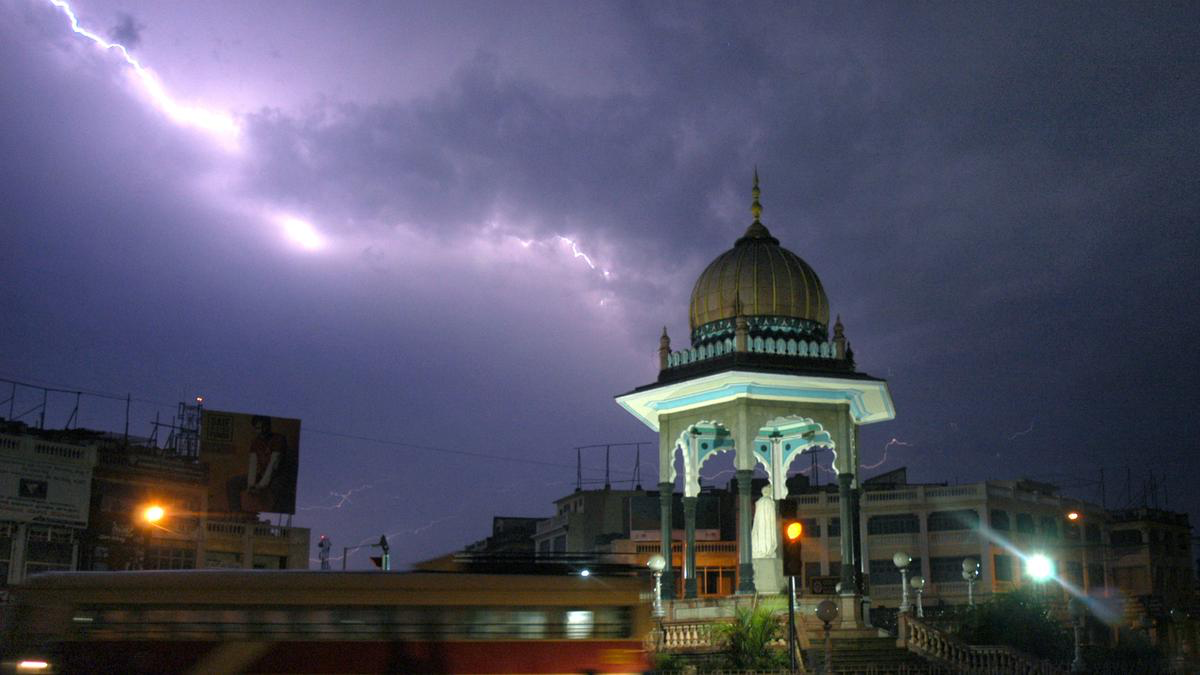
- Lightning is a natural atmospheric discharge of electricity that occurs during thunderstorms.
- It is a visible and highly energetic electrical discharge between the ground and the atmosphere or within cloud systems.
Formation and Mechanism
- Lightning is generated by the separation of electric charges within a thunderstorm cloud.
- It occurs when there is an imbalance between the negatively charged bottom of the cloud and the positively charged ground or another cloud.
- The mechanism involves the movement of electrons and ions within the cloud and between the cloud and the ground.
Types of Lightning
- Cloud-to-Ground (CG) Lightning: This is the most common type of lightning. It occurs between the cloud and the ground, either directly or through conducting objects like trees, buildings, or people.
- Intra-Cloud (IC) Lightning: This lightning occurs within the cloud itself, between different regions of charge separation within the thunderstorm cloud.
- Cloud-to-Cloud (CC) Lightning: As the name suggests, this lightning occurs between two separate thunderstorm clouds.
Characteristics and Effects
- Lightning is characterized by its intense brightness, which is a result of the high electrical current passing through the air.
- It generates a flash of light, heat, and a powerful shockwave that creates thunder.
- The heat generated by lightning can reach temperatures hotter than the surface of the sun.
- Lightning can cause physical damage to structures, trees, and other objects it strikes, and it poses a significant risk to human safety due to the potential for electrocution.
Lightning Safety and Precautions
- Lightning safety measures are crucial to minimize the risk of injury or death during thunderstorms.
- Seeking shelter indoors is the safest option. Avoid open areas, tall structures, water bodies, and metal objects during a thunderstorm.
- If caught in an open area, crouch down with feet together, minimizing contact with the ground.
- It is advisable to avoid using electronic devices plugged into electrical outlets during a thunderstorm.
Lightning Detection and Early Warning Systems
- Advanced technologies and early warning systems have been developed to detect and predict lightning strikes.
- These systems use various methods such as lightning sensors, satellite imagery, and atmospheric monitoring to provide warnings and forecasts.
- Early warning systems aim to alert people in advance, allowing them to take necessary precautions and seek shelter during thunderstorms.
|
PRACTICE QUESTION
Q) Discuss the causes, characteristics, and impacts of lightning on human life and the environment. (150 words)
|

https://www.thehindu.com/news/national/can-deaths-due-to-lightning-be-considered-a-natural-disaster/article67087105.ece#:~:text=The%20Union%20government%20is%20not,on%20the%20condition%20of%20anonymity.