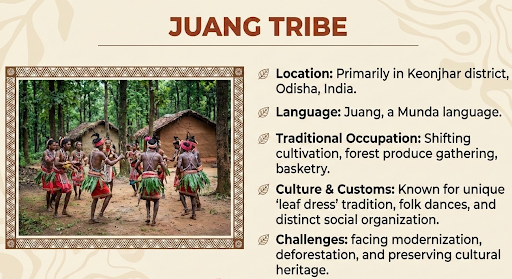
The Juang are a PVTG in Odisha, primarily inhabiting the Gonasika hills. Belonging to the Munda linguistic family, they practice shifting cultivation (Toila) and maintain a unique social structure centered around the Majang youth dormitory.
Why In News?
A 16-year-old girl, Sumitra Juanga, from the Juang PVTG community in Odisha’s Keonjhar district, has successfully transformed her village's mindset regarding child marriage and maternal health.
About Juang Tribe
The Juang are one of the 13 Particularly Vulnerable Tribal Groups (PVTGs) found in Odisha, primarily inhabiting the Gonasika hills of Keonjhar district and the plains of Dhenkanal and Angul districts.
Etymology: Term 'Juang' translates to "Man" or "Sons of Man".
Historical Name: They were historically referred to as Patuas (leaf-wearers) because the women traditionally wore girdles of leaves.
Origin Myth: They believe they originated from the earth on the Gonasika hills near the source of the Baitarani River.
Divisions: Culturally and geographically, they are divided into two sections:
Language
Social Organization
Political Organization
Village Council: The village is an autonomous socio-political unit managed by a council of elders known as the Barabhai.
Pirh Council: Above the village level, the Hill Juangs have a traditional territorial organization called Pirh, which consists of a group of villages. The head of this inter-village council acts as a supreme socio-political authority.
Religious Head: The Nagam or Dehuri is the religious head who officiates communal worship.
Economic Life
Shifting Cultivation (Toila): The Hill Juang primarily practice shifting cultivation, locally known as Toila or Ering. They grow crops like oilseeds (Rasi), pulses, and millets on hill slopes.
Hunting and Gathering: Their diet and economy are heavily supplemented by collecting forest produce such as roots, tubers, and fruits.
Basketry: Juangs, especially those in the plains, are skilled basket weavers, crafting items from bamboo which they exchange for paddy and other essentials.
Religion and Culture
Deities: Their supreme deities are Dharam Devta (Sun God) and Basukimata (Mother Earth). They generally do not have specific idols for these supreme gods but offer prayers to them first during every ritual.
Festivals: Their festivals are closely linked to the agricultural cycle:
Dance: The Changu dance is their traditional folk dance, performed by both men and women to the beat of the Changu (a tambourine-like drum).
Source: TIMESOFINDIA
|
PRACTICE QUESTION Q. The 'Majang' or 'Mandaghar' in Juang culture refers to: A) A type of shifting cultivation B) The village deity C) A traditional youth dormitory D) A harvest festival Answer: A Explanation: The 'Majang' or 'Mandaghar' in Juang culture refers to C) A traditional youth dormitory. It acts as a central hub for village social, economic, and cultural life, where unmarried youth live and where villagers gather to discuss community matters. |
The Juang tribe is one of the 13 Particularly Vulnerable Tribal Groups (PVTGs) located exclusively in Odisha. They primarily inhabit the heavily forested Gonasika hills of Keonjhar district, as well as parts of Dhenkanal and Angul districts.
The 'Majang' or Mandaghar is a traditional youth dormitory in the Juang community. It serves as a community center, guest house, and village council venue where young unmarried boys and girls receive their essential cultural education and life skills.
Pradhan Mantri Janjati Adivasi Nyaya Maha Abhiyan (PM-JANMAN) is a targeted government initiative with a massive budgetary outlay designed to address critical infrastructural, health, educational, and livelihood gaps for 75 PVTGs across India.


© 2026 iasgyan. All right reserved