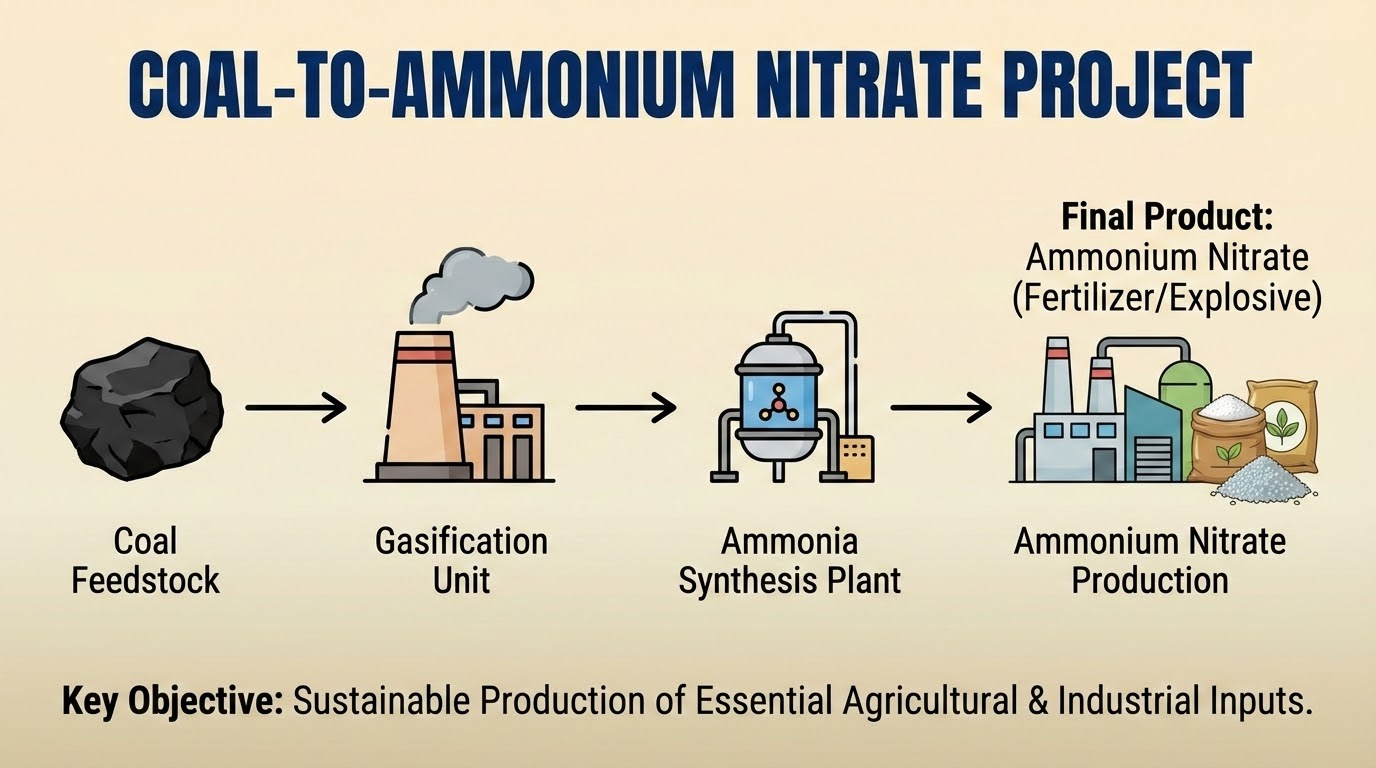
Bharat Coal Gasification and Chemicals Limited (BCGCL), a joint venture between BHEL and Coal India, is establishing India's first commercial-scale coal-to-ammonium nitrate plant in Odisha. The facility uses indigenous gasification technology to produce 2,000 TPD of ammonium nitrate for industrial use
Why In News
Bharat Coal Gasification and Chemicals Limited (BCGCL) and Mahanadi Coalfields Limited (MCL) have signed an agreement for the country’s first indigenous coal-to-ammonium nitrate project.
About the Coal-To-Ammonium Nitrate Project
Location: Lakhanpur, Jharsuguda District, Odisha.
Objective: Produce 2,000 tonnes per day (TPD) of Ammonium Nitrate.
Implementing Body: BCGCL, a Joint Venture (JV) between Coal India Limited (CIL) (51%) and BHEL (49%).
Estimated Investment: Approximately ₹11,782 crore. Recent reports on the land lease cite an investment potential of up to ₹25,000 crore for the broader initiative.
Product Usage: Primarily for bulk explosives used in mining (CIL is a major consumer) and fertilizers for agriculture.
The Core Technology: Coal Gasification
This project utilizes indigenously developed Pressurised Fluidised Bed Gasification (PFBG) technology by BHEL.
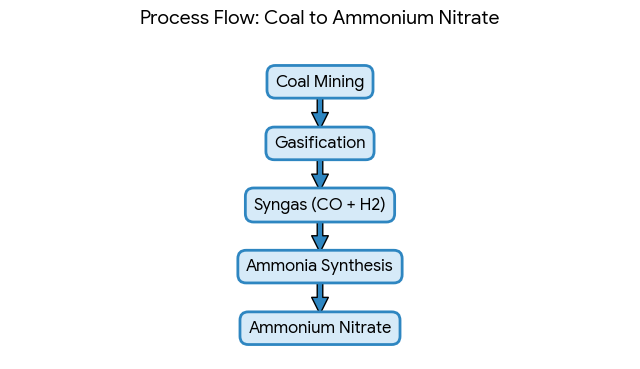
Coal Gasification is a thermo-chemical process that converts coal into Syngas (Synthesis Gas), which is a mixture primarily of Carbon Monoxide and Hydrogen.
Strategic Significance
Reducing Import Dependence
Current Status: India is a net importer of chemicals and petrochemicals. A significant portion of Ammonium Nitrate and the natural gas required to produce it is imported.
Impact: This project serves as backward integration for Coal India Limited. By producing its own explosives raw material (ammonium nitrate), CIL reduces supply chain vulnerability and costs.
Utilizing Domestic Resources
India has the 4th largest coal reserves in the world but lacks adequate oil and gas. Gasification offers a cleaner way to use this abundant coal for chemical production rather than just burning it for power.
It unlocks the value of non-coking, high-ash coal found in Odisha.
Technological Sovereignty
This is the first commercial deployment of BHEL’s home-grown gasification tech. Success here validates India's ability to build complex industrial technology, moving away from reliance on expensive licensed technology from the West or China.
Source: BUSINESS-STANDARD
|
PRACTICE QUESTION Q. Consider the following statements regarding Coal Gasification: 1. It is a process of burning coal directly at high temperatures to generate electricity. 2. Syngas produced from coal gasification primarily consists of Carbon Monoxide, Hydrogen, Carbon Dioxide, and Methane. Which of the statements given above is/are correct? a) 1 only b) 2 only c) Both 1 and 2 d) Neither 1 nor 2 Answer: b) 2 only Explanation: Statement 1 is incorrect: Coal gasification is a thermo-chemical process that partially oxidizes coal using specifically controlled amounts of air, oxygen, steam, or carbon dioxide. This converts the coal into a gaseous state rather than burning it completely as a solid fuel. Statement 2 is correct: The primary product of coal gasification is Syngas (Synthesis Gas). This gas is a mixture consisting mainly of Carbon Monoxide and Hydrogen, along with varying amounts of Carbon Dioxide, Methane, and water vapour. |
Coal gasification is a thermochemical process that transforms solid coal into a gas instead of burning it directly. It partially oxidizes coal using air, oxygen, steam, or carbon dioxide under controlled high temperatures and pressures to create a useful gas mixture.
Syngas (Synthesis Gas) is the direct output of coal gasification, comprising Carbon Monoxide, Hydrogen, Carbon Dioxide, and Methane. In the BCGCL project, Hydrogen is extracted from Syngas to produce Ammonia, which is then converted into Ammonium Nitrate for fertilizers and commercial explosives.
While gasification emits fewer particulate matters and localized pollutants than direct coal burning, it is still highly water-intensive and produces significant amounts of CO2. To meet India's Net-Zero 2070 targets, these plants must integrate Carbon Capture, Utilization, and Storage (CCUS) technologies and Zero Liquid Discharge systems.



© 2026 iasgyan. All right reserved