

The Supreme Court questioned the 2023 law replacing the CJI with a Cabinet Minister for Election Commission appointments, raising concerns that the change compromises ECI independence by giving the Executive a decisive majority.
|
Read all about: Election Commission of India (ECI) l Appointment Of Election Commissioners |
Election Commissioners (ECs) are high-ranking constitutional functionaries who form the Election Commission of India (ECI), an autonomous body entrusted with the superintendence, direction, and control of all elections to Parliament, State Legislatures, and the offices of the President and Vice-President.
Originally a single-member body, the ECI now functions as a multi-member institution comprising the Chief Election Commissioner (CEC) and two other Election Commissioners.
Currently, appointments are governed by the Chief Election Commissioner and Other Election Commissioners (Appointment, Conditions of Service and Term of Office) Act, 2023.
Constitutional Vacuum: For over seven decades, Parliament failed to enact a specific law for appointments under Article 324(2), leaving the process entirely to executive discretion.
Executive Dominance and Bias: Unilateral appointments by the ruling government created the risk of installing compliant "yes-men", which threatens the institution's neutrality.
Lightning-Speed Appointments: Severe concerns over transparency were raised when specific commissioners (eg. Arun Goel, 2022) were appointed within 24 hours, leaving no time for meaningful scrutiny.
Short Tenures: Successive governments intentionally appointed older bureaucrats who could not complete their full six-year terms before reaching the retirement age of 65, undermining institutional continuity.
Asymmetry in Removal: While the CEC enjoys strong security of tenure and can only be impeached like a Supreme Court Judge, the other ECs can be removed merely on the recommendation of the CEC.
In 2023 judgment (Anoop Baranwal vs Union of India), a five-judge Constitution Bench made several observations:
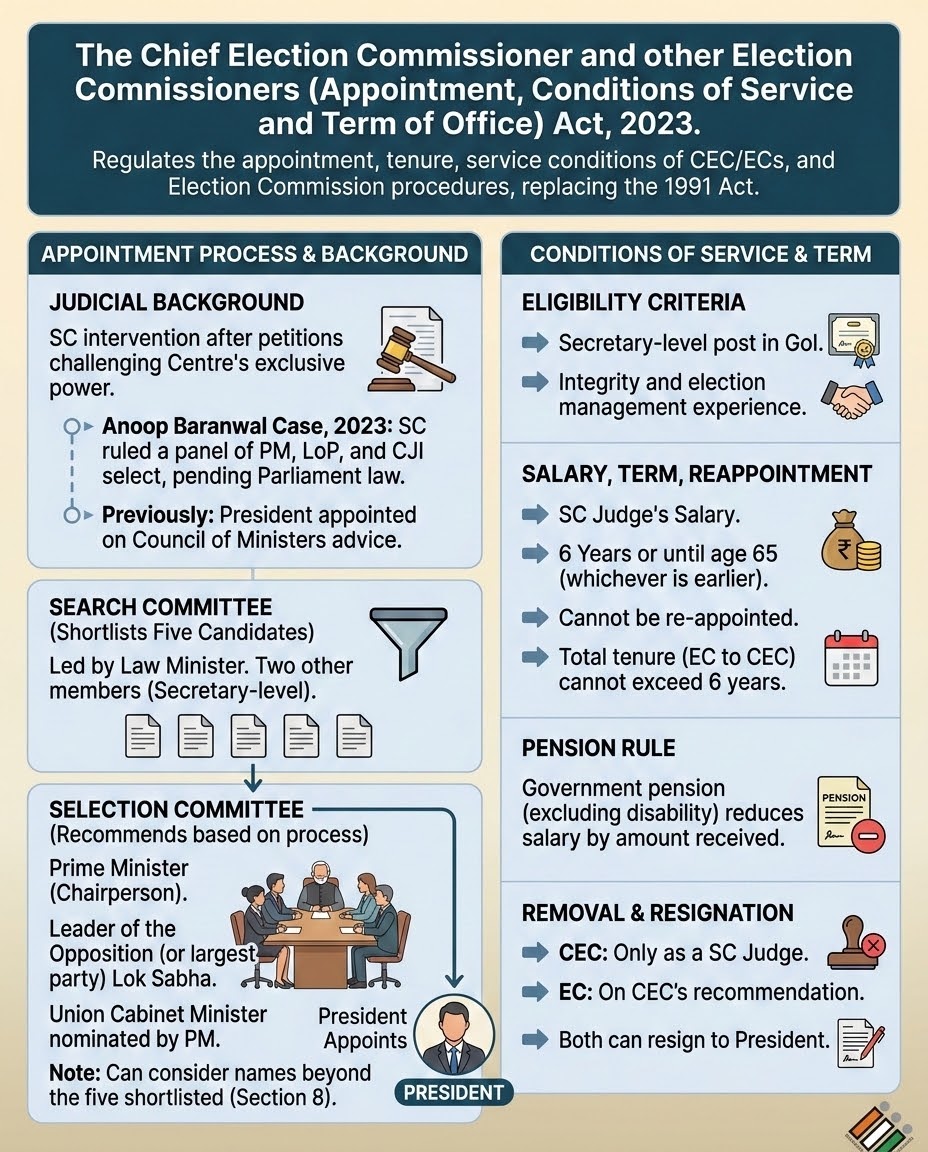 What Are the Concerns Regarding the New Law on Appointment of CEC and ECs?
Restoration of Executive Majority: By excluding the Chief Justice of India and replacing him with a Union Cabinet Minister, the 2023 Act gives the executive an absolute 2:1 majority in the Selection Committee.
Overruling the Judiciary: Critics argue that the new legislation acts as a device to bypass the Supreme Court's judgment without curing the fundamental defect of executive dominance.
Appointments Despite Vacancies: The Act allows the Selection Committee to finalize appointments even if the position of the Leader of the Opposition is vacant, effectively enabling a ruling-party monopoly over the choice.
Downgraded Status: The new law equates the salary and service conditions of the CEC and ECs to a Cabinet Secretary (a government-controlled post) rather than a Supreme Court Judge, raising concern over diminished institutional authority.
|
Why Is Independence of the Election Commission Crucial for Democracy?
|
South Africa: The Independent Electoral Commission appointments recommended by a highly neutral panel including the President of the Constitutional Court, a representative of the Human Rights Commission, and the Public Protector.
United Kingdom: Members of the Electoral Commission are overseen by the Speaker's Committee, judged strictly on professional criteria, and must be approved by the House of Commons.
United States: The Federal Election Commission requires appointments by the President to be confirmed by the Senate, and strictly mandates a bipartisan balance where no more than three members can belong to the same political party.
Canada: To fully shield the office from the executive, the Chief Electoral Officer is appointed via a resolution of the House of Commons for a secure ten-year term and reports directly to Parliament.
Neutral Selection Collegium: Establish a truly balanced Selection Committee that includes the Chief Justice of India or a similar neutral judicial element to prevent a dominant executive majority.
Enhanced Transparency in the Search Process: Publicize Search Committee proceedings, disclosing candidate shortlists early with documented selection justifications.
Equal Constitutional Protection: Amend Article 324(5) to grant the other Election Commissioners the same stringent impeachment protections currently reserved solely for the Chief Election Commissioner.
Statutory Financial Autonomy: Financial independence by ensuring that the ECI's expenditure shall be "charged" on the Consolidated Fund of India, preventing it from being reduced or altered by the government, as recommended by the Law Commission (255th Report).
Independent Permanent Secretariat: Create an independent secretariat for the ECI (similar to the Lok Sabha) with full power over recruitment, to end reliance on government-deputed staff, as recommended by the Dinesh Goswami Committee on Electoral Reforms (1990).
Post-Retirement Bar: Prevent conflicts of interest by making the CEC and ECs legally ineligible for post-retirement appointments (like Governorships) under the government.
Ensuring the absolute independence and impartiality of the Election Commission through transparent, structurally insulated appointments is an indispensable safeguard for preserving the democratic ethos and electoral integrity of India.
Source: THEHINDU
|
PRACTICE QUESTION Q. Consider the following statements regarding the Chief Election Commissioner and Other Election Commissioners (Appointment, Conditions of Service and Term of Office) Act, 2023: 1. The Selection Committee to recommend appointments comprises the Prime Minister, the Chief Justice of India, and the Leader of the Opposition. 2. The salary and conditions of service of the Chief Election Commissioner and Election Commissioners are equivalent to that of the Cabinet Secretary. Which of the statements given above is/are correct? (a) 1 only (b) 2 only (c) Both 1 and 2 (d) Neither 1 nor 2 Answer: b Explanation: Statement 1 is incorrect: Under the 2023 Act, the Chief Justice of India (CJI) was replaced in the Selection Committee. The committee now consists of:
Statement 2 is correct: The Act shifted the salary and service conditions of the CEC and ECs from being equivalent to a Supreme Court Judge to being equivalent to the Cabinet Secretary. |
It is a law regulating the appointment, conditions of service, and term of office of the CEC and ECs, which replaced the earlier 1991 Act.
The Supreme Court mandated an interim panel comprising the Prime Minister, Leader of the Opposition, and the Chief Justice of India to appoint the CEC and ECs until Parliament enacted a specific law.
Their salary, allowances, and service conditions are now equivalent to those of the Cabinet Secretary to the Government of India, downgraded from the status of a Supreme Court Judge under the old law.
© 2026 iasgyan. All right reserved