MoSPI’s 2026 guidelines shift the GSVA base year to 2022-23, capturing post-pandemic digital growth. While improving sub-national planning through standardized DDP metrics, structural gaps like single deflation remain, necessitating a transition to double deflation for robust, real-time economic accuracy.
Why In News?
The Ministry of Statistics and Programme Implementation (MoSPI) has revised the base year of National Accounts to 2022–23, with the objective of more accurately reflecting the current structure of the economy.
What is Gross State Value Addition (GSVA)?
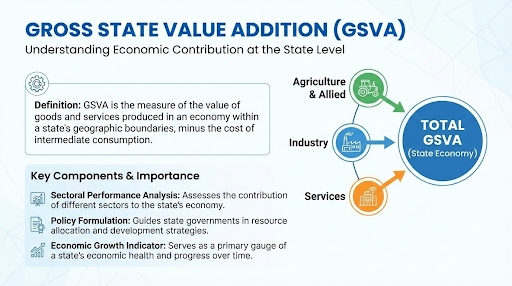
GSVA is a metric that measures the total value of goods and services produced within the geographical boundaries of a specific state, after deducting the cost of inputs and raw materials used in the production process.
It serves as the supply-side measure of a state's economy and is the state-level equivalent of Gross Value Added (GVA). Mathematically, it is expressed as:
GSVA is the primary component used to derive the Gross State Domestic Product (GSDP), which is calculated by adding product taxes and subtracting product subsidies from GSVA.
How is GSVA Measured in India?
The compilation of GSVA is decentralized but follows a standardized methodology prescribed by the National Statistical Office (NSO) to ensure comparability. It is measured sector-wise using two main approaches:
Sectoral Measurement Breakdown
Agriculture: Estimates are based on land use statistics, crop production data, and prices from state directorates.
Manufacturing: Organized manufacturing data is sourced from the Annual Survey of Industries (ASI), while the unorganized sector relies on periodic surveys.
Services: Value addition is estimated using workforce participation rates and value added per worker, or administrative data from budget documents for public services.
New Guidelines for Compilation of GSVA (April 2026)
In April 2026, the Ministry of Statistics and Programme Implementation (MoSPI) released Draft Uniform Guidelines to overhaul the estimation of GSVA and District Domestic Product (DDP).
Base Year Revision: Base year for National and State Accounts has been revised from 2011-12 to 2022-23 to accurately reflect the current economic structure and relative prices.
Standardized DDP Framework: For the first time, uniform guidelines have been issued for compiling District Domestic Product (DDP).
New Data Sources: Guidelines integrate high-frequency data sources such as GST Network (GSTN) data, PLFS (Periodic Labour Force Survey), and administrative data from online platforms to better capture the services sector and gig economy.
Capturing the Unincorporated Sector: Refined estimation techniques are introduced to better measure the unincorporated (informal) sector and emerging sectors like renewable energy, which were previously under-reported.
Source: PIB
|
PRACTICE QUESTION Q. Consider the following statements regarding Gross State Value Addition (GSVA): 1. It is a demand-side metric that measures the total value of goods and services consumed within the geographical boundaries of a state. 2. Gross State Domestic Product (GSDP) is derived by adding product taxes and subtracting product subsidies from GSVA. Which of the statements given above is/are correct? a) 1 only b) 2 only c) Both 1 and 2 d) Neither 1 nor 2 Answer: b Explanation: Statement 1 is incorrect. Gross State Value Added (GSVA) is a supply-side metric that measures the value of goods and services produced within the geographical boundaries of a state, rather than consumed. It is calculated as the value of output minus intermediate consumption. Statement 2 is correct. Gross State Domestic Product (GSDP) is indeed derived from GSVA by adding product taxes and subtracting product subsidies (GSDP = GSVA + Product Taxes - Product Subsidies). |
GSVA is a supply-side metric that calculates the total value of goods and services produced within a state's geographical boundaries. It is calculated by taking the total value of output and deducting the cost of intermediate consumption (inputs and raw materials).
GSDP is calculated using GSVA as its foundational building block. To find GSDP, one must add all product taxes to the GSVA and subtract all product subsidies (GSDP = GSVA + Product Taxes - Product Subsidies).
Single deflation adjusts only the final output for inflation, which can distort real growth figures during volatile input pricing (like oil shocks). Double deflation, which is the recommended best practice, adjusts both the final output and the intermediate inputs for inflation, providing a much more accurate picture of real economic value addition.


© 2026 iasgyan. All right reserved