The Himalayan tahr, a robust wild goat with a thick reddish-brown coat and backward-curving horns, thrives in the high-altitude, rocky cliffs of Himachal Pradesh’s Kugti Wildlife Sanctuary. These agile climbers are frequently spotted grazing across its alpine pastures and steep, rugged terrain.
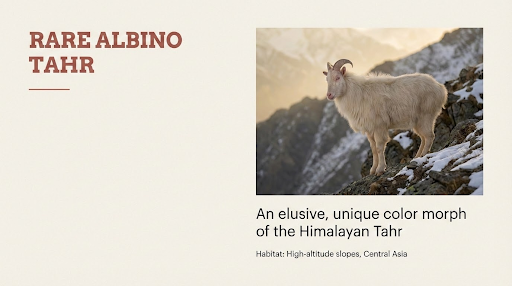
Why In News
A rare white female albino Himalayan Tahr was recorded for the first time in the Kugti Wildlife Sanctuary.
What is Himalayan Tahr?
The Himalayan Tahr (Hemitragus jemlahicus) is a large, high-altitude ungulate related to the wild goat, native to the rugged hills of the Himalayas.
Core Characteristics
Physical Appearance: It is known for its small head, large eyes, and small, backward-curved horns.
Habitat: They inhabit the steep, rocky slopes and alpine meadows of the Himalayas at altitudes ranging from 2,500 to 5,000 meters.
Distribution: Their native range extends across India, Nepal, and Bhutan; in India, they are predominantly found in Jammu & Kashmir, Himachal Pradesh, and Uttarakhand.
Conservation & Legal Status
IUCN Red List: Classified as Near Threatened
Wildlife Protection Act (1972): In India, it is protected under Schedule I, granting it the highest legal safeguard against hunting and trade.
Threats: The primary threats include habitat loss due to infrastructure development, competition with domestic livestock for grazing, and illegal poaching.
About Kugti Wildlife Sanctuary
Kugti Wildlife Sanctuary, located in Himachal Pradesh's Chamba district, is the state's second-largest protected area.
The Manimahesh Temple is located in the Kugti Wildlife Sanctuary
Geographical Profile
Altitude: The sanctuary features a dramatic elevational range from 2,195 metres to 5,040 metres, encompassing diverse climatic zones.
Location: It is in the high-altitude region between the Ravi and Chenab rivers.
Connectivity: It forms a vital ecological corridor, bordered by the Tundah Wildlife Sanctuary to the North-West and the Dhauladhar Wildlife Sanctuary to the South-East.
Ecological Diversity
Flora: The vegetation transitions from Moist Deodar and Western Mixed Coniferous forests at lower altitudes to Alpine Pastures near the snow line. Dominant species include Deodar (Cedrus deodara), Kail (Pinus wallichiana), and Silver Fir.
Fauna: It is a stronghold for the Himalayan Tahr (Near Threatened), Ibex, Brown Bear, and Musk Deer. Rare sightings include the recently documented albino female Himalayan Tahr.
Avifauna: The sanctuary is home to high-altitude birds like the Monal, Snow Cock, and various pheasants.
Source: TRIBUNEINDIA
|
PRACTICE QUESTION Q. The Manimahesh Temple, a religious tourism site, is located within which of the following protected areas? a) Hemis National Park b) Kugti Wildlife Sanctuary c) Valley of Flowers National Park d) Pin Valley National Park Answer: b Explanation: The Manimahesh Temple and the sacred Manimahesh Lake are located within the Kugti Wildlife Sanctuary in the Chamba district of Himachal Pradesh. |
Kugti Wildlife Sanctuary is located in the Bharmour region of the Chamba district in Himachal Pradesh, strategically situated between the Ravi and Chenab river basins.
The Himalayan Tahr is currently classified as 'Near Threatened' on the IUCN Red List due to severe threats from habitat fragmentation and hunting.
Answer: Albinism causes a complete lack of melanin pigment, destroying the animal's natural camouflage. This makes them highly visible against rocky terrains in snowless months, increasing their vulnerability to apex predators like the Snow Leopard,



© 2026 iasgyan. All right reserved