

States oppose the Viksit Bharat–Guarantee for Rozgar and Ajeevika Mission (Gramin) Act, 2025 (VB-G RAM G) due to heavy co-funding burdens, structural centralized caps, and a shift from a justiciable right to work to a restricted administrative mission.
|
Read all about: VB-G RAM G Bill to Replace MGNREGA l VB-G RAM G Act 2025 Explained |
It is a legislative framework that repeals and replaces the MGNREGA, 2005, effective July 1, 2026. It transitions India’s rural safety net from an open-ended, demand-driven right to a centralized, supply-driven, budget-capped asset-creation mission.
Why Introduced?
Rectifying Scattered Capital Spend: Sub-optimal asset creation under MGNREGA led to short-term distress employment rather than asset creation.
Structural Labor Realignment: Nearly 45% of India’s rural workforce remains underemployed or engaged in low-productivity farm operations. (Source: Periodic Labour Force Survey). The framework systematically migrates excess labor into infrastructure assets.
Capping Fiscal Volatility: Unpredictable mid-year supplementary budget spikes under demand-driven models created severe financial strains on the Union Treasury.
Objectives
Boost Rural Disposable Income: Elevate household consumption by expanding the baseline legal employment days.
Build Durable Rural Assets: Align village level infrastructure to the PM Gati Shakti National Master Plan to accelerate saturation outcomes.
Enforce Leakage-Free Governance: Deploy modern biometric, geospatial, and AI tools to eradicate corrupt intermediary networks.
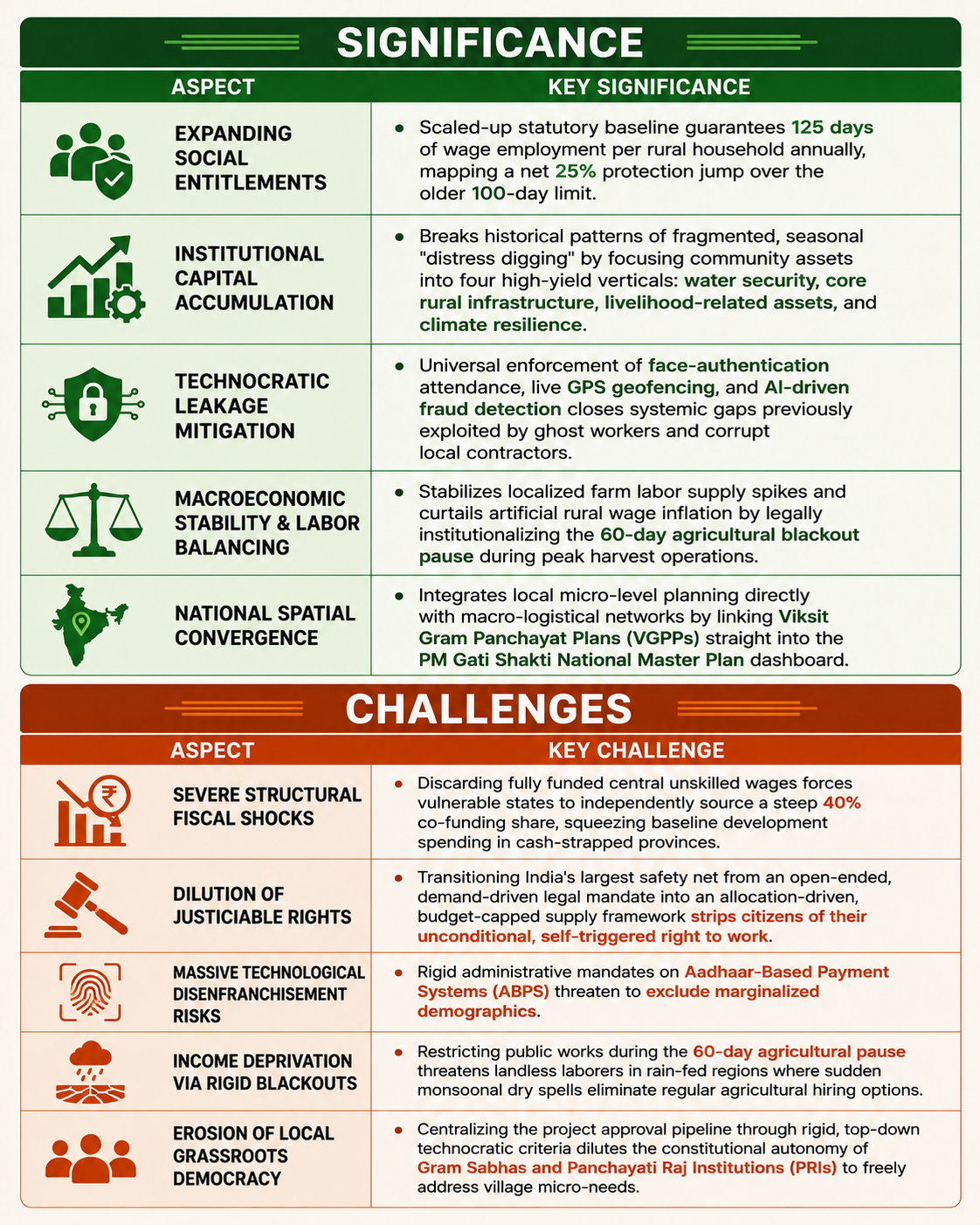
Enhanced Employment Threshold: Guarantees 125 days of wage employment per rural household annually, marking a 25% statutory increase over the older 100-day metric.
Shared Financial Architecture: Operates as a Centrally Sponsored Scheme with a mandatory 60:40 Centre-to-State cost-sharing ratio for general states, and 90:10 for Himalayan and Northeastern states.
Normative Budget Allocations: The Centre pre-defines and caps state budgets using objective indicators and rule-based parameters instead of open-ended demand requests.
Statutory Agricultural Pause: Mandates a 60-day freeze on public works during peak local sowing and harvesting periods to preserve critical farm labor supply lines.
Thematic Work Verticals: Restricts all public works strictly into four domains: water security, core rural infrastructure, livelihood-related assets, and climate resilience.
Digital Surveillance Infrastructure: Deploys the Viksit Bharat National Rural Infrastructure Stack featuring mandatory face-authentication, real-time GPS tracking, and AI-enabled fraud monitoring.
Severe Escalation of State Fiscal Burdens
Shift in Wage Liability: Under MGNREGA, the Centre paid 100% of unskilled wage costs, while states only managed partial material expenses.
Case Study (Jharkhand): Under the previous regime, Jharkhand's statutory expenditure commitment hovered around ₹1,804 crore, but expanding the system to a 125-day model under the new 40% co-funding mandate multiplies the state's direct liability up to ₹9,293 crore.
Capped Open-Ended Allocations: If a state experiences unexpected climate shocks or localized agricultural crises and exceeds its centrally designated "normative allocation," the state must fund 100% of the financial overruns entirely on its own.
Weakening of the Justiciable Rights-Based Framework
Supply-Driven Rationing Risk: Transitioning from a demand-driven right to work into a fixed-budget, supply-driven system gives bureaucratic machinery the power to ration employment based on available central funds rather than real-time public distress.
Diluted Center Accountability for Delays: The statutory shift removes the direct legal obligation of the Union government to pay mandatory delay compensation to rural workers when central funds face administrative or technological freezes.
Erosion of Constitutional Decentralization
Centralized Implementation Boundaries: Under Section 5(1) of the Act, the Central government holds the unilateral authority to notify specific operational areas and link fund disbursement to centrally drafted performance metrics, bypassing local state priorities.
Overriding Gram Sabha Mandates: Village development plans into a centralized geospatial stack connected to the PM Gati Shakti National Master Plan overrides the structural autonomy of Gram Panchayats to freely self-determine local work categories.
The 60-Day Mandatory Blackout Disruption
Income Volatility for Landless Laborers: The Act enforces up to a 60-day absolute freeze on public works during peak seasonal sowing and harvesting periods.
Digital Exclusion and Technical Infrastructure Disparities
High Failure Rates of Aadhaar Integration: The Central government removed over 2.7 million workers from the MGNREGS database between October and November 2025 through e-KYC verification or Aadhaar-Based Payment System (ABPS) accounts.
Connectivity Bottlenecks: Poorer rural pockets across Bihar, Jharkhand, and Chhattisgarh experience systemic internet and server outages.
Transitioning to Predictable Rules-Based Budgeting
Containing Deficit Spikes: The Union Ministry of Rural Development allocated ₹95,692 crore for FY 2026-27. Shifting to normative allocations based on objective variables enables predictable fiscal planning, protecting the system from arbitrary mid-year debt spikes .
State Co-Ownership Drives Efficiency: Forcing state governments to contribute a 40% financial stake incentivizes local administrations to strictly monitor projects, filter out ghost payroll lists, and eliminate corrupt intermediary cartels.
Maximizing National Asset Value via Strategic Convergence
Eradicating Fragmented Public Spending: The older framework produced scattered, short-term "distress employment" assets that washed away each monsoon.
Integration with PM Gati Shakti: Connecting local infrastructure projects directly to the Viksit Bharat National Rural Infrastructure Stack ensures that village check-dams, canals, and rural connectivity routes map cleanly onto national industrial and logistical corridors.
Protecting the Agricultural Labor Supply Chain
Preventing Farm Labor Shocks: Artificially inflating rural wage employment during peak crop cycles historically caused severe farm labor shortages and escalated food inflation.
Enhancing the Legal Welfare Safety Net
25% Net Increase in Workdays: The Centre highlights that the Act formally expands the statutory guarantee from 100 days to 125 days of wage employment per eligible household annually, providing unmatched long-term income protection.
Timely Wage Payouts: The law explicitly mandates direct bank transfers via DBT weekly, or within 15 days of muster roll closure. Delayed payments attract a mandatory statutory interest penalty of 0.05% per day, ensuring bureaucratic accountability.
Eradicating Corruption through Technocratic Governance
Total Fiscal Leakage Prevention: Deploying real-time geofencing, GPS tracking at worksites, and AI-driven fraud analytics prevents local contractors from inflating attendance sheets or using heavy machinery for manual work categories.
 Way Forward
Institutionalize Flexible Fiscal Architecture: Deploy a counter-cyclical emergency buffer fund at the central level to grant quick financial waivers to states struck by acute climate disasters or severe macroeconomic adjustments.
Decentralize Blackout Timelines: Empower local Gram Sabhas to dynamically schedule and split the 60-day agricultural pause according to real-time regional weather fluctuations rather than imposing rigid, top-down state-level blocks.
Establish Offline Fail-Safe Safeguards: Create a dual-mode, hybrid attendance and authentication mechanism allowing manual verification protocols to avoid wage delays or job rejections due to rural internet and server blackouts.
Deepen Skill Devolution Pathways: Link the expanded 25-day additional work limit with formal vocational programs under the National Skill Development Corporation (NSDC) to systematically graduate unskilled laborers into formal, semi-skilled industrial jobs.
Guarantee Timely Redressal Mechanisms: Strengthen statutory accountability by setting up independent district-level Ombudsmen offices tasked with resolving digital exclusion grievances, payment disputes, and tech mismatches within 7 business days.
The transition to VB-G RAM G reshapes rural social security grid from an emergency safety net into a structured infrastructure mission, requiring deep cooperative federalism to protect citizen rights while building durable national assets.
Source: THEHINDU
|
PRACTICE QUESTION Q. "The opposition to VB-G RAM G reflects deeper concerns relating to fiscal federalism, decentralisation and rural employment security." Analyze. (250 Words, 15 Marks) |
The Viksit Bharat – Guarantee for Rozgar and Ajeevika Mission (Gramin) [VB-G RAM G] is a comprehensive new statutory framework enacted under the Ministry of Rural Development that replaces the Mahatma Gandhi National Rural Employment Guarantee Act (MGNREGA) effective July 1, 2026.
The new framework alters the foundational mechanism of rural employment across four key parameters:
States are strongly protesting the transition because it substantially escalates their financial burden by forcing them to cover 40% of all expenditure instead of the nominal 10% material cost share under MGNREGA. State administrations argue that shifting to a fixed "normative budget" formula effectively dilutes the legal right to work on demand, while making states legally liable to fund any excess employment requests out of their pocket.
The Union Government maintains that the open-ended design of MGNREGA no longer aligns with modern rural economic realities. The Centre states that the 60:40 model instils cooperative partnership and financial accountability, eliminates institutional corruption via digital controls like the Viksit Bharat National Rural Infrastructure Stack, and drives the creation of high-quality, durable community assets across water conservation and rural infrastructure.
© 2026 iasgyan. All right reserved