

The 16th India-Japan Annual Summit held in New Delhi, marked a historic shift as Prime Ministers Sanae Takaichi and Narendra Modi signed 129 MoUs to operationalize a roadmap for economic security, AI, and defense co-development.
|
Read all about: INDIA-JAPAN SPECIAL STRATEGIC AND GLOBAL PARTNERSHIP l INDIA-JAPAN RELATIONS EXPLAINED l INDIA-JAPAN STRATEGIC PARTNERSHIP |
Defence and Security Cooperation
Transition to Co-Development: Bilateral defense relations have evolved from mere exercises to the joint development of military hardware.
The UNICORN Project: The 2026 summit finalized the transfer and co-development of the Unified Complex Radio Antenna (UNICORN) mast system for the Indian Navy, enhancing stealth and electronic warfare capabilities.
Institutional Frameworks: Cooperation is anchored by the 2+2 Foreign and Defence Ministerial Dialogue and operationalized through the Reciprocal Provision of Supplies and Services Agreement (AcSA).
Economic Security and Supply Chain Resilience
De-risking from Monopolies: Driven by the threat of economic coercion and arbitrary export controls by dominant regional powers, the nations adopted the India-Japan Joint Declaration on Economic Security Cooperation.
Priority Sectors: Collaborative resilience focuses deeply on semiconductors, critical minerals, clean energy, pharmaceuticals, and telecommunications.
Technology and Artificial Intelligence
Strategic AI R&D: The India-Japan AI Cooperation Initiative treats AI as a frontier, aiming to build safe, secure, and human-centric ecosystems.
Institutional Integration: Deep-tech linkages have been forged through MoUs between entities like IIT Bombay, BharatGen, and Japan's National Institute of Informatics (NII) to build multilingual Large Language Models (LLMs) focusing on scientific reasoning.
Infrastructure Development
High-Speed Rail: The Mumbai-Ahmedabad High-Speed Rail (MAHSR) corridor leverages Japan's Shinkansen technology.
Freight Corridors & Metros: Japan provides Official Development Assistance (ODA) implementation capital for India's Dedicated Freight Corridors (DFCs) and metro systems in cities like Delhi, Bengaluru, and Mumbai.
Promoting Maritime Stability
Interoperability: Regular bilateral exercises like JAIMEX (Navy), Dharma Guardian (Army), and Veer Guardian (Air Force) ensure high tactical coordination.
Domain Awareness: Japan participates in the Gurugram-hosted Information Fusion Centre - Indian Ocean Region (IFC-IOR) to build layered, algorithmic maritime domain awareness (MDA).
Strengthening Rules-Based Order
Rejecting Coercion: The alliance checks non-market policies and the weaponization of economic dependencies, maintaining transparent and open navigation lines.
Norm Building: Japan and India act as stabilizing pillars within the Quad, prioritizing an inclusive narrative so smaller stakeholders do not feel forced to choose sides.
Enhancing Regional Connectivity
Northeast India as a Gateway: Through the Act East Forum, Japan is providing ODA into India's North Eastern Region (NER) to build roads and bridges, linking it to the Bay of Bengal and BIMSTEC zones.
Third-Country Port Infrastructure: Strategic development of the Matarbari deep-sea port in Bangladesh functions as a regional hub, connecting landlocked Northeast India to international shipping lanes.
Supporting Economic Resilience
Systemic Cultivation vs Territorial Command: Unlike China's "String of Pearls" model, the India-Japan approach relies on "Metabolic" network building—creating an ecosystem of interoperable data centers, cold chains, and cross-border payment rails.
Horizontal Integration: Shared digital public infrastructure creates resilience by internalizing capacity.
Balancing Strategic Competition
The "G-Minus Two" Model: As the US shifts towards a transactional approach under the Trump 2.0 era, and China wields export controls, India and Japan provide a middle-power safety net, configuring industries and supply chains that mitigate dependencies.
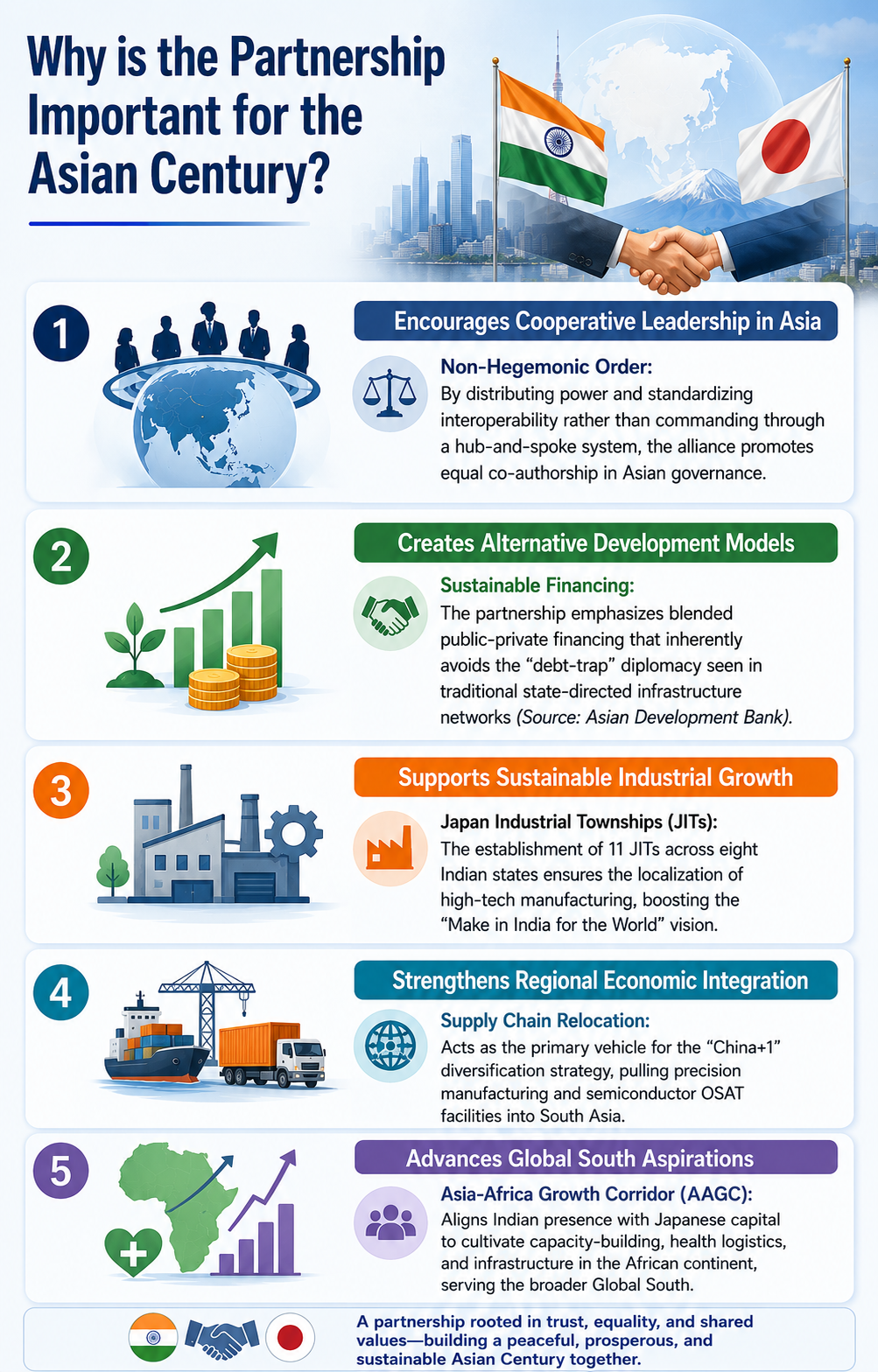 What Recent Developments Have Deepened India–Japan Relations?
New Defence Cooperation Agreements
First Co-Development Milestone: The signing of the Memorandum of Implementation for the UNICORN integrated naval antenna.
Export Guideline Relaxation: Japan’s recent relaxation of defense export principles facilitates advanced technology transfers across land, sea, and air platforms.
Economic Security Roadmap
Actionable Frameworks: The new Economic Security Factsheet 2.0 operationalizes private-sector collaboration across 129 new MoUs, aggregating investments of approximately $12.5 billion immediately secured at the 2026 Summit.
AI and Technology Partnerships
Strategic R&D: Deep linkages between the IndiaAI Mission and METI Japan have established pathways to share supercomputing resources and develop foundation models.
Critical Minerals Cooperation
Joint Working Group (JWG): A formal mechanism has been instituted to navigate the exploration, processing, and technology sharing for rare earths and critical minerals.
Expanded Investment Commitments
Ten-Trillion Yen Target: The leadership solidified the pipeline to inject 10 trillion yen into India over a decade, while establishing a dedicated "Japan Business Week" through the Indian PMO to improve the ease of doing business.
Regional Geopolitical Uncertainties
Trump 2.0 Volatility: Transaction-based US policies and tariffs have shaken the broader strategic environment, forcing India and Japan to navigate unpredictable "America First" postures.
The Russia Factor: India’s continued energy and defense reliance on Russia juxtaposes sharply with Japan's alignment with G7 sanctions over the Ukraine conflict.
Supply Chain Disruptions
Dependency Risks: Both economies remain exposed to supply chain weaponization, particularly given heavy reliance on Chinese raw materials and intermediate electronic components.
Trade and Market Access Issues
Widening Trade Deficit: India's merchandise trade deficit with Japan nearly tripled from $5.18 billion in 2015-16 to $15.4 billion in 2025-26.
Non-Tariff Barriers: Stringent Sanitary and Phytosanitary (SPS) measures by Japan restrict Indian exporters, demanding a deep review of the 2011 Comprehensive Economic Partnership Agreement (CEPA).
Technological Competition
Regulatory Bottlenecks: Differences in regulatory standards and delayed parliamentary oversight in Japan often slow the rapid transfer of critical technologies.
Divergent Economic Priorities
Workforce Culture and Taxes: Japanese corporations express hesitancy over India's complex tax systems, labor dispute resolutions, and general business practices.
Expanding Defence Industrial Collaboration
Beyond Buyer-Seller: Evolve from purchasing hardware to joint manufacturing and technology transfer in aerospace (e.g., US-2 amphibious aircraft), underwater drones, and shipbuilding.
Accelerating Semiconductor Cooperation
OSAT and Fab Facilitation: Accelerate partnerships like the Renesas Electronics setup in Gujarat to secure the chip supply chain away from vulnerable choke points.
Deepening AI and Emerging Technology Partnerships
Digital Partnership 2.0: Fully integrate the digital ecosystems focusing on cybersecurity, high-performance computing, and cross-border data governance.
Strengthening Maritime Domain Awareness
Shared Satellite Data: Integrate inputs from Japan’s Quasi Zenith Satellite System (QZSS) with India's regional surveillance hubs to ensure real-time tracking of adversarial movements.
Enhancing People-to-People Exchanges
Targeting 500,000 Placements: Leverage the Specified Skilled Worker (SSW) system and initiatives like the Haryana-Fukuoka Connect to circulate talent. Improve linguistic training networks directly aligned with industrial requirements.
Promoting Joint Investments in Third Countries
Strategic Extraterritoriality: Accelerate joint infrastructural developments like the Matarbari Port in Bangladesh and collaborative agricultural and technological projects across the Global South.
By shifting from transactional diplomacy to deep technological, industrial, and demographic integration, the India-Japan partnership acts as the definitive and resilient anchor for a multipolar, democratic Indo-Pacific in the Asian Century.
Source: INDIANEXPRESS
|
PRACTICE QUESTION Q. Evaluate the geopolitical and demographic complementarities that make the India-Japan partnership a constructive model for stability in the Indo-Pacific. 150 words |
Japan offers unmatched capital, advanced precision technology, and a shared vision for a rules-based Indo-Pacific, acting as a highly trusted, non-hegemonic counterweight to regional aggression. Their relationship operates without historical grudges and rests on exceptional democratic synergy.
The Annual Summit functions as the primary institutional driver for the Special Strategic and Global Partnership. The 16th Summit in 2026 proved monumental, shifting cooperation to defense co-development (UNICORN), securing a $12.5 billion immediate private-sector infusion, and structuring resilient supply chains.
They align their regional maritime doctrines (FOIP and MAHASAGAR) to ensure freedom of navigation and oppose unilateral coercion. Strategically, they operate through the Quad, share maritime domain awareness (IFC-IOR), and conduct robust multilateral and bilateral military exercises (Malabar, JAIMEX).
Japan is the premier provider of implementation capital and technical expertise via Official Development Assistance (ODA). Flagship projects include the Mumbai-Ahmedabad High-Speed Rail (Bullet Train), massive investments in Dedicated Freight Corridors (WDFC), metropolitan transit networks, and strategic connectivity projects in India's North Eastern Region.
© 2026 iasgyan. All right reserved