

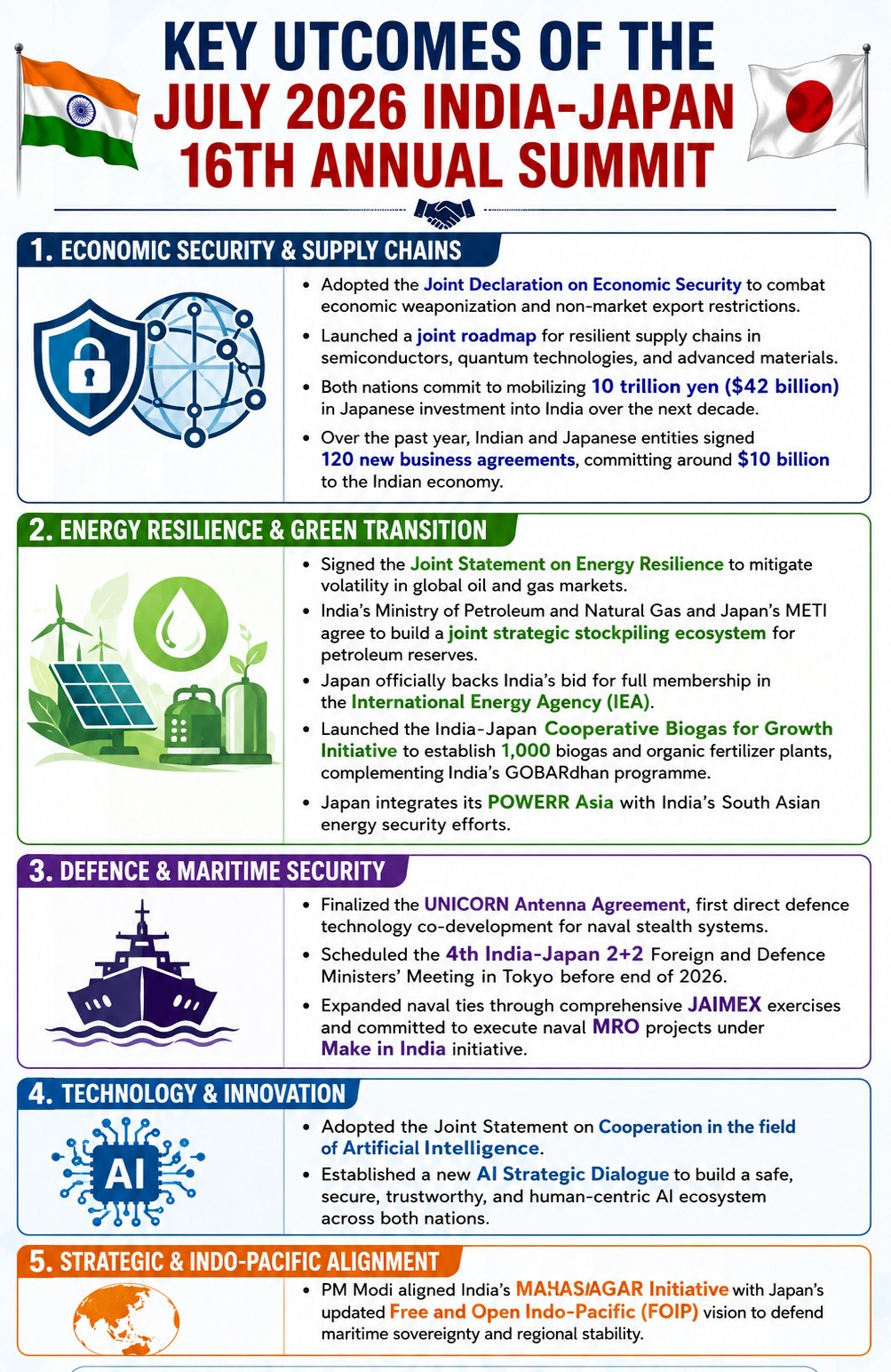
Japanese Prime Minister Sanae Takaichi’s state visit to India for the 16th India-Japan Annual Summit established a joint roadmap focusing on economic security, artificial intelligence, defense co-development, and resilient supply chains.
|
Read all about: India-Japan Strategic Partnership |
India and Japan share a Special Strategic and Global Partnership based on shared democratic values, commitment to a free and open Indo-Pacific, economic cooperation and strategic convergence.
Civilizational Links: Cultural exchange began in the 6th century A.D. through the introduction of Buddhism to Japan. The monk Bodhisena became the first documented Indian to arrive in Japan (704-760 AD).
Modern Diplomatic Ties: Established in 1952, India stood among the first nations to normalize post-WWII relations with Japan.
Partnership Evolution: The relationship evolved from a "Global Partnership" in 2000 to a "Special Strategic and Global Partnership" in 2014.
Economy and Trade: Bilateral trade reached US$ 27.47 billion in FY 2025-26, with India exporting $6.04 billion and importing $21.43 billion.
Economic Security: The nations execute joint roadmaps to strengthen supply chains in semiconductors, quantum tech, and advanced materials.
Defence and Security: The nations conduct the 2+2 Ministerial Dialogue and participate in multilateral exercises like Malabar.
Technology and Innovation: The India-Japan Digital Partnership (IJDP) focuses on trusted AI, IoT, and Next-Gen telecom.
Connectivity and Infrastructure: Japan serves as India's largest Official Development Assistance (ODA) donor, committing over JPY 8.5 trillion cumulatively for critical infrastructure.
Clean Energy and Climate Action: The India-Japan Clean Energy Partnership (CEP) drives the new Cooperative Biogas for Growth Initiative targeting 1,000 biogas plants.
Mobility and People-to-People Exchanges: Initiatives like the Specified Skilled Worker (SSW) program aim to send 50,000 skilled Indian personnel to Japan over five years.
Indo-Pacific Cooperation: India’s Indo-Pacific Oceans' Initiative (IPOI) and MAHASAGAR doctrine deeply align with Japan's updated Free and Open Indo-Pacific (FOIP) strategy.
Space Exploration: ISRO and JAXA jointly develop the Chandrayaan-5 / LUPEX (Lunar Polar Exploration) mission to study lunar volatile materials at the Moon's South Pole (Source: ISRO).
Civil Nuclear Cooperation: The 2016 Civil Nuclear Agreement allows Japan to supply nuclear technology to India, maintaining strategic trust despite India's non-NPT status.
Shared Vision for a Free and Open Indo-Pacific: Integrating India's Indian Ocean dominance with Japan's Western Pacific presence creates a credible security architecture.
Countering Supply Chain Vulnerabilities: Both nations combat economic weaponization and build resilient critical mineral supply chains to break dependency on non-market actors.
Enhancing Maritime Security: Both countries heavily depend on Sea Lines of Communication (SLOCs) passing through the Strait of Malacca and South China Sea; joint naval patrols ensure freedom of navigation.
Strengthening Economic Resilience: Japan utilizes India's young workforce to counter its aging population (29%+ above 65), merging Japanese capital with Indian human resources.
Promoting Rules-Based International Order: The partnership enforces the United Nations Convention on the Law of the Sea (UNCLOS) to prevent unilateral changes to the maritime status quo.
Supporting Regional Stability in Asia-Pacific: Japan's transparent, capacity-building ODA provides developing Asian nations a sustainable alternative to China's Belt and Road Initiative (BRI).
Global Governance Democratization: Together in the G4 grouping (with Brazil and Germany), they forcefully lobby for permanent seats and reform at the UN Security Council.
Economic and Infrastructure: The Mumbai–Ahmedabad High-Speed Rail Project utilizes Shinkansen E5 technology, while the Delhi–Mumbai Industrial Corridor (DMIC) attracts $90+ billion in investments.
FDI Status: Japan ranks fifth in FDI to India, contributing US$ 44.97 billion cumulatively since 2000.
Business Presence: 1,434 Japanese companies operate 5,200 business establishments in India.
Defence Exercises: Forces conduct Dharma Guardian (Army), JAIMEX (Navy), and Veer Guardian (Air Force) to ensure domain interoperability.
Defence Tech: The UNICORN Antenna Agreement marks the first direct defense technology co-development project.
Logistics: The Acquisition and Cross-Servicing Agreement (ACSA) permits mutual logistics support across the Indo-Pacific.
Economic Security: The Supply Chain Resilience Initiative (SCRI) integrates India, Japan, and Australia to diversify production nodes.
Northeast Connectivity: Japanese ODA funds roads, bridges, and forest management near the India-Myanmar-China tri-junction.
 What Benefits Does the India–Japan Partnership Offer?
Increased Foreign Investment: Over 81.5% of Japanese companies in India plan to expand operations within the next two years.
Technology Transfer: Secures advanced engineering standards for infrastructure (metros, freight corridors) and precision manufacturing hardware.
Infrastructure Development: Japanese concessional loans provide transparent, low-interest capital for urban transport and healthcare without debt-trap risks.
Enhanced Defence Capabilities: Access to Japanese platforms (like US-2 amphibious aircraft) and real-time maritime domain awareness strengthens India's naval deterrence.
Greater Supply Chain Resilience: Direct integration of Indian MSMEs into advanced Japanese corporate supply chains via the newly inaugurated India-Japan SME Forum.
Stronger Indo-Pacific Cooperation: Reinforces ASEAN centrality while providing a robust, non-treaty counterbalance to China's regional hegemony.
Energy Security Buffers: Japan offers technical expertise to expand India's underground crude oil stockpiles, insulating both nations from Persian Gulf supply shocks.
Trade Imbalances: Despite existing frameworks, bilateral trade hovers around $27 billion, underperforming compared to Sino-Japanese trade.
Slow Progress in Some Infrastructure Projects: Land acquisition hurdles and India-side bureaucratic delays stall mega-projects like the Mumbai-Ahmedabad High-Speed Rail.
Regional Security Uncertainties: Japan's deep integration into the US alliance system occasionally misaligns with India's multi-alignment strategy (e.g., relations with Russia).
Divergent Economic Priorities: Japanese Sanitary and Phytosanitary (SPS) standards effectively block Indian agricultural exports (seafood, poultry) from entering Japanese markets.
Competition from Other Regional Partnerships: Japan maintains $300+ billion trade exposure to China, making rapid economic decoupling highly complex.
People-to-People Deficit: Severe language barriers and cultural unfamiliarity limit grassroots connectivity, with only ~40,000 Indians residing in Japan.
Special Strategic and Global Partnership: The highest bilateral designation instituted in 2014, covering multi-domain cooperation.
Comprehensive Economic Partnership Agreement (CEPA): Enacted in 2011 to abolish tariffs on 94% of traded items over 10 years; currently undergoing modernization reviews.
India–Japan Annual Summit Mechanism: Established in 2006, guaranteeing continuous top-tier strategic coordination between Prime Ministers.
Quad Framework: A minilateral grouping (India, Japan, US, Australia) tracking public goods, vaccines, maritime domain awareness, and emerging tech.
Act East Policy: Upgraded by India in 2014, complementing Japan’s strategic footprint in Southeast Asia.
Free and Open Indo-Pacific (FOIP) Vision: A Japanese doctrine championing rules-based maritime order, heavily synchronized with India's MAHASAGAR initiative.
India-Japan Industrial Competitiveness Partnership (IJICP): Implemented in 2021 by DPIIT and METI to resolve industrial bottlenecks across 12 sectors, including logistics and textiles.
Expanding Defence Industrial Cooperation: Fast-track Make-in-India co-production of unmanned systems and fully operationalize the UNICORN defense project timeline.
Accelerating Infrastructure Projects: Enact swift single-window clearances and streamline land acquisition to meet the 2027 deadline for priority sections of the Bullet Train.
Deepening Semiconductor and Critical Minerals Collaboration: Launch joint ventures targeting rare earth processing in third-party nations to bypass non-market export restrictions.
Enhancing Academic and Skill Partnerships: Scale up the Technical Intern Training Programme (TITP) to facilitate greater cross-border mobility for Indian graduates.
Strengthening Supply Chain Resilience: Harmonize mutual recognition of standards to overcome CEPA's non-tariff and SPS barriers.
Expanding Cooperation in Emerging Technologies: Link Indian startup ecosystems directly with Japanese Venture Capital through the Japan Innovation Network (JIN).
Integrating Digital Payment Systems: Enforce domicile-portable links between India's UPI/NPCI structures and Japanese financial networks to facilitate seamless bilateral trade.
The India-Japan partnership transcends traditional diplomacy, fusing democratic values, structural economic complementarity, and formidable maritime deterrence to anchor absolute stability in the Indo-Pacific.
Source: INDIANEXPRESS
|
PRACTICE QUESTION Q. "India–Japan relations have evolved from economic cooperation to a comprehensive strategic partnership in the Indo-Pacific region." Examine. (250 Words, 15 Marks) |
Japan acts as a crucial strategic counterbalance to China, providing high-quality, transparent ODA for critical infrastructure without debt-trap risks. It shares a deep democratic alignment, robustly supports India's permanent membership bid in the UNSC via the G4, and serves as an indispensable technological partner for India's "Act East" policy.
Elevated during the 2014 summit, it is the highest bilateral designation India accords to Japan. The "Special" tag denotes an absolute absence of bilateral disputes and immense mutual trust, while "Strategic and Global" reflects comprehensive cooperation spanning defense technology, civil nuclear energy, Indo-Pacific maritime security, and global institutional reform.
The Quad operates as a flexible, non-treaty minilateral framework (with the US and Australia) that allows India and Japan to project coordinated deterrence in the Indo-Pacific. It focuses heavily on delivering public goods—such as resilient supply chains, critical technologies, and maritime domain awareness—ensuring a rules-based order without provoking NATO-style alliance anxieties.
The Mumbai–Ahmedabad High-Speed Rail Project (Bullet Train) stands as the ultimate symbol of bilateral cooperation. Financed heavily by Japanese concessional ODA and utilizing Japan's advanced Shinkansen E5 technology, the project represents unprecedented technology transfer and urban mobility transformation.
© 2026 iasgyan. All right reserved