

Copyright infringement not intended
Picture Courtesy: THEHINDU
The BRICS bloc faces internal differences and geopolitical tensions that may affect its ability to act as a unified alternative to Western-led institutions.
|
Read all about: LEGALITY OF U.S.-ISRAEL STRIKES ON IRAN l IRAN CRISIS EXPLAINED: IMPACT ON INDIA l IRAN-ISRAEL CONFLICT & IMPACT l IRAN-ISRAEL CRISIS: CHALLENGES AND WAY FORWARD FOR INDIA |
BRICS is an intergovernmental grouping of major emerging economies that serves as a platform for economic and geopolitical coordination among countries of the Global South.
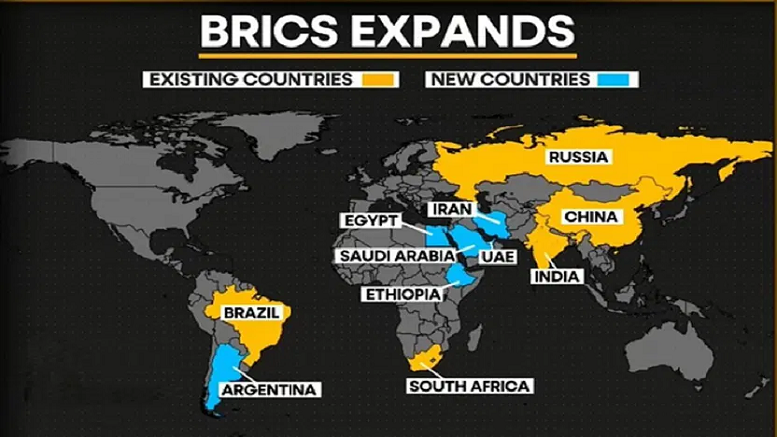 Membership
As of 2026, the group consists of 11 full member countries:
Key Functions and Goals
The bloc operates across three core pillars: Political and Security, Economic and Financial, and Cultural/People-to-People exchanges. Its primary goals include:
How is BRICS Challenging the Western-led Order?
Economic and Financial Challenges
GDP Dominance
As of 2026, the expanded BRICS+ represents more than 35% to 40% of global GDP when measured by Purchasing Power Parity (PPP), having already surpassed the G7's share (Source: Doon Defence Dreamers).
De-dollarisation Efforts
BRICS nations are reducing reliance on the U.S. dollar by increasing trade settlements in local currencies, which reached an estimated 25% of intra-bloc trade by 2025.
Alternative Financial Infrastructure
The group has launched BRICS Pay, a decentralized payment messaging system, and the BRICS Bridge to facilitate cross-border transactions outside the Western-controlled SWIFT network.
New Development Bank (NDB)
Established as an alternative to the World Bank, the NDB provides infrastructure and sustainable development funding without the political conditionalities often attached to Western loans.
Geopolitical and Resource Power
Expansion (BRICS+)
Inclusion of new members like Egypt, Ethiopia, Iran, the UAE, and Indonesia has boosted the bloc's collective weight to approximately 35-40% of global GDP (PPP) and nearly half the world's population.
Energy and Resource Dominance
With major producers like Iran and the UAE, the expanded bloc now controls over 40% of global crude oil production and has 72% of rare earths. (Source: CSIS)
Global Governance Reform
BRICS advocates for the reform of the UN Security Council and the restructuring of voting powers in international financial institutions to reflect modern geopolitical realities.
Sovereignty and Non-Interference
The bloc promotes a "non-Western" (though not always "anti-Western") model of international relations that emphasizes state sovereignty and rejects unilateral sanctions.
Strategic Expansion
The 2026 expansion cycle, led by India's presidency, expected to attract nations from Africa, Asia, and Latin America to expand strategic autonomy
Internal and External Pressures
Divergent National Interests
Members like India and Brazil prefer a balanced approach that refines rather than overturns the current order, whereas Russia and China often push for a more anti-Western stance.
Geopolitical Rivalries
Tensions between India and China, particularly over border disputes, complicate unified decision-making and long-term strategic alignment.
Western Pressure
U.S. leadership has warned that countries attempting to replace the dollar could face 100% tariffs on their trade with the United States
Lack of Structure
Unlike the EU or NATO, BRICS lacks a permanent secretariat or binding charter, which limits its operational efficiency.
Imported Regional Conflicts
Expansion has brought historical rivals into the same bloc, such as Iran and Saudi Arabia or Egypt and Ethiopia, who are locked in a hydro-political standoff over the Nile.
China's Dominance
China accounts for approximately 70% of the total BRICS GDP, leading to concerns among other members about a "China-centric" power imbalance within the grouping
Conflicting Governance Models
The bloc includes a mix of established democracies (India, Brazil, South Africa) and authoritarian states (China, Russia, Iran), making it difficult to reach a consensus on issues like human rights or global governance standards
India's strategy within BRICS is defined by its role as a "Bridge Builder", balancing its leadership of the Global South with its strategic partnerships in the West.
Core Strategy: The "RICS" Framework
Under 2026 Chairship, India has redefined the BRICS acronym to reflect four strategic pillars:
Tactical Balancing and "Non-Western" Identity
Neutrality vs. Anti-Westernism
India frames itself as a "non-Western" power, not an "anti-Western" one, to avoid alienating partners like the U.S. while still challenging Western institutional dominance.
Managing China
India uses BRICS as a diplomatic pressure point to engage China on neutral ground, seeking to resolve border standoffs and address trade imbalances while simultaneously participating in the Quad to counter Chinese maritime assertiveness.
Stance on De-dollarisation
India has rejected the proposal for a common BRICS currency, viewing it as unworkable and potentially China-centric; instead, it promotes the internationalisation of the Rupee through bilateral local-currency trade.
Financial Innovation
The Reserve Bank of India (RBI) is proposing the linkage of Central Bank Digital Currencies (CBDCs) within BRICS to facilitate cheaper cross-border trade without a radical break from the dollar.
Global South Leadership
Inclusivity: India advocates the inclusion of new members and "partner countries" from Africa and Southeast Asia to prevent BRICS from becoming a narrow Russia-China axis.
"Vishwamitra" Diplomacy: By leveraging successful G20 legacy, India seeks to act as the "sensible middle" that mediates between the G7 and BRICS to prevent global fragmentation.
BRICS, despite internal rivalries, holds the potential to reshape the global order, and India should leverage its strategic autonomy to champion an equitable, multipolar world by focusing on consensus in functional areas like the NDB, climate finance, and technology.
Source: THE HINDU
|
PRACTICE QUESTION Q. With reference to the New Development Bank (NDB) and the Contingent Reserve Arrangement (CRA), consider the following statements: 1. The New Development Bank is headquartered in Johannesburg, South Africa. 2. Unlike the World Bank's capital-share voting, all NDB founding members have equal votes. 3. The CRA is a framework for providing protection against global liquidity pressures. How many of the above statements are correct? A) Only one B) Only two C) All three D) None Answer: B Explanation: Statement 1 is incorrect: The New Development Bank (NDB) is headquartered in Shanghai, China. Johannesburg, South Africa, is the site of its Africa Regional Centre, but it is not the global headquarters. Statement 2 is correct: In the NDB's governance structure, each of the five founding members (Brazil, Russia, India, China, and South Africa) was allocated an equal number of shares and has equal voting power. This differs from the World Bank, where voting power is weighted based on capital share. Statement 3 is correct: The Contingent Reserve Arrangement (CRA) was established to provide a framework for mutual support against global liquidity pressures, specifically to help members forestall short-term balance of payments pressures and strengthen financial stability. |
Established in 2015 and headquartered in Shanghai, the NDB (often called the "BRICS Bank") provides loans for infrastructure and sustainable development. Unlike the World Bank, all founding members have equal voting power.
The main contradiction is the divergent foreign policy goals of its members. India is increasingly aligning with the U.S.-led Quad, while China and Russia are actively positioning themselves as challengers to Western dominance. This makes a unified stance on major geopolitical issues nearly impossible.
The acronym represents the five founding members: Brazil, Russia, India, China, and South Africa. The term was originally "BRIC," coined by economist Jim O’Neill in 2001 to identify the fastest-growing emerging economies.
© 2026 iasgyan. All right reserved