

Copyright infringement not intended
Picture Courtesy: csis
Context
As of early 2026, Iran is at the center of a major geopolitical crisis driven by the termination of the JCPOA, reimposed sanctions, severe domestic economic problems, and escalating regional conflicts.
The current tensions have deep historical roots, shaped by several key events over the past few decades.
1979 Islamic Revolution: Established a new government in Tehran with a strong anti-Western stance, altering Iran's relationship with the world.
Discovery of Nuclear Program: In the early 2000s, the revelation of clandestine nuclear facilities in Iran raised international alarm, leading to a series of UN sanctions.
The 2015 JCPOA (Iran Nuclear Deal): Agreement was signed between Iran and the P5+1 nations (China, France, Germany, Russia, the UK, and the US).
Under this deal, Iran agreed to strict limits on its nuclear activities in exchange for the lifting of economic sanctions.
US Withdrawal (2018): The United States unilaterally withdrew from the JCPOA and reimposed severe sanctions under a "maximum pressure" campaign designed to damage Iran's economy.
Iran's Counter-Response: In retaliation, Iran began to breach the limits set by the JCPOA, accelerating its nuclear program and heightening regional tensions.
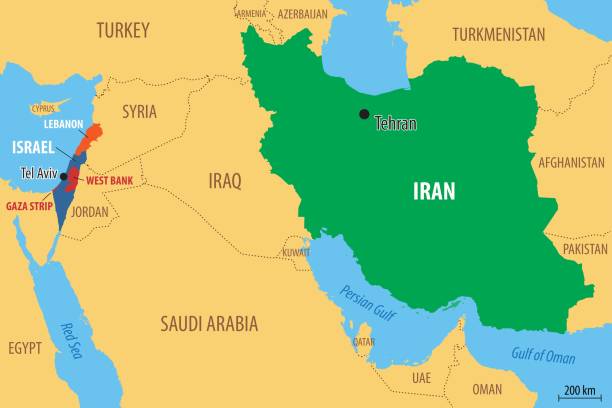 Current Status of Iran's Nuclear Program
With the collapse of diplomacy, Iran's nuclear program has advanced to a critical stage, causing concern for international security.
High-Level Uranium Enrichment: Iran has accumulated a stockpile of uranium enriched to 60% purity, which is extremely close to the 90% required for weapons-grade material.
Reduced International Monitoring: Iran has restricted the monitoring capabilities of the International Atomic Energy Agency (IAEA) by removing surveillance cameras and other equipment, making it impossible to verify the peaceful nature of Iran's nuclear activities. (Source: IAEA Report).
Formal Collapse of JCPOA: The JCPOA officially ended in October 2025. A "snapback" mechanism was triggered by European powers in September 2025, which led to the reinstatement of all previous UN sanctions against Iran.
The "Axis of Resistance"
Iran projects its influence across the Middle East through a network of allied non-state actors, which it refers to as the "Axis of Resistance."
Proxy Warfare Strategy: Iran provides financial, military, and ideological support to groups like Hezbollah in Lebanon, Houthi rebels in Yemen, and various militias in Iraq and Syria.
The long-standing "shadow war" between Iran and Israel has escalated into direct military strikes, including attacks on Iranian military and nuclear sites in mid-2025.
Case Study - Red Sea Disruptions: Attacks on commercial ships in the Red Sea by Houthi rebels have severely disrupted global trade.
Economic Collapse and Civil Unrest
Years of sanctions and internal mismanagement have led to a severe domestic crisis.
Economic Contraction
Iran's economy is forecast to grow by only 0.6% in 2025, but inflation is expected to rise to 42.4% and the jobless rate is projected to reach 9.2%, according to the IMF.
Currency Collapse & Protests
A major depreciation of the Iranian rial (trading at about 1.07 million rials per USD) sparked large nationwide protests in Iran in late December 2025.
Human Rights Crisis
Government response to protests involved severe repression, including lethal force, mass arrests, internet shutdowns, and a sharp rise in executions, drawing international condemnation.
Implications for India
Energy Security
Although India stopped importing oil from Iran due to US sanctions, regional instability threatens its energy security.
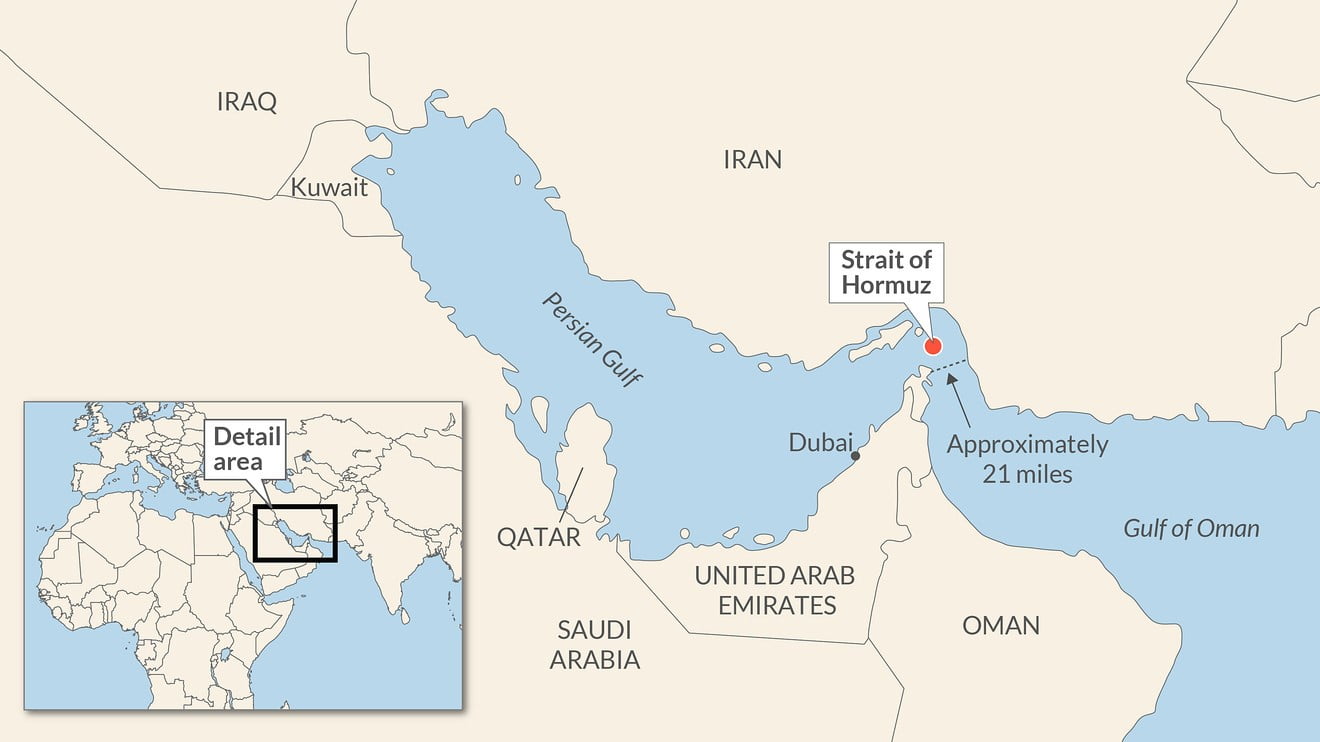
About 45% of India's crude imports come from the Middle East. Any conflict near the Strait of Hormuz, a vital chokepoint for global oil trade, could lead to severe price volatility. (Source: NUS Institute of South Asian Studies).
 Connectivity & Chabahar Port
The Chabahar Port is critical to India's strategy to bypass Pakistan and access markets in Afghanistan and Central Asia. Following the re-imposition of sanctions, the project's future is uncertain.
India's financial commitment of $120 million has been fulfilled, but a conditional US waiver for operations is set to expire, threatening its long-term viability.
Regional Balance of Power
India has viewed Iran as a strategic counterweight to Pakistan and regional extremist groups. A destabilized Iran could disrupt this balance, creating a security vacuum that benefits Pakistan and China.
Security of Indian Diaspora
The safety of the Indian diaspora in the Gulf remains a high priority for New Delhi, driven by the region's concentration of nearly 9 million Indian workers.
Resolving the Iran crisis requires a pragmatic and multi-pronged approach focused on de-escalation and diplomacy. The failure of coercive policies like sanctions highlights the need for a new strategy.
Revive Diplomacy: All parties, especially the US and Iran, must return to the negotiating table without preconditions to find a sustainable diplomatic solution.
Promote Regional Dialogue: Lasting stability must be driven by regional powers. Continued dialogue between rivals like Saudi Arabia and Iran is essential for building a collective security framework.
Leverage India's Constructive Role: With its unique position of maintaining good relations with all key players (Iran, Israel, Saudi Arabia, and the US), India can act as a diplomatic bridge to facilitate dialogue and advocate for a rules-based order.
Address Domestic Grievances: The Iranian government must address the legitimate economic and political demands of its people. Continued repression will only lead to further instability.
A stable and peaceful West Asia is vital for global security and trade, and navigating the Iran crisis requires moving beyond zero-sum thinking toward cooperative solutions.
Source: THE HINDU
|
PRACTICE QUESTION Q. "Economic distress fueled by sanctions often leads to internal political upheavals." Examine this statement in the context of the recent Iranian protests. (150 Words) |
The JCPOA, signed in 2015 between Iran and the P5+1 countries (China, France, Germany, Russia, the UK, and the US), lifted international sanctions on Iran in exchange for strict limits on its nuclear program. The deal began to unravel in 2018 when the US unilaterally withdrew and reimposed sanctions. It officially collapsed in October 2025 after Iran progressively breached nuclear limits and European powers triggered a "snapback" of UN sanctions.
Chabahar Port in Iran is crucial for India's connectivity strategy. It allows India to bypass Pakistan and gain direct access to markets in Afghanistan and Central Asia. The port is a key component of the International North-South Transport Corridor (INSTC), enhancing trade and India's regional influence. However, its long-term viability is currently at risk due to the reimposition of US sanctions.
The "Axis of Resistance" refers to a network of allied non-state actors and militias across the Middle East supported by Iran. This network includes groups like Hezbollah in Lebanon, Houthi rebels in Yemen, and various militias in Iraq and Syria. Iran uses this network to project power, challenge regional rivals like Israel and the US, and engage in "gray zone" conflicts without direct state-to-state war.
© 2026 iasgyan. All right reserved