Why In News?
Reservation effectively boosts women's numerical presence but remains an incomplete solution; long-term progress depends on converting symbolic representation into substantive influence.
What is Gender Inequality?
Gender inequality involves disparate treatment and opportunities based on gender. This structural issue results in the unequal distribution of power and resources, systematically disadvantaging women and non-binary people.
Gender Inequality In India
India ranks 131st out of 148 countries in the Global Gender Gap Report 2025, reflecting a cumulative gender parity score of 64.1%.
Economic Inequality
Political Inequality
Social and Health Inequality
Educational Attainment: Female literacy rate stands at 71.5% compared to 87.4% for males, impacting women's ability to enter the formal economy. (Source: National Family Health Survey)
Legal and Safety Issues
Despite the framework of the Constitution—which guarantees equality before the law (Article 14), prohibits discrimination (Article 15), and ensures equal opportunity (Article 16)—gender inequality persists as a "paradox of progress."
Dominance of Patriarchal Norms
Son Preference: Cultural institutions like patrilineality (inheritance through male heirs) and patrilocality (women moving to the husband's home) create a "son meta-preference," resulting in female foeticide and viewing daughters as liabilities due to dowry traditions.
Role Stereotyping: Societal norms confine women to "nurturer" roles and men to "providers." A 2025 India Today survey highlighted this disparity: 75% of Kerala respondents opposed male-led household decision-making, whereas 96% in Uttar Pradesh favored maintaining such dominance.
Gaps in Implementation and Enforcement
The "Sarpanch-Pati" Phenomenon: Despite 33–50% reservation in local bodies (Panchayats), male relatives exercise the actual power, reducing female leadership to a nominal status.
Legal Inefficiency: While laws like the Protection of Women from Domestic Violence Act and POSH Act exist, low conviction rates and delayed justice (over 2.24 lakh cases under the POCSO Act pending in courts) deter women from seeking legal help.
Normalization of Violence: Nearly one-third of women have experienced physical or sexual violence, yet many stay silent due to social stigma or fear of retaliation. (Source: WHO)
Structural Economic Invisibility
The Unpaid Care Gap: Women perform a disproportionate share of domestic work, which contributes nearly 40% to India's GDP but remains uncounted. Indian women spend an average of 299 minutes daily on unpaid care, compared to just 97 minutes for men. (Source: Time Use Survey)
Wage Disparity: Even in the formal sector, women earn 30–40% less than men for comparable roles.
Intersectionality of Marginalization
The struggle for equality is harder for women who face multiple layers of discrimination.
The "Digital and Skill" Divide
While education enrollment has reached near-parity at the primary level, the gap widens in higher education and technical fields.
Reservation is a constitutionally mandated Affirmative Action system (compensatory discrimination). It sets aside a specific percentage of seats in government employment, educational institutions, and legislatures for historically marginalized or underrepresented social groups.
The system is based on the principle of "Substantive Equality"—the idea that for equality to be real, the law must treat people differently if their starting points are unequal.
Core Objectives of Reservation
Correction of Historical Injustice: To compensate for centuries of social exclusion, economic deprivation, and systemic discrimination faced by Scheduled Castes (SCs) and Scheduled Tribes (STs) under the caste system and colonial rule
Social Justice and Equality: To fulfill the constitutional mandate of Articles 14, 15, and 16, ensuring that the state takes proactive steps to bring "backward classes" on par with the rest of society.
Ensuring Adequate Representation: To ensure that the "voice" of marginalized communities is present in the decision-making processes of the state (Legislature) and in the execution of policies (Bureaucracy).
Breaking the Monopolies of Power: To dismantle the traditional hold of certain dominant castes and classes over "white-collar" jobs and higher education, thereby democratizing the socio-economic landscape.
Economic Upliftment: By providing access to secure government employment and quality higher education, reservation serves as a tool for poverty alleviation and upward social mobility.
Types of Reservation in India
Political Reservation: Seats are reserved in the Lok Sabha and State Assemblies for SCs and STs (Article 330 & 332). Recently, the 106th Amendment introduced 33% reservation for women in these bodies.
Educational Reservation: Reserving seats in state-run and state-aided educational institutions, including IITs and IIMs.
Employment Reservation: Reserving a percentage of posts in government services and public sector undertakings.
Current Reservation Quotas (National Level)
|
Category |
Reservation Percentage |
Basis/Source |
|
Scheduled Castes (SC) |
15% |
Historical marginalization |
|
Scheduled Tribes (ST) |
7.5% |
Tribal isolation/backwardness |
|
Other Backward Classes (OBC) |
27% |
Social & Educational backwardness (Source: Mandal Commission) |
|
Economically Weaker Sections (EWS) |
10% |
Economic backwardness (Source: 103rd Amendment) |
Proxy Representation
A major hurdle is "proxy" representation, where male relatives often dominate elected women in local bodies. This reduces reservation to a symbolic gesture, leaving women with official titles but no genuine administrative authority.
Instrumentalization and Tokenism
There is a persistent risk of women being used as "political pawns" by party gatekeepers.
Intersectional Neglect
Reservation lacks an intersectional lens, benefiting only a specific subset of women.
Implementation Bottlenecks and Delays
Constitutional guarantees can be stalled by procedural requirements.
Societal and Structural Barriers
Reservation cannot legislatively erase millennia of patriarchy.
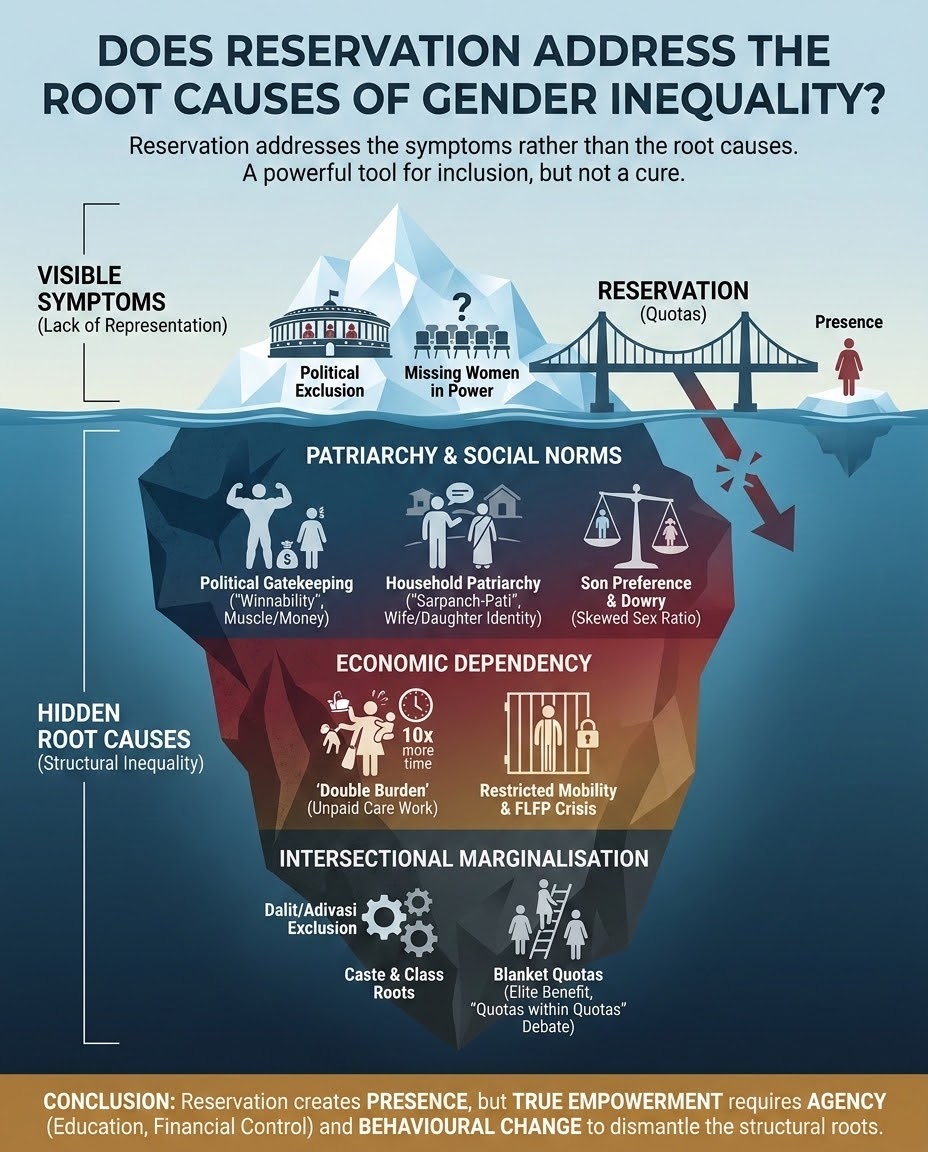 Way Forward
Eliminating the "Proxy" Culture
Administrative Training: Mandatory capacity-building programs for first-time elected women to help them understand budgeting, legal procedures, and administrative protocols, reducing their dependence on male relatives.
Ombudsman for PRIs: Establishing a dedicated grievance cell or Panchayat Ombudsman to report and penalize cases of "Sarpanch-Pati" interference.
Internal Party Reforms
Democratizing Tickets: Political parties should be incentivized or legally mandated to provide a percentage of "non-reserved" tickets to women, ensuring they are not confined only to reserved constituencies.
Gender-Balanced Leadership: Encouraging parties to appoint women to high-level decision-making committees (like the Parliamentary Board) rather than just the "Women’s Wing."
Intersectional and Inclusive Design
Quota-within-Quota: Addressing the demand for sub-quotas for OBC and minority women within the 33% reservation to prevent "elite capture" and ensure the benefits reach the most marginalized.
Rotational Policy Review: Ensuring that the rotation of reserved seats does not discourage incumbent women from building long-term constituencies and developing expertise.
Economic and Social Empowerment
Financial Autonomy: Linking political reservation with Economic Empowerment (e.g., through the National Rural Livelihoods Mission) so that women have independent financial resources to contest elections.
Care Infrastructure: Implementing a nationwide "crèche and childcare" policy to reduce the unpaid care burden, allowing women the time and energy required for high-stakes political life.
Behavioral Change
Role Model Campaigns: Using mass media to highlight successful women leaders at the grassroots, thereby normalizing female authority and shifting the electorate’s mindset.
Gender Sensitization: Mandatory training for the bureaucracy and police to treat elected women representatives with the same professional dignity as their male counterparts.
Conclusion
True gender parity in India requires a multidimensional strategy that transcends legislative quotas to integrate financial autonomy, care infrastructure, and a fundamental societal shift away from patriarchal norms.
Source: INDIANEXPRESS
|
PRACTICE QUESTION Q. Political representation is a necessary but insufficient condition for gender justice. Critically analyze. 150 words |
The Nari Shakti Vandan Adhiniyam, also known as the 106th Constitutional Amendment Act (2023), is a historic law that mandates a 33% reservation for women in the Lok Sabha and State Legislative Assemblies to enhance female representation in national and state politics.
Despite constitutional guarantees of equality, women in India face severe political underrepresentation, holding only 13.6% of seats in the 18th Lok Sabha. Reservation acts as a legally mandated form of affirmative action to correct historical injustices and ensure female perspectives are institutionalized in policymaking.
It is a form of proxy representation prevalent in local Indian governance where the husband or a male relative of an elected female representative wields the actual administrative and financial power, severely undermining the core purpose of political reservation.
© 2026 iasgyan. All right reserved