

Copyright infringement not intended
Picture Courtesy: bbs-today
The Department of Water Resources, River Development and Ganga Rejuvenation organized a workshop on "Strengthening Groundwater Management for India's Water Future".
|
Read all about: Groundwater Depletion in India l Groundwater Management in India l Groundwater Sinking Indian Cities l Groundwater Pollution in India |
High Dependency
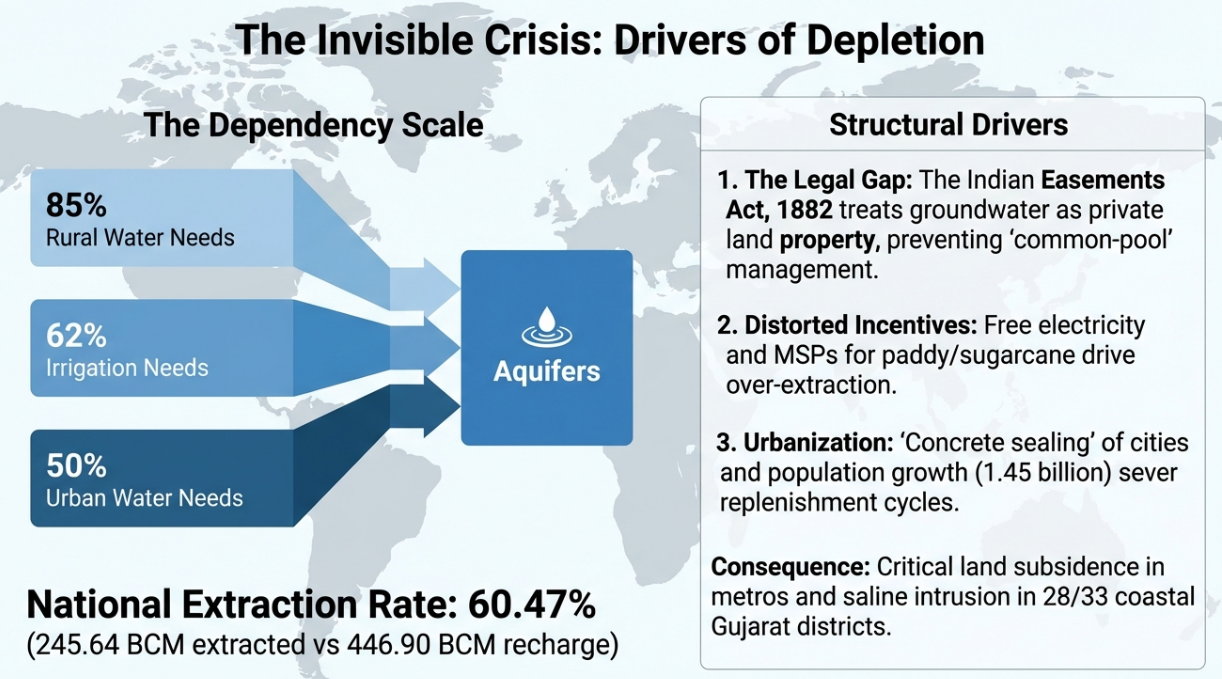
Groundwater meets nearly 62% of irrigation needs, 85% of rural water supply, and 50% of urban demand. (Source: Ministry of Jal Shakti)
 Extraction Status
The 'Dynamic Ground Water Resource Assessment Report, 2024' indicates that the annual groundwater extraction is 245.64 Billion Cubic Meters (BCM) with an overall extraction stage of 60.47%, which is deemed sustainable as it remains within the limits of replenishment.
Regional Disparities
About 11.1% of groundwater assessment units are 'Over-exploited' and an additional 3.05% are 'Critical', indicating high extraction rates concentrated in Northwest, West, and Southern India. (Source: Ground Water Resource Assessment Report)
Water Quality Crisis
A NITI Aayog report indicates that 70% of India's water is contaminated with substances like nitrates, fluoride, arsenic, and heavy metals, posing health risks.
Ensuring National Food Security
Over 95% of wheat and 65% of rice cultivation relies heavily on groundwater, and depletion could lead to a 20% reduction in winter crop harvests nationwide by 2025 and beyond. (Source: Science For All)
Preventing Public Health Crises
Widespread over-extraction has triggered geogenic contamination, with millions of people exposed to hazardous levels of arsenic and fluoride as water tables drop.
Mitigating Climate Change Impacts
As a "buffer" against erratic monsoons that provide 60% of India's recharge, sustainable aquifers are vital for long-term climate resilience.
Managing Economic Instability
Water scarcity poses a severe risk to the economy, with potential GDP losses of nearly 6% by 2050 if current depletion rates—some exceeding 100% in regions like Punjab and Rajasthan—are not reversed.
Protecting Urban Infrastructure
Excessive extraction in cities like Delhi and Chennai has led to land subsidence, damaging buildings and roads as underlying aquifers collapse.
Promoting Social Equity
Decentralized groundwater management is more equitable than large-scale canal projects, protecting the livelihoods of smallholder farmers who cannot afford to drill increasingly deeper borewells.
Fulfilling Global Commitments
Sustainable management is essential for India to meet its COP 21 climate resilience goals and the United Nations Sustainable Development Goals (SDG 6, 11, and 12).
Restoring Natural Ecosystems
Aquifers maintain base flows for rivers, streams, and wetlands; their depletion directly threatens biodiversity and causes perennial rivers to run dry during non-monsoon months.
Outdated Legal Framework
The Indian Easements Act of 1882 treats groundwater as a private commodity tied to land, which encourages over-extraction due to a lack of regulation. To reform this, the Model Groundwater Bill (2017) was proposed, but its adoption by states has been slow.
Agriculture-Energy Nexus
Subsidized or free electricity for agriculture drives over-extraction by encouraging excessive water pumping and the cultivation of water-intensive crops, leading to severe water stress in states like Punjab and Haryana.
Institutional Fragmentation
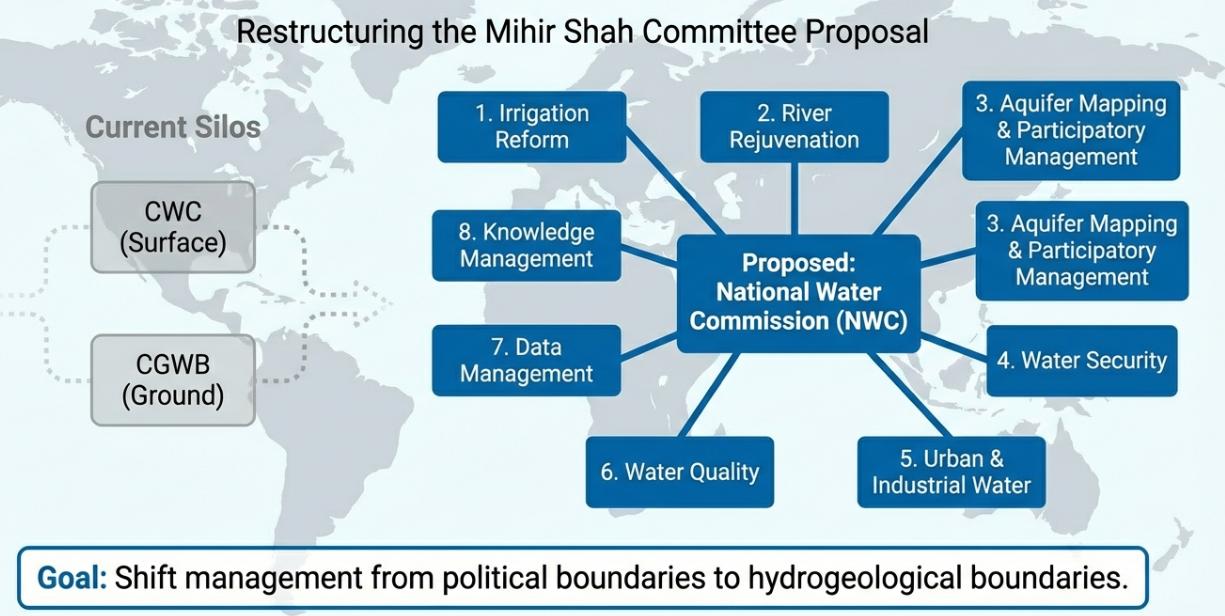
The siloed water management approach, divided between the Central Water Commission (CWC) for surface water and the Central Ground Water Board (CGWB) for groundwater, was recommended for unification into a single National Water Commission (NWC) by the Mihir Shah Committee (2016), though the NWC has not been established as of January 2026.
Widespread Contamination
Aquifer contamination stems from overuse of agricultural fertilizers and mismanagement of industrial and municipal waste, leading to chemical pollution that presents major health hazards and increases water treatment costs.
The government's approach is shifting from being supply-centric to focusing on demand-side management, scientific mapping, and community participation.
This ₹6,000 crore community-led program targets 8,565 water-stressed Gram Panchayats across seven states (Gujarat, Haryana, Karnataka, Madhya Pradesh, Maharashtra, Rajasthan, and Uttar Pradesh). It incentivizes sustainable practices like water budgeting and efficient irrigation. (Source: PIB)
Jal Shakti Abhiyan (JSA): Catch the Rain
An annual nationwide mission-mode campaign. By December 2026, it coordinated approximately 1.21 crore water conservation and artificial recharge works. (Source: PIB)
Jal Sanchay Jan Bhagidari (JSJB)
Launched in 2024 to strengthen JSA, this initiative has completed 39,60,333 artificial recharge and storage works as of January 22, 2026. (Source: PIB)
Mission Amrit Sarovar
Aims to create or rejuvenate at least 75 water bodies (ponds) in every district. As of January 2026, nearly 69,000 Amrit Sarovars have been constructed or restored.
NAQUIM 2.0
Second phase of the National Aquifer Mapping and Management Programme provides high-granularity data at the Panchayat level to guide local water management decisions.
Pradhan Mantri Krishi Sinchai Yojana (PMKSY) - Per Drop More Crop
Promotes micro-irrigation techniques to reduce groundwater extraction for farming.
Building Bye-Laws
The Ministry of Housing & Urban Affairs requires state governments to adopt regulations mandating rainwater harvesting in new constructions.
Adopt Integrated Water Governance
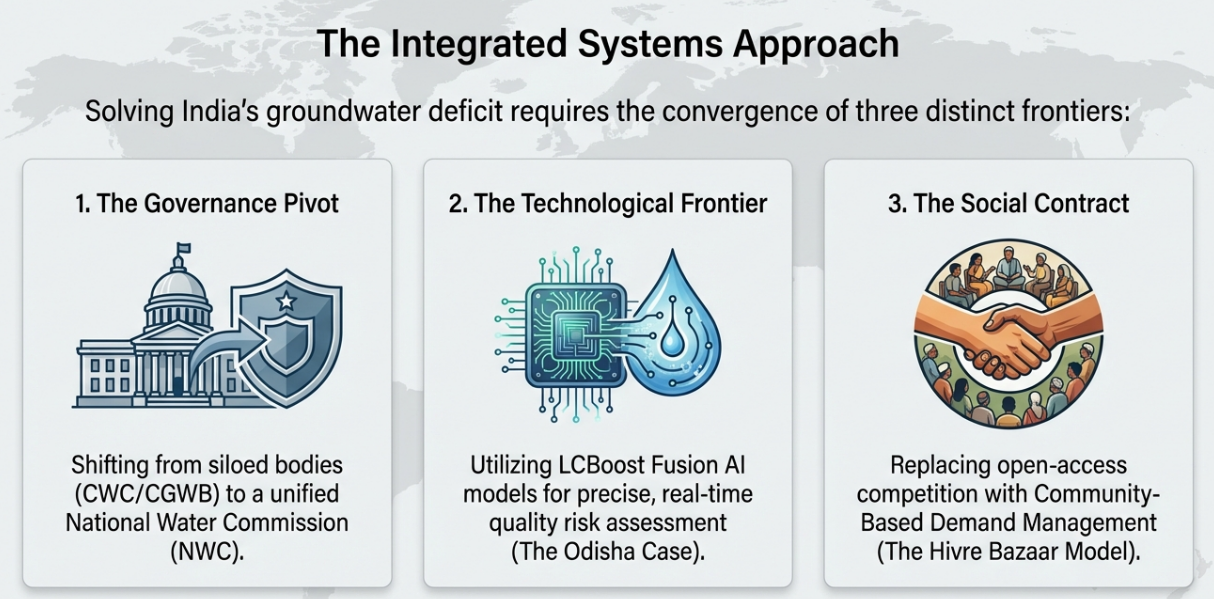
Implement the Mihir Shah Committee's recommendation to establish a unified National Water Commission for holistic management of surface and groundwater.
 Rationalize the Agriculture-Energy Nexus
Shift from electricity subsidies to models like Direct Benefit Transfers (DBT) or promote solar pumps under schemes like PM-KUSUM, to empower farmers to manage energy and water use sustainabl.
Empower Local Communities
Scale up the participatory model of Atal Jal nationwide. Legally empowering local Water User Associations to manage their resources based on scientific data can foster accountability.
Leverage Modern Technology
Utilize IoT-based sensors for real-time monitoring of groundwater levels and quality, and use AI for predictive analysis to better manage water supply and demand.
Promote a Circular Water Economy
Mandate and incentivize wastewater treatment and reuse in urban and industrial areas to reduce the demand for fresh groundwater and combat pollution.
Learn Lessons from Global Leaders
Israel: A world leader in water management, Israel uses drip irrigation for demand management and recycles over 80% of its wastewater for agricultural use, reducing pressure on freshwater sources (Source: World Bank).
Australia (Murray-Darling Basin Plan): The plan capped water extraction and established a water trading market for buying and selling water rights. This incentivizes efficient water use and allows reallocation to higher-value uses or environmental flows.
Solving groundwater crises requires an integrated, demand-focused, and community-led approach combining legal reforms, economic incentives, and technology to ensure long-term sustainability.
Source: PIB
|
PRACTICE QUESTION Q. Consider the following statements about the Atal Bhujal Yojana (ATAL JAL): 1. It is a centrally sponsored scheme implemented across all states of India. 2. It focuses on supply-side interventions like building large-scale irrigation projects. 3. It incentivizes Gram Panchayats to prepare Water Security Plans and promotes behavioral change. Which of the statements given above is/are correct? (a) 1 and 2 only (b) 3 only (c) 2 and 3 only (d) 1, 2 and 3 Answer: (b) Explanation: Statement 1 is incorrect: The Atal Bhujal Yojana is a Central Sector Scheme (100% funding from Central Government, though half is a World Bank loan which is repaid by the Central government), not a Centrally Sponsored Scheme (which has a state share). Statement 2 is incorrect: The scheme focuses on demand-side management interventions (efficient water use practices, crop diversification, etc.) rather than large-scale supply-side interventions like building large-scale irrigation projects. Statement 3 is correct: The Atal Bhujal Yojana is a community-led scheme that aims to bring about behavioral changes at the local level for sustainable groundwater management. It incentivizes Gram Panchayats to prepare and implement community-led Water Security Plans (WSPs) through a participatory process, which includes water budgeting and awareness programs. |
The Atal Bhujal Yojana is a scheme focused on improving groundwater management in seven water-stressed states. It emphasizes community participation, demand management, and behavioral change at the local level, mainly through the efforts of Gram Panchayats, shifting the focus from increasing water supply.
The 2016 Mihir Shah Committee recommended creating a unified National Water Commission (NWC) by merging the Central Water Commission (CWC) for surface water and the Central Ground Water Board (CGWB) for groundwater. The purpose of this merger is to achieve integrated and holistic water management by eliminating the current institutional divide between the two water bodies.
Environmentally, over-extraction of groundwater leads to several problems. It can reduce the base flow of rivers, harm wetland ecosystems, cause land subsidence (sinking of the ground), and lead to saltwater intrusion in coastal aquifers, contaminating freshwater sources.
© 2026 iasgyan. All right reserved