Copyright infringement not intended
Picture Courtesy: INDIAN EXPRESS
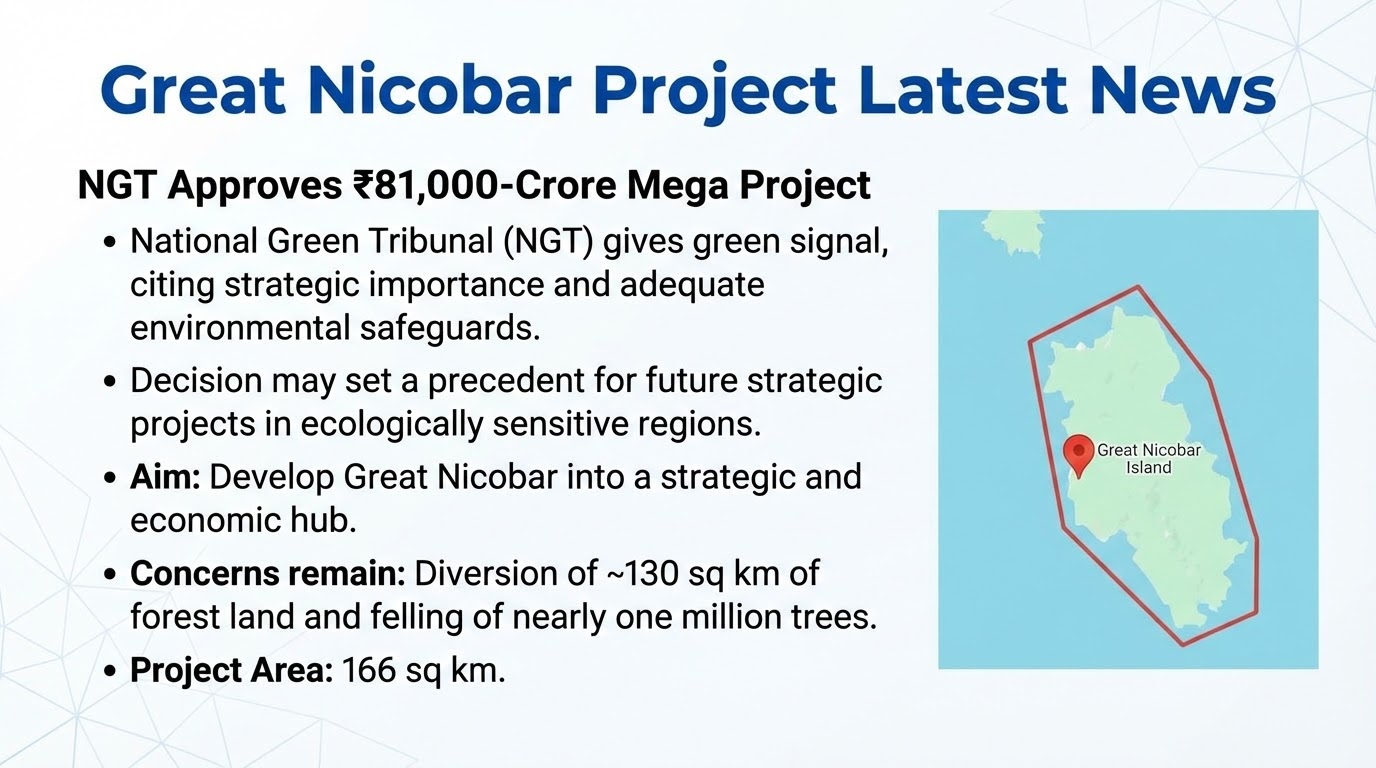
The National Green Tribunal (NGT) declined to stay the Environmental Clearance (EC) granted to the Great Nicobar Development Project.
|
Read all about: Great Nicobar Project l Greater Nicobar and Shompen Tribes l Andaman & Nicobar Islands |
It is an ₹81,000-crore mega infrastructure initiative designed to transform the island into a major global maritime, economic, and defence hub.
Initially driven by NITI Aayog, the project’s implementing agency is now the Andaman and Nicobar Island Integrated Development Corp Ltd (ANIIDCO).
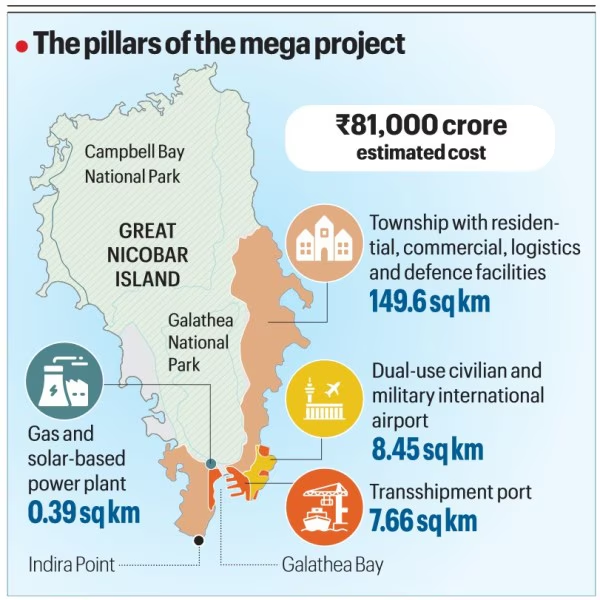
 Core Components
The project spans approximately 166 sq km (about 18% of the island) and consists of four main pillars:
 Why is this Project Strategically Vital for India?
Control over Malacca Strait
Great Nicobar's strategic location at the Malacca Strait allows India to monitor naval movements, particularly of China, as 80% of China's energy imports and 30% of global trade pass through this critical choke point. (Source: World Economic Forum)
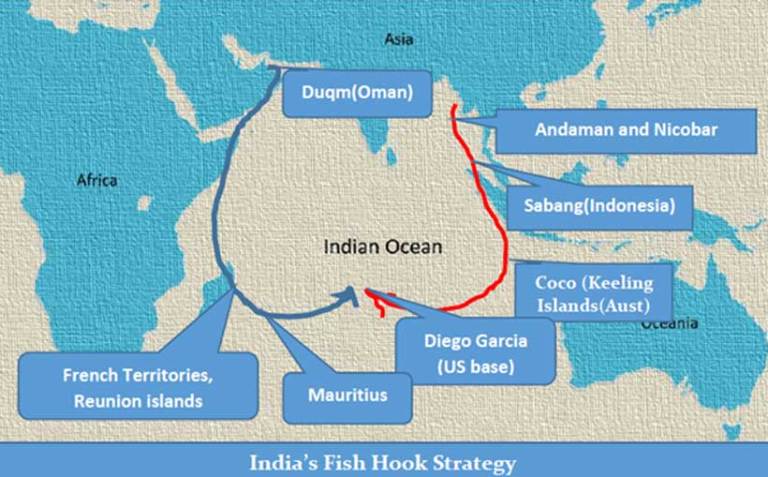
Countering China's "String of Pearls"
The project is a key part of India's "Double Fish Hook" strategy to counter China's "String of Pearls" strategy; port development in Gwadar (Pakistan), Hambantota (Sri Lanka), and Kyaukpyu (Myanmar) to encircle India..
 Economic Gains from Transshipment
The Galathea Bay port aims to capture roughly 75% of India's transshipped cargo currently handled by foreign ports like Colombo and Singapore, thereby addressing an estimated annual loss of $200-$220 million and boosting India's economy and maritime trade. (Source: Ministry of Ports)
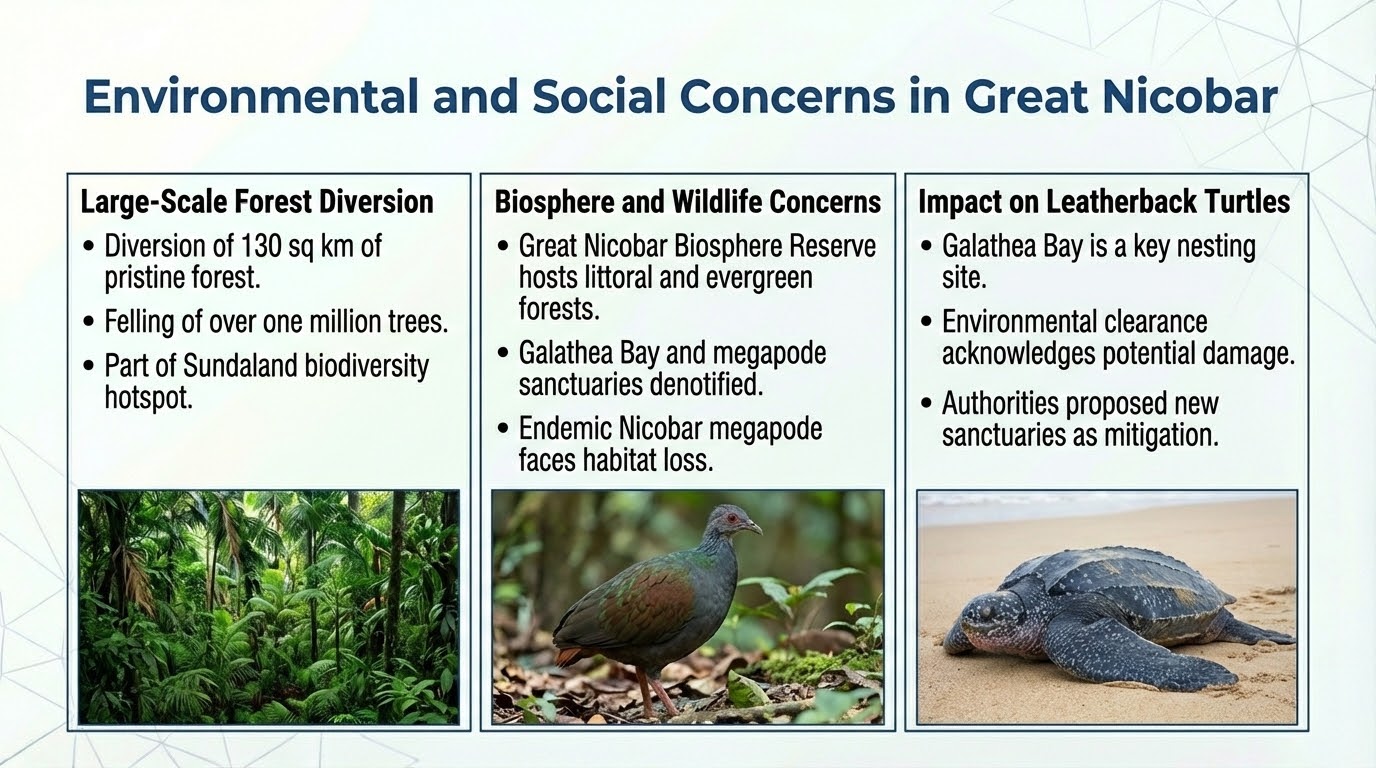
Deforestation and Biodiversity Loss
The project requires clearing 130.75 sq km of tropical rainforest, which involves felling an estimated 9.64 lakh trees (Source: Minister of State for Environment)
Threat to Endemic Species: The project poses a direct threat to unique wildlife:
 Destruction of Marine Ecosystems and Geological Risks
Coral Reefs: The sea-reclamation project will destroy vast, pristine coral reefs. The controversial coral "translocation" plan has a very low chance of success globally. (Source: IPCC Ocean Reports).
Seismic Vulnerability: Located in the seismic "Ring of Fire," the island was the 2004 Tsunami epicenter, causing the land to permanently sink by up to 4 meters (eg. Indira Point). Large-scale infrastructure construction here poses an immense disaster risk. (Source: National Centre for Seismology Data).
How Does the Project Impact Indigenous Communities?
The project's human cost is centered on the potential impact on two vulnerable tribal groups protected under the Andaman and Nicobar Islands (Protection of Aboriginal Tribes) Regulation, 1956.
The Compensatory Afforestation Controversy
The plan to compensate for dense tropical rainforest loss in Nicobar by planting trees in the arid Aravalli landscape of Haryana, thousands of kilometers away, has been widely criticized as an "ecological fallacy."
The proposal to replace a complex, biodiverse tropical rainforest with a plantation in a semi-arid zone lacks ecological equivalence. This violates the "like-with-like" replacement principle established by the Supreme Court in the T.N. Godavarman case.
Strict Oversight: The NGT-appointed High-Power Committee must enforce stringent environmental safeguards with full transparency.
Re-evaluating Project Scale: The government could consider reducing the scale of the township component to minimize the required forest diversion while prioritizing the core strategic assets (port and airfield).
Upholding Tribal Rights: The rights of the Shompen and Nicobarese, as guaranteed under the Forest Rights Act (FRA) 2006, must be protected. Their "Free, Prior, and Informed Consent" (FPIC) must be obtained genuinely, not just as a procedural formality.
Building Disaster-Resilient Infrastructure: All construction must adhere to the highest standards of seismic and tsunami resilience to mitigate the inherent geological risks of the region.
The Great Nicobar Project highlights the trade-off between national security and ecological preservation. While its strategic value is clear, the implementation needs careful reassessment.
India must balance the goal of being a "Net Security Provider" in the Indian Ocean with its responsibility to avoid becoming a "Net Ecological Destroyer" in this fragile territory.
Source: INDIAN EXPRESS
|
PRACTICE QUESTION Q. Evaluate how the Great Nicobar Holistic Development Project tests India’s ability to balance its 'Act East' policy with its global climate change commitments under the Paris Agreement. 250 words |
The project aims to develop Great Nicobar Island into a strategic and economic hub featuring an International Transshipment Terminal, a dual-use airport, a power plant, and a greenfield township to counter China's influence and capture transshipment revenue
Galathea Bay has a natural depth of 20 meters, making it suitable for docking the world's largest container ships. Its location near the Malacca Strait helps in capturing transshipment cargo currently handled by Colombo or Singapore.
The project impacts the Shompen, a Particularly Vulnerable Tribal Group (PVTG) living in isolation, and the Nicobarese, many of whom are currently living in relief settlements following the 2004 Tsunami.
© 2026 iasgyan. All right reserved