Copyright infringement not intended
Picture Courtesy: NEWSONAIR
Context
The Supreme Court highlighted the need to distinguish between 'freebies', which are populist handouts with negative economic consequences, and genuine 'welfare schemes' that empower citizens and build national capacity.
|
Read all about: FREEBIES VS PUBLIC WELFARE INVESTMENT l JUDICIAL REVIEW ON FREEBIES: WELFARE VS FISCAL PRUDENCE l FREEBIES AND WELFARE SCHEMES |
What is Freebies vs Welfare Debate?
The debate centers on distinguishing between populist freebies and legitimate welfare measures based on their objectives, design, and impact.
|
|
Freebies |
Welfare |
|
Primary Goal |
Securing immediate electoral gains through populist measures. |
Achieving long-term human and economic development. Aligned with the Directive Principles of State Policy (DPSP) |
|
Nature of Goods |
Distribution of non-merit goods (e.g., laptops, grinders) that promote private consumption without significant positive externalities. |
Provision of merit goods (education, health) and public goods (infrastructure) with strong positive externalities. |
|
Time Horizon |
Short-term, often linked to the election cycle. |
Long-term, designed for sustained impact. |
|
Economic Impact |
Consumption-oriented. Can distort markets, create a dependency culture, and lead to resource misallocation. |
Investment-oriented. Enhances productivity, creates assets, builds human capital, and boosts sustainable growth. |
|
Economic Impact |
Strains public finances, increases public debt, crowds out essential capital expenditure, can create market distortions, and a dependency culture. |
Builds human capital, boosts productivity, and reduces inequality. May require a large initial outlay but generates future tax revenue and reduces long-term social costs. |
|
Targeting |
Often universal or poorly targeted, leading to leakages. |
Generally targeted towards vulnerable and marginalized groups. |
|
Beneficiary Outcome |
Creates passive recipients and can disincentivize work. |
Empowers citizens, making them self-reliant and productive. |
|
Examples |
Universal loan waivers, untargeted electricity subsidies, distribution of free consumer goods (laptops, TVs), |
Public schools and hospitals, skill development programs, Ayushman Bharat (PM-JAY), Subsidized food grains (PDS), employment guarantee (MGNREGA), Mid-Day Meals. |
Supreme Court: Initially, in S. Subramaniam Balaji (2013), the Court viewed promises as policy, not 'corrupt practice.' Recently, the court expressed concern that irrational freebies impede national economic progress.
Election Commission of India (ECI): The Model Code of Conduct mandates funding details for party promises, but the ECI's enforcement is limited since manifestos are not legally binding and it cannot deregister parties for fiscally unsound pledges.
Finance Commission: The 16th Finance Commission urges states to maintain fiscal discipline, suggesting a cap on subsidy expenditures relative to their Gross State Domestic Product (GSDP).
Reserve Bank of India (RBI): The RBI consistently warns that competitive freebies strain state budgets, increase debt, and 'crowd out' essential capital expenditure (infrastructure, education, healthcare).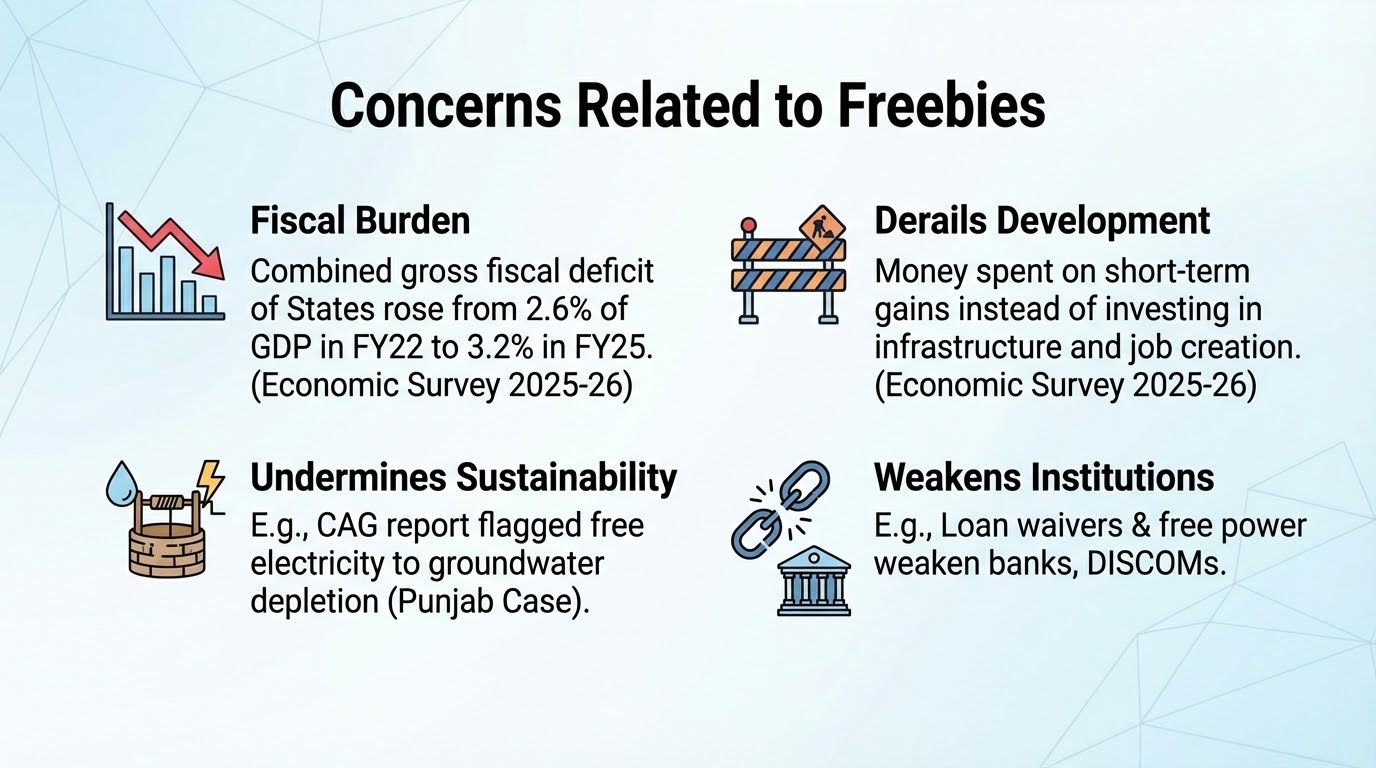
Arguments Against the 'Freebie Culture'
Fiscal Unsustainability
Unchecked freebies impose a heavy burden on state finances. The estimated cost of major poll promises could reach Rs 1.7 lakh crore in FY26, pushing the combined gross fiscal deficit of states higher. (Source: Economic Survey 2025-26)
Crowding Out Productive Capital Expenditure
Money spent on freebies often comes at the expense of investing in schools, hospitals, and infrastructure, which provide long-term growth rather than temporary, non-productive consumption.
Creation of Dependency Culture
Providing free goods and services without conditions can discourage work and self-reliance, creating a dependency culture.
Undermining Democratic Integrity
Distributing freebies is seen as a form of electoral bribery that distorts, rather than informs, voter choice by influencing them with immediate rewards.
Long-Term Economic Risks
Freebies do not address root causes of poverty, and when funded by borrowing, they pose risks of financial instability similar to crises seen in countries like Sri Lanka.
Misallocation of Resources
Freebies provide private goods (e.g., free television, grinders) rather than public goods, which do not offer significant social or developmental benefits, leading to resource wastage. 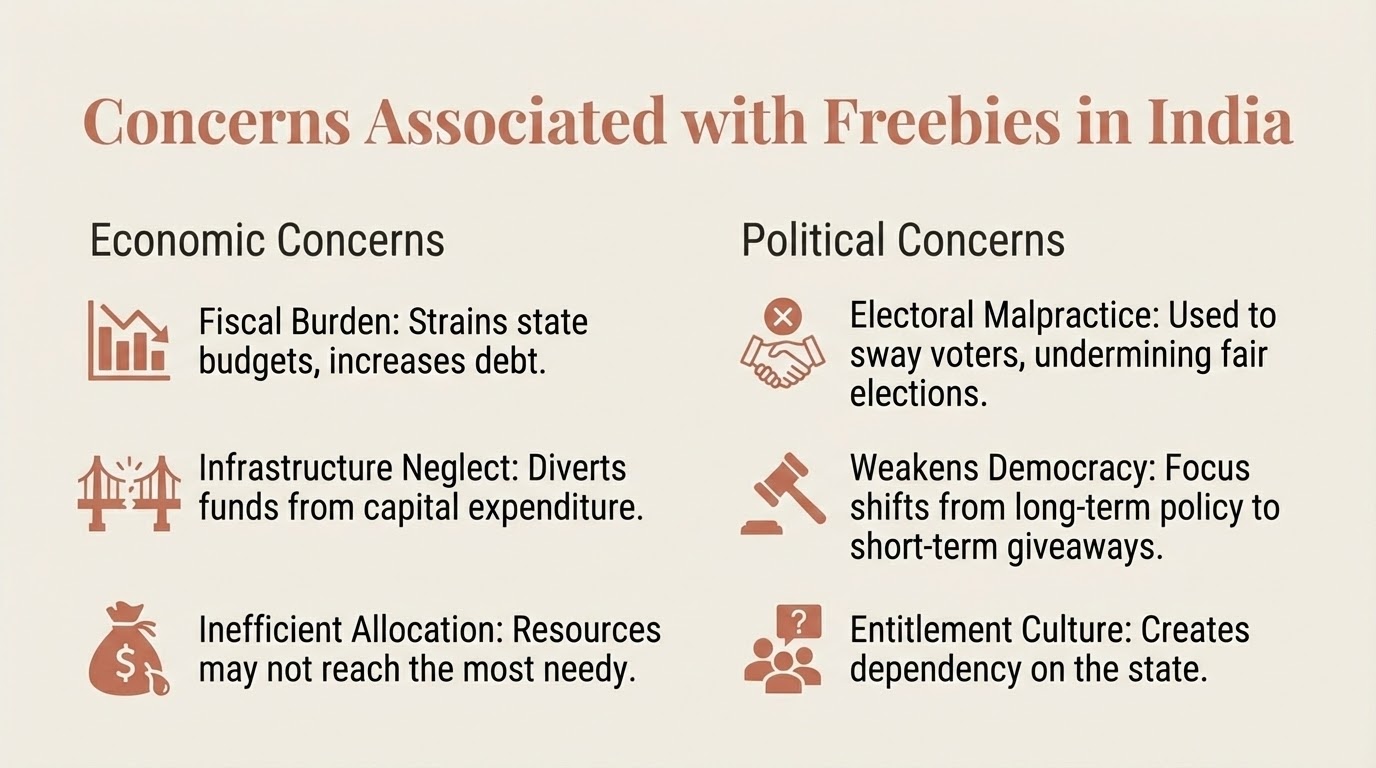 Arguments in Favour of Welfare Provisions (labelled 'Freebies')
Poverty Alleviation and Social Safety Nets
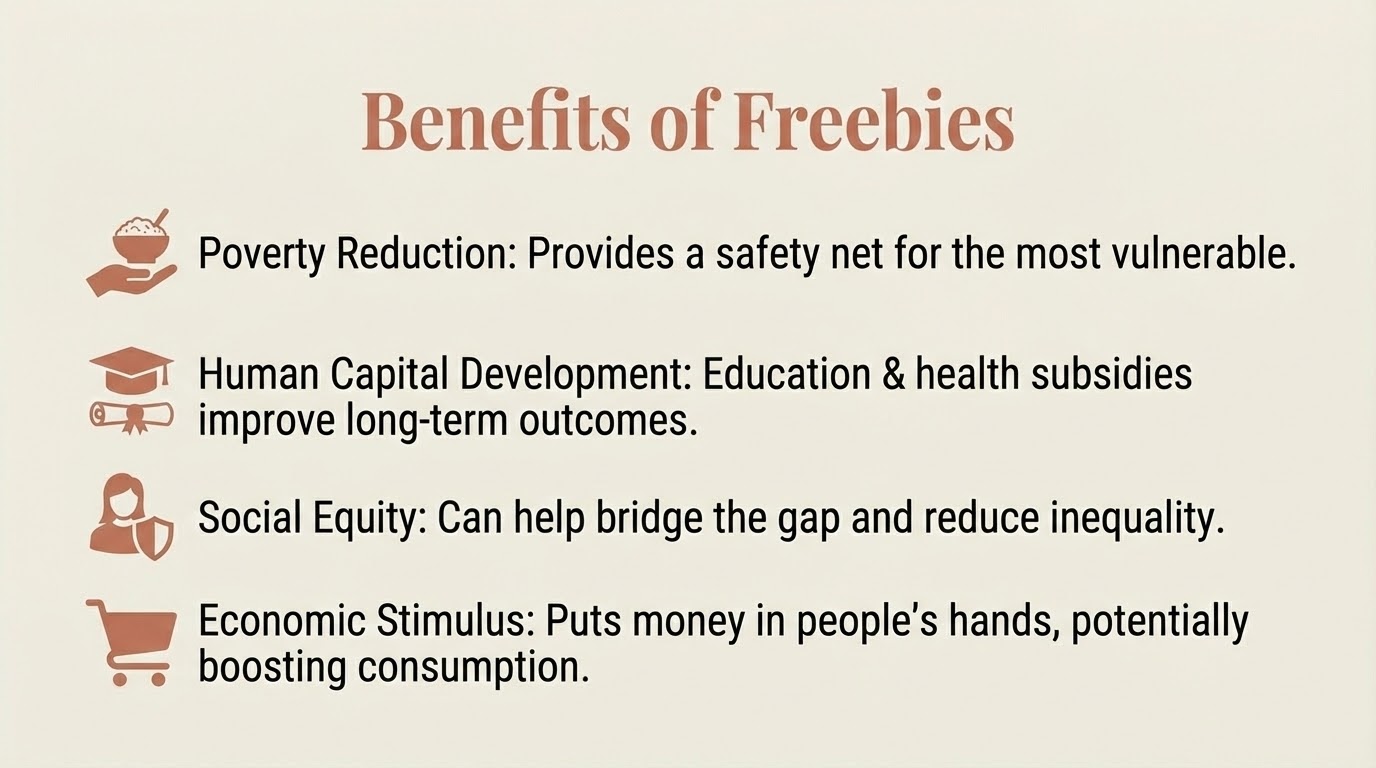
Welfare schemes provide immediate relief to low-income households, ensuring basic sustenance. Examples include food security measures (PDS, midday meals) that prevent hunger and improve nutrition for marginalized communities.
Enhancing Human Capabilities (Welfare Approach)
Drawing on Amartya Sen's "capability approach," supporters argue that free education, healthcare, and nutrition boost long-term productivity, social mobility, and dignity, going beyond mere consumption.
Empowerment of Women and Marginalized Groups
Direct cash and free/subsidized goods (e.g., bus passes, sewing machines) boost women's financial independence, decision-making power, and workforce participation.
Boosting Economic Demand and Growth
Free or subsidized basic goods (e.g., electricity, water) increase the poor's disposable income, stimulating local economies and overall consumer demand.
Educational Access and Skill Development
Items like laptops, bicycles, or smartphones bridge the digital divide and improve access to education. For example, free bicycles for schoolgirls in Bihar and West Bengal raised enrollment.
Constitutional and Moral Responsibility
Constitution mandates the government (Article 38, DPSPs) to act as a welfare state, reducing inequality and promoting social, economic, and political justice.
Increased Political Participation and Trust
Delivering tangible benefits strengthens the citizen-state connection, fostering trust, accountability, and higher voter turnout, especially among the poor.
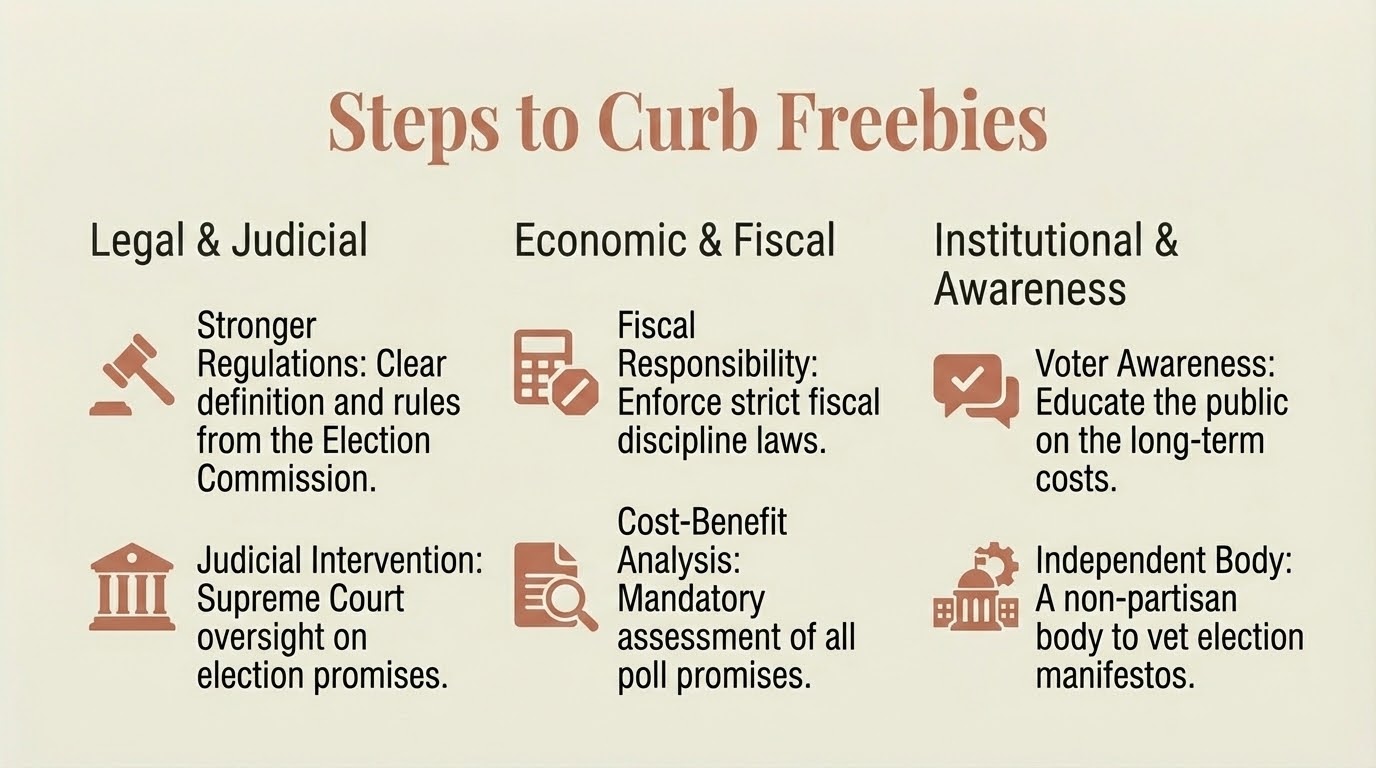
 Way Forward
Clear Distinction
Develop a clear framework to differentiate between unproductive, populist freebies and essential, life-enhancing welfare schemes based on their long-term impact on human capital and economic productivity.
Strengthening Fiscal Discipline
The Fiscal Responsibility and Budget Management (FRBM) Act should be strengthened. Subsidy schemes should have 'sunset clauses' for periodic review and evaluation.
Promoting Conditional Transfers
Shift towards Conditional Cash Transfers (CCTs), as seen in global models like Mexico's 'Progresa' and Brazil's 'Bolsa Familia'. This links financial aid to positive actions like school attendance or health check-ups, thereby building human capital
Targeted Delivery
Utilize the JAN DHAN-AADHAAR-MOBILE (JAM) TRINITY for Direct Benefit Transfers (DBT) to reduce leakage and ensure aid reaches only the needy, avoiding universal, indiscriminate handouts.
Outcome-Based Budgeting
Shift from simply allocating funds to tracking the long-term impact of schemes on education, health, and skill development.
Enhanced Voter Awareness
Civil society and the media must play a role in educating voters about the opportunity cost of freebies and the importance of sustainable fiscal management for long-term prosperity.
Legal and Institutional Reforms
Strengthen the ECI's powers to enforce fiscal transparency in election manifestos and consider amendments to the Representation of the People Act, 1951 to address the undue influence of irrational promises.
 Conclusion
Welfare must be sustainable, targeted, and empowering, not a choice over fiscal discipline. The focus should shift from dependency-creating freebies to capability-building. All stakeholders—judiciary, legislature, ECI, and the electorate—must collaborate for a compassionate and economically resilient welfare state.
Source: NEWSONAIR
|
PRACTICE QUESTION Q. How does the prioritization of 'Non-Merit Goods' over Capital Expenditure (Capex) hinder India's goal of becoming a $5 Trillion economy? |
Welfare (Merit Goods) refers to expenditure on essential services like education, health, and nutrition (PDS) that build human capital and fulfill constitutional obligations under Articles 38 and 47. Freebies (Non-Merit Goods) are defined as unviable, universal handouts (like free consumer goods or electricity) given primarily for electoral gains without long-term economic benefits.
In this case, the Supreme Court ruled that promises made in an election manifesto do not constitute "corrupt practices" under the Representation of the People Act, 1951. The Court held that the distribution of largesse is a policy decision rooted in the Directive Principles of State Policy.
Freebies, such as free electricity, severely impact the power sector because state governments often fail to reimburse Distribution Companies (DISCOMs) for the costs. This leads to massive accumulated losses (e.g., TANGEDCO's ₹1.5 lakh crore loss) and creates outstanding dues to power generation companies, threatening the banking sector with Non-Performing Assets (NPAs).
© 2026 iasgyan. All right reserved