

The Bombay High Court ruled that statutory obligations (like pensions) must be given legal and fiscal priority over discretionary populist schemes like Mukhyamantri Majhi Ladki Bahin Yojana.
|
Read all about: FREEBIES CULTURE HAMPERS INDIA'S ECONOMIC DEVELOPMENT l SUPREME COURT QUESTIONS FREEBIES l BALANCING EMPOWERMENT WITH ECONOMICS: RISING FREEBIES l ABOUT FREEBIES AND WELFARE SCHEMES |
Maharashtra Government launched the Mukhyamantri Majhi Ladki Bahin Yojana in 2024 to provide ₹1,500 monthly to eligible women aged 21-65 from economically weaker backgrounds.
The controversy revolves around financial strain on the state exchequer and widespread enrollment of ineligible beneficiaries.
In April 2026, the Bombay High Court questioned the scheme's financial sustainability, criticizing the state for prioritizing large-scale cash transfers over critical obligations like salaries and pensions.
Mitigating Economic Shocks: Governments expand safety nets as shock absorbers for the informal sector, which comprises over 90% of the workforce and lacks benefits.
Enabling "Rights-Based" Entitlements: Shift from discretionary charity to legally enforceable rights, making reversals politically and legally challenging.
Leveraging Digital Public Infrastructure (DPI): Digital tools have lowered delivery costs and leakages, enabling fiscally viable, broad-based cash transfer expansion.
Managing "Transient" Poverty: Because Indian poverty is fluid, with families cycling in and out due to shocks, safety nets must reach beyond the chronically poor.
Encouraging Economic Reform: Safety nets mitigate the immediate impact of structural shifts.
 How Fiscal Responsibility Comes Into Conflict with Welfare Scheme?
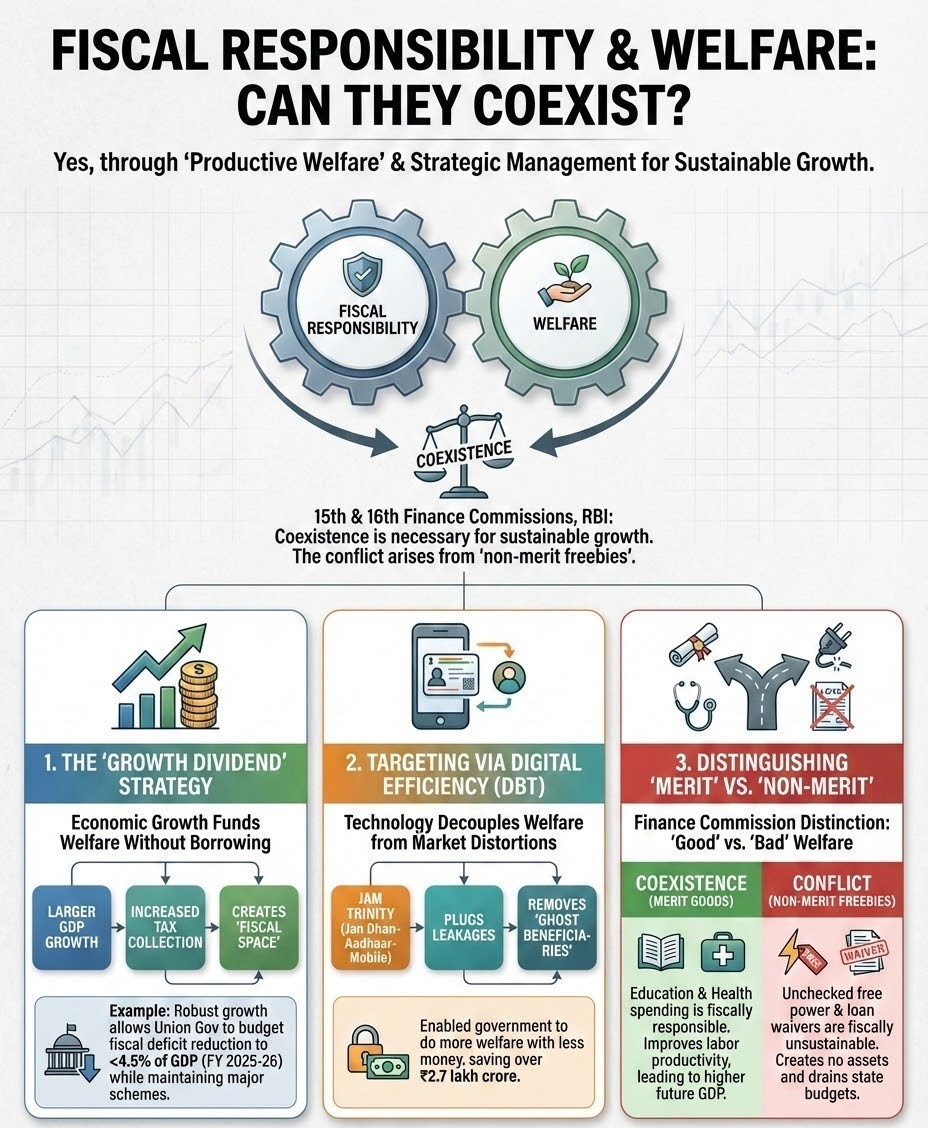
"Crowding Out" of Capital Expenditure: Fiscal responsibility dictates investing in income-generating assets, whereas welfare is classified as consumption-oriented revenue expenditure.
Rising Debt and Interest: Fiscal prudence requires a stable debt-to-GDP ratio. Unfunded welfare schemes increase borrowing requirements.
Inflationary Pressure: Fiscal prudence maintains low inflation, but massive welfare payouts expand money supply without increasing production.
Economic and Resource Impacts: Fiscal prudence supports market efficiency, whereas some welfare initiatives risk resource misallocation.
FRBM Target Violations: The Fiscal Responsibility and Budget Management (FRBM) Act mandates borrowing limits, a 3% Fiscal Deficit cap for states.
 Way Forward
Legal Distinction between "Merit" and "Freebie": Governments must legally separate "merit goods" (health, education) from "private transfers" like cash for votes.
The "Asset-Creation" Mandate: Shift welfare from pure consumption to asset creation.
Sunset Clauses for Subsidies: Welfare schemes should be finite.
Fiscal Federalism: Improve accountability by decentralizing welfare delivery to local bodies.
Dynamic Beneficiary Lists: Adopt dynamic data to exclude the "newly rich."
 Conclusion
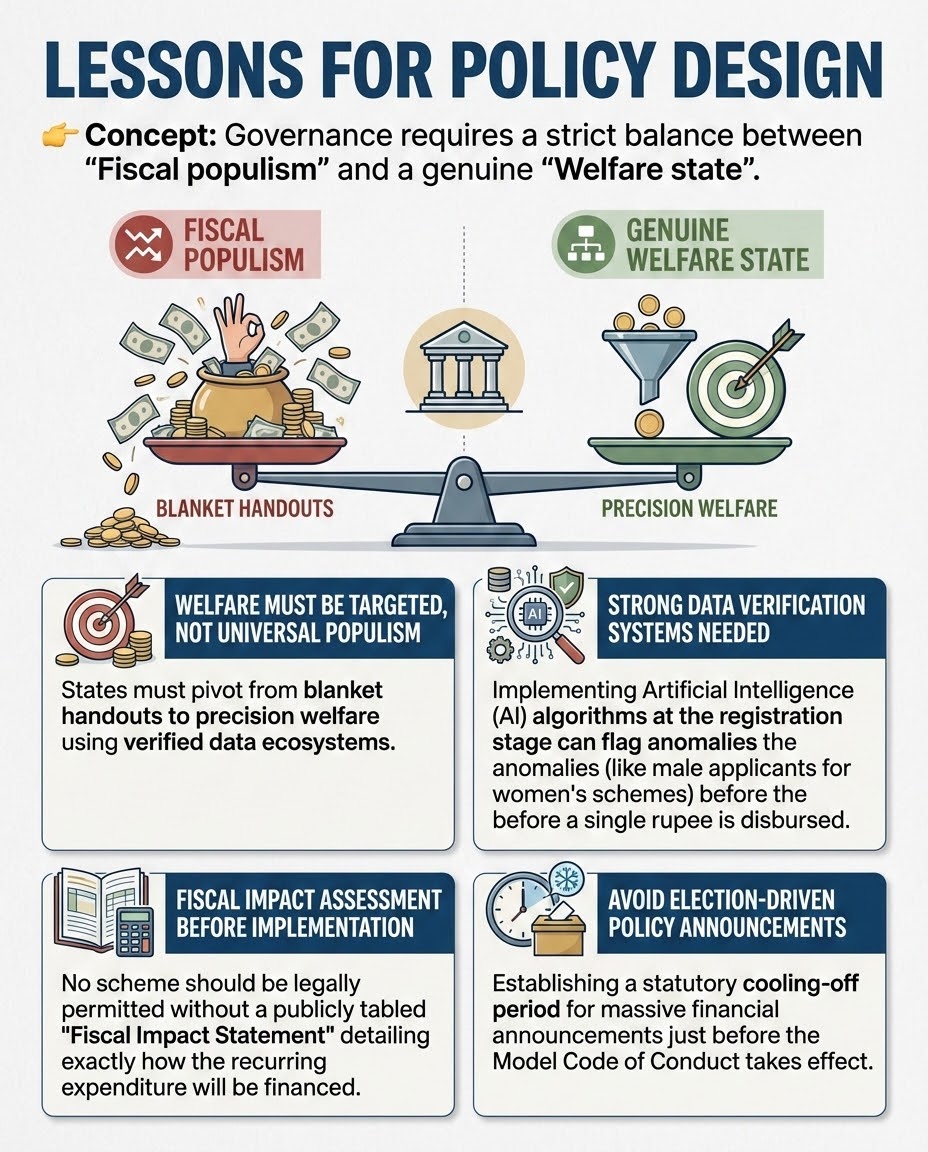
Welfare and fiscal discipline must coexist through precise targeting and robust data architecture. The Ladki Bahin controversy proves that leaks, not intent, threaten sustainability. Success requires replacing political misuse with rigorous fiscal planning to ensure justice for the truly needy
Source: THE HINDU
|
PRACTICE QUESTION Q. "The expansion of social safety nets through direct cash transfers often blurs the line between welfarism and competitive populism." Critically analyze, 150 words |
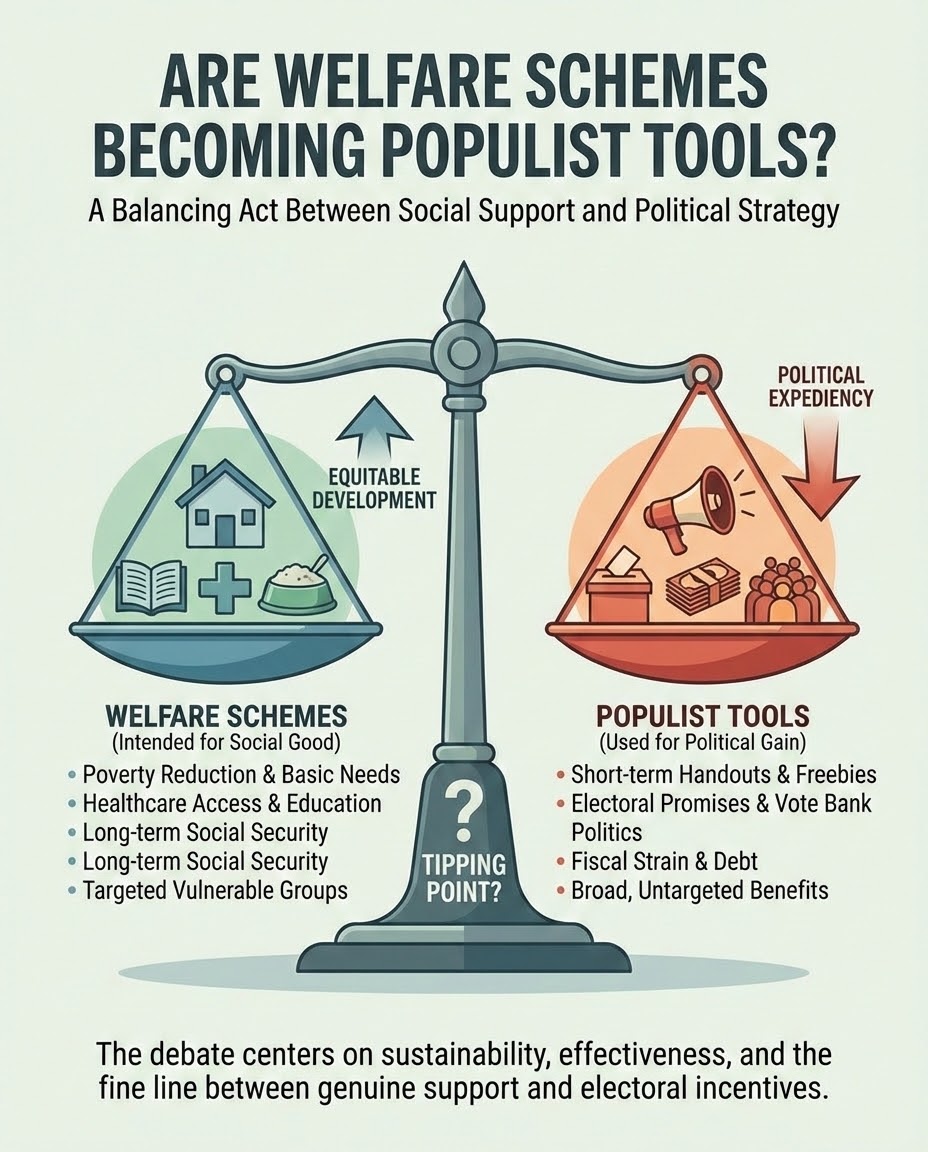
The debate centers on the distinction between productive welfare schemes (like health, education, and MGNREGA asset creation) and politically motivated 'freebies' (like irrational cash handouts). Genuine welfare aims at long-term poverty alleviation and capacity building, while freebies often act as short-term voter inducements that severely strain state finances.
It is a welfare scheme launched by the Maharashtra government providing a direct cash transfer of ₹1,500 per month to eligible women aged 21-65 years from families with an annual income below ₹2.5 lakh.
Unfunded cash transfers and subsidies rapidly increase a state's fiscal deficit and public debt. They often "crowd out" productive capital expenditure—meaning governments have less money to spend on critical infrastructure, health, and education—pushing the state into a long-term debt trap where future generations pay for today's consumption.
© 2026 iasgyan. All right reserved