The World Health Organization identifies climate change as the 21st century's greatest public health threat, as rising temperatures and extreme weather disrupt disease patterns, nutrition, and global livelihoods.
|
Read all about: INDIA'S CLIMATE CRISIS AND THE PATH FORWARD l CLIMATE CHANGE AND HEALTH l INDIA IS WARMING FAST l CLEAN ENERGY AND CLIMATE FINANCE l GLOBAL CLIMATE ACTION |
Climate change refers to long-term shifts in temperatures and weather patterns.
Mechanism: Burning fossil fuels releases greenhouse gases (such as carbon dioxide and methane) that act like a blanket wrapped around the Earth, trapping the sun's heat and raising global temperatures
Current State: The world is warming faster now than at any point in recorded history. The last decade (2015–2024) was the warmest on record, with the average global temperature reaching approximately 1.45°C above pre-industrial levels in 2023. (Source: WMO)
Major health organizations, including the WHO, have declared climate change a "health emergency" because it threatens the fundamental pillars of human health: clean air, safe drinking water, nutritious food supply, and safe shelter.
Direct Physical Trauma & Mortality
Extreme Heat: Heat stress is a leading cause of weather-related death. Between 2000 and 2019, approximately 489,000 heat-related deaths occurred annually worldwide. (Source: WHO).
Natural Disasters: The frequency and intensity of floods, storms, and wildfires are increasing.
Spread of Infectious Diseases
Vector-borne Diseases: Warmer temperatures expand the habitat range of mosquitoes and ticks.
Waterborne Illness: Heavy rainfall and flooding contaminate water supplies, increasing the risk of diseases like cholera, typhoid, and leptospirosis.
Air Quality and Respiratory Health
Pollution: Climate change increases ground-level ozone and particulate matter. In 2021, deaths attributable to PM2.5 from fossil fuel combustion stood at over 2 million globally. (Source: Lancet)
Allergens: Higher temperatures and CO2 levels trigger longer pollen seasons and higher pollen concentrations, worsening asthma and allergies.
Food and Water Insecurity
Malnutrition: Extreme weather events like droughts and floods disrupt food production.
Nutrient Decline: Rising CO2 levels lower the nutritional value (zinc, iron, and protein) of staple crops like rice and wheat.
Mental Health Crisis
Climate change is a driver of mental health disorders, ranging from "eco-anxiety" to trauma experienced by populations displaced by disasters.
Disproportionate Impact (Equity)
Those who contribute the least to greenhouse gas emissions—such as children, the elderly, and populations in low-income countries—bear the brunt of the health impacts.
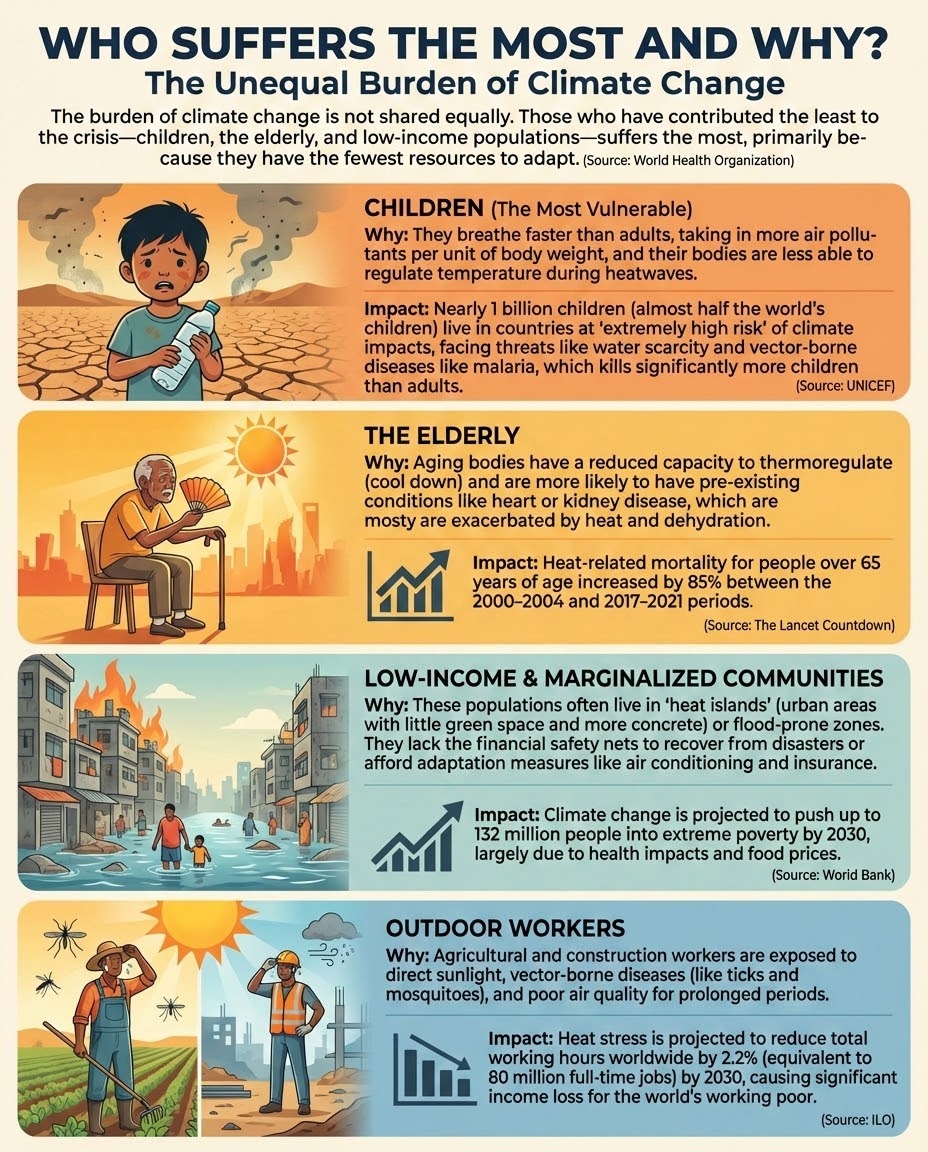 Why does India face a higher risk?
India is frequently termed a "climate vulnerability hotspot" because it faces a unique convergence of geographic hazards, high population density, and economic reliance on climate-sensitive sectors.
According to the Germanwatch Climate Risk Index 2026, India ranks as the 9th most affected country globally by extreme weather events between 1995 and 2024.
Coastal Vulnerability: With a coastline of over 7,500 km, densely populated cities like Mumbai, Kolkata, and Chennai are on the frontlines of sea-level rise and intensifying cyclones.
Himalayan Meltdown: The Himalayas, the "Third Pole," are warming at a rate higher than the global average.
Monsoon Dependence: Indian agriculture, which employs nearly half the workforce, is heavily rain-fed.
Despite ambitious targets like achieving net-zero emissions by 2070, several structural barriers hinder India's ability to adapt effectively.
The "Finance Gap"
Scale of Need: Developing countries like India need more funding for adaptation (building sea walls, changing crops) than is currently available.
Debt vs Grants: Much of the climate finance comes as loans rather than grants, pushing developing nations further into debt to pay for a crisis they contributed least to.
Infrastructure & Health Systems
Urban Heat Islands: Rapid, unplanned urbanization has replaced green cover with concrete, creating "heat islands" where cities are hotter than surrounding areas.
Weak Surveillance: There is a lack of comprehensive, local-level data linking specific climate events to health outcomes, which limits the ability of health systems to prepare for outbreaks of diseases like dengue or cholera.
Governance & Coordination
Siloed Approach: Climate action is viewed as the sole responsibility of the Ministry of Environment, whereas it requires deep coordination across ministries like Health, Urban Development, and Agriculture.
To bridge the gap between "ambition" and "survival," the response must shift from a purely environmental approach to a public health and safety imperative.
Integrate Health into All Climate Policies
Every climate investment—whether in transport, housing, or energy—must be evaluated for its health impact. For example, urban planning should prioritize "cool roofs" and green corridors not just to save energy, but explicitly to reduce heatstroke mortality.
Establish a real-time "Climate-Health Surveillance System" that links meteorological data (heat/rain) with hospital admission data to predict and prepare for outbreaks of dengue, malaria, or heat stress.
Secure "Grant-Based" Adaptation Finance
India and the Global South must push for the New Collective Quantified Goal (NCQG) on climate finance to focus on grants rather than loans.
Currently, 58% of adaptation finance comes as debt, forcing nations to pay interest on money borrowed to survive a crisis they did not cause. Replacing this with grants prevents a "climate debt trap". (Source: UNEP)
Localized "Heat Action Plans" (HAPs)
Move beyond generic advisories to "hyper-local" HAPs. This includes triggering early warning systems based on Wet-Bulb Global Temperature (which accounts for humidity) rather than just dry heat, as humidity is the key driver of mortality in India.
Legally mandate "heat breaks" and cool water availability for outdoor laborers (construction, agriculture) during peak hours.
Accelerate "Just" Energy Transition
While expanding solar, India must actively plan for the phase-down of coal without destroying the livelihoods of millions in coal-dependent states like Jharkhand and Odisha.
Invest in battery storage and grid modernization to ensure that renewable energy can actually replace coal power during night peaks, rather than just supplementing it (Source: Climate Action Tracker).
To ensure a liveable future, India must transition from a mitigation-focused strategy to one that treats climate adaptation as a public health priority, securing non-debt financing and resilient infrastructure to protect its most vulnerable populations from escalating environmental threats.
Source: THE HINDU
|
PRACTICE QUESTION Q. Climate change is shifting from an environmental challenge to a complex public health emergency in India. Discuss. 150 words |
In the M.K. Ranjitsinh vs Union of India (2024) case, the Supreme Court of India recognized the right to be free from the adverse effects of climate change as a distinct fundamental right. It is anchored in Article 14 (Right to Equality) and Article 21 (Right to Life), establishing that a clean, stable environment is a prerequisite for human health and survival.
According to the Lancet Countdown Report, extreme heat and humidity caused India to lose a staggering 247 billion potential labor hours in 2024. This physiological inability to perform outdoor labor wiped out an estimated $194 billion in potential income, severely impacting the national GDP and low-income workers.
The Urban Heat Island effect occurs when urban centers experience significantly warmer temperatures than surrounding rural areas. This is caused by dense concrete infrastructure and a drastic loss of green spaces (tree cover). It traps heat and air pollutants, eliminating the cooler night-time temperatures needed for the human body to recover, leading to severe dehydration and heatstroke.
© 2026 iasgyan. All right reserved