

Copyright infringement not intended
Picture Courtesy: blogs.iiit.ac
Artificial Intelligence (AI) in rural India is transforming age-old structural deficits into digital dividends, turning the 'Last Mile' into the 'First Mile' of the nation’s technological revolution.
|
Read all about: Artificial Intelligence In India Explained l AI Leadership in Global South l Sarvam AI: Sovereign AI For India |
AI is transforming rural sectors into data-driven, resilient ecosystems by treating the technology as a digital public good for inclusive development.
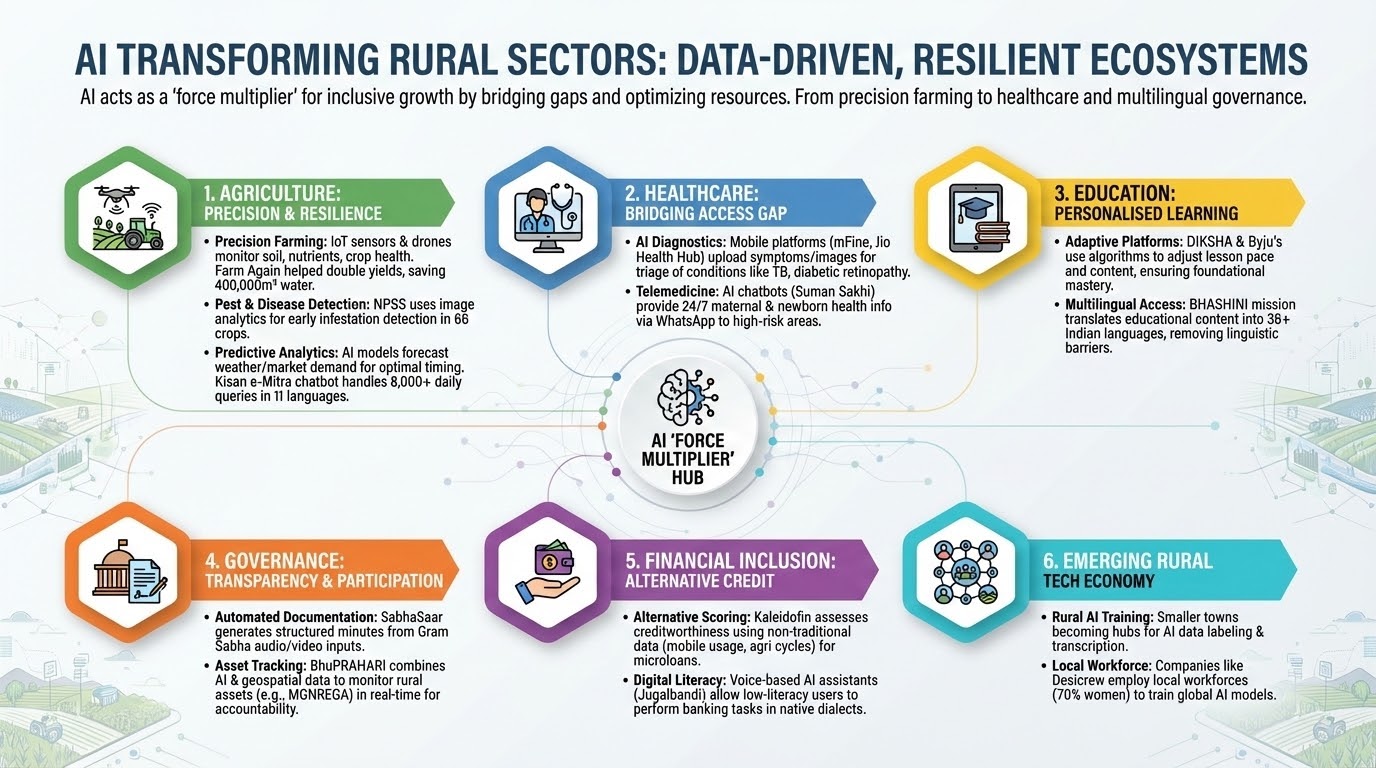 Agriculture: The "Data-Driven" Revolution
AI is shifting farming from a risk-prone livelihood to a precise, data-driven enterprise.
Precision Farming: Using satellite imagery, IoT sensors, and drones, AI monitors soil moisture, nutrient levels, and crop health in real-time.
Early Detection: Systems like the National Pest Surveillance System (NPSS) use image analytics to detect pest infestations and diseases early.
Climate Resilience: AI-powered predictive analytics provide hyper-local weather forecasts and monsoon onset alerts, helping farmers decide the optimal time for sowing and irrigation.
Market & Price Discovery: AI analyzes demand-supply trends to help farmers achieve better price realization and reduce distress-driven sales.
Healthcare: Bridging the Accessibility Gap
In areas with limited physical infrastructure, AI-enabled services extend the reach of specialists.
AI Diagnostics: Tools are used for remote screening of diseases like tuberculosis, diabetic retinopathy, and cancer by analyzing medical images with high precision.
Virtual Assistance: Multilingual, AI-powered chatbots like the Suman Sakhi provide maternal and newborn health information directly to rural families.
Predictive Health: Analytics help forecast disease outbreaks (e.g., malaria or dengue) by monitoring symptom trends and environmental data.
Education & Skilling: Personalized Learning
AI addresses teacher shortages and resource gaps through digital platforms.
Adaptive Learning: Platforms like DIKSHA use AI to personalize educational content based on a student's pace and learning level.
Vocational Training: AI-driven tools provide skill-based training in local languages, preparing rural youth for the digital economy.
Interactive Tools: Augmented Reality (AR) and Virtual Reality (VR) are used to make complex subjects like science and history more engaging in rural classrooms.
Governance: Decentralized & Transparent Administration
AI is being integrated into local bodies (like Panchayats) to streamline public service delivery.
Automated Documentation: Tools like SabhaSaar generate structured minutes of village meetings from audio/video inputs in multiple languages.
Asset Management: Platforms like BhuPRAHARI use geospatial AI to track and monitor assets created under rural employment schemes (e.g., MGNREGA).
Linguistic Inclusion: Platforms such as BHASHINI remove language barriers by providing voice-based interfaces for government services in over 36 Indian languages.
Financial Inclusion: Alternative Credit Scoring
AI is enabling formal credit for those without traditional banking histories.
Micro-lending: AI models assess creditworthiness based on non-traditional data like mobile usage patterns and agricultural cycles.
Financial Literacy: AI-driven chatbots in native languages assist rural populations in managing expenses and learning about government welfare schemes.
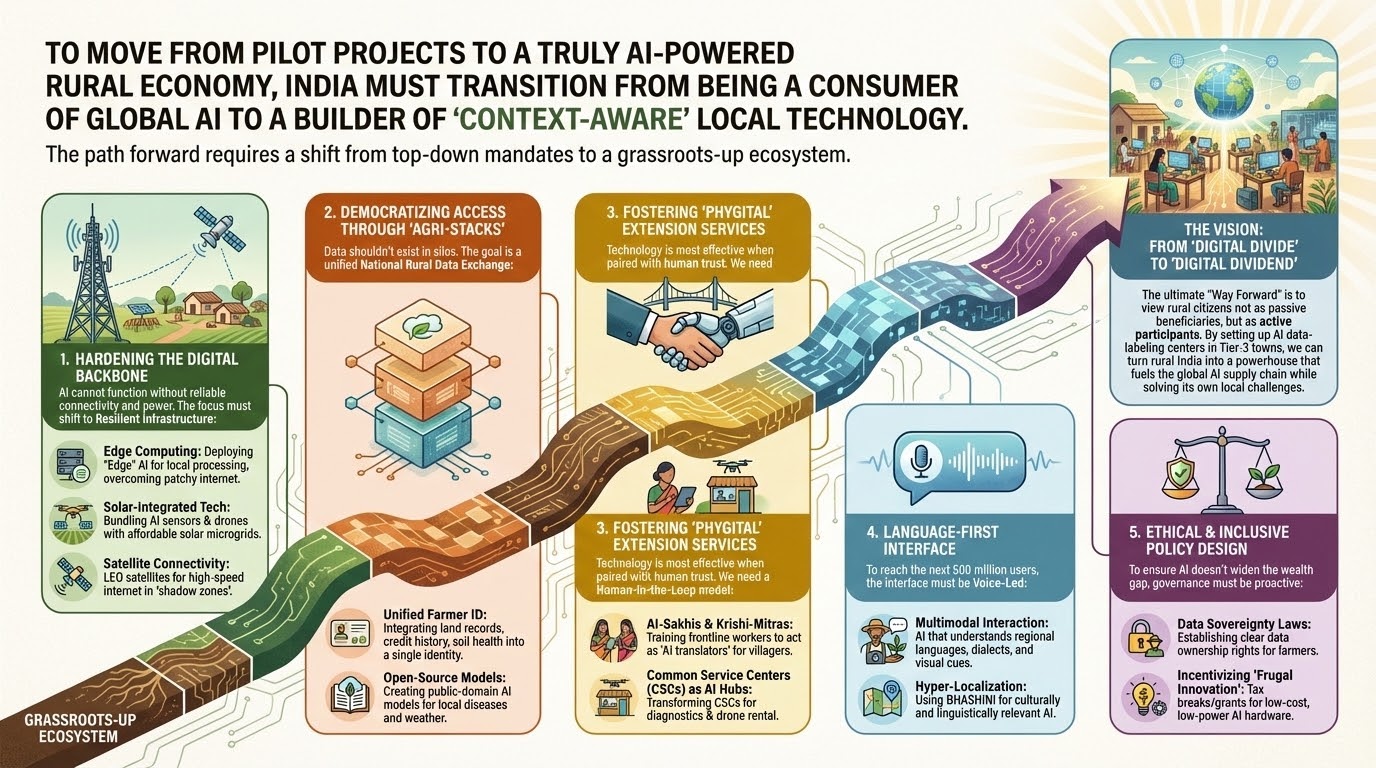
Strategic Missions & Infrastructure
IndiaAI Mission: This initiative focuses on building a sovereign AI stack. It includes the procurement of over 38,000 GPUs to provide affordable AI compute-as-a-service to startups and researchers.
AIKosh: A national data platform hosting over 9,500 datasets and 273 sectoral models, serving as a central repository for public-sector AI innovation.
BharatGen: India’s first sovereign multimodal LLM, designed to represent diverse languages and cultural nuances.
Sector-Specific AI Deployments
Agriculture (AgriStack): AI tools like the National Pest Surveillance System (NPSS) and Bharat-VISTAAR provide real-time pest alerts and localized farming advisories to millions of farmers.
Language Inclusion (Bhashini): The Bhashini Mission uses AI for real-time translation, enabling voice-based access to digital services in over 22 scheduled languages.
Governance (SabhaSaar & BhuPRAHARI): AI is used to automate documentation for village councils (SabhaSaar) and monitor rural infrastructure via satellite imagery (BhuPRAHARI).
Regulation & Safety
India AI Governance Framework (2025): Establishes a risk-based regulatory approach, prioritising ethical principles like "Innovation over Restraint" while strictly managing high-risk use cases like deepfakes.
IndiaAI Safety Institute (IASI): A dedicated body formed to set safety standards, conduct red-teaming of foundational models, and ensure algorithmic transparency.
Talent & Research
Centers of Excellence (CoEs): Three specialized CoEs have been established in top academic institutions to focus on AI in Healthcare, Agriculture, and Sustainable Cities.
YUVAI: A national program designed to equip school students (Classes 8-12) with foundational AI skills to solve local community challenges.
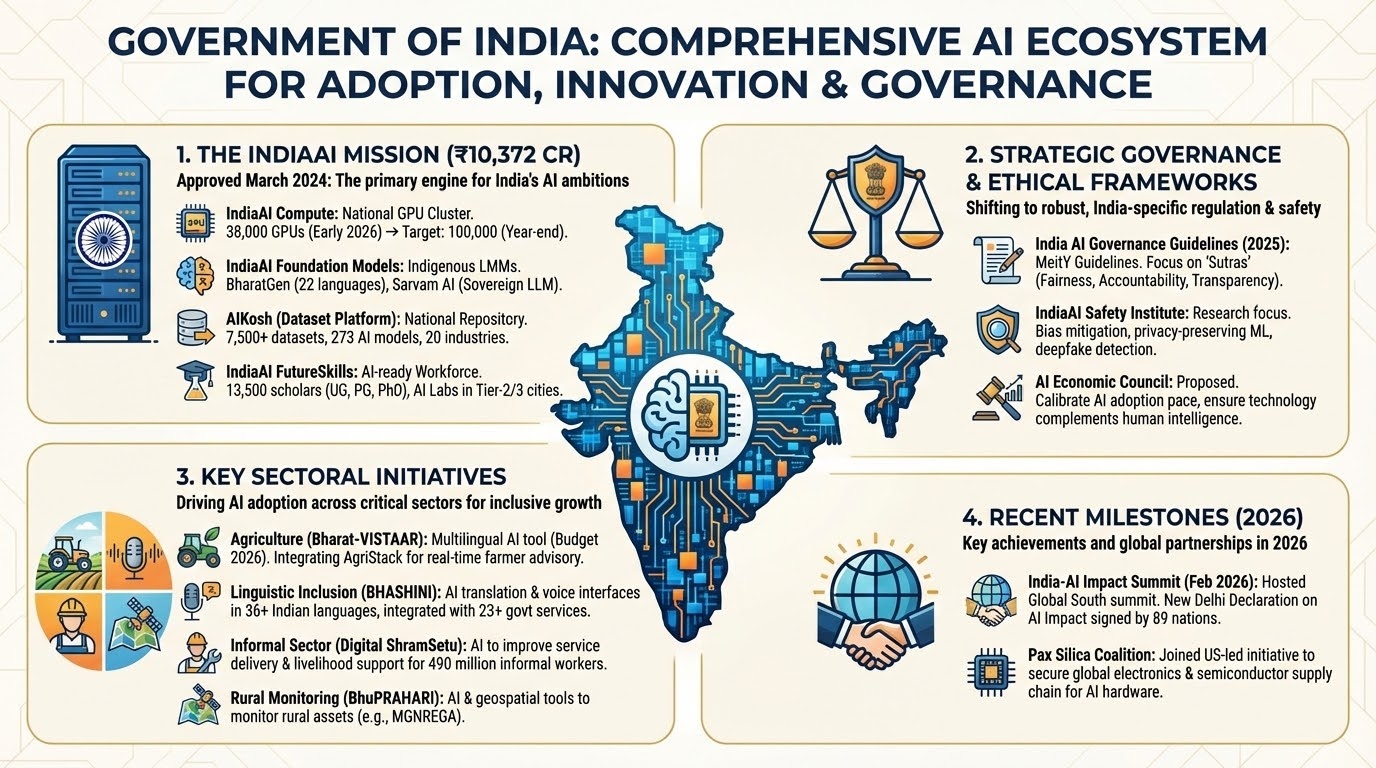 What Challenges Hinder Widespread AI Adoption in Rural India?
The Digital and Data Divide
Connectivity Gaps: Despite the growth of 4G/5G, many "shadow zones" in remote hilly or tribal regions lack the stable, high-speed internet required for real-time AI processing.
Lack of Quality Local Data: AI models require massive datasets to be accurate. Much of the historical data for rural India (soil health, local weather, dialects) is either unrecorded, fragmented, or stored in physical formats that are difficult to digitize.
Linguistic and Literacy Barriers
Dialect Complexity: AI struggles with the hyper-local dialects and colloquialisms used in village settings, leading to "hallucinations" or incorrect advice.
Digital Literacy: According to the Central Board for Workers Education, only 38% of Indian households are digitally literate (61% urban, 25% rural), and lack the foundational digital skills needed to interact with complex AI interfaces.
Infrastructure and Cost Constraints
Hardware Costs: High-tech tools like AI-enabled drones, IoT soil sensors, and smart diagnostic kits remain prohibitively expensive for individual smallholder farmers without heavy government subsidies.
Reliable Power: AI hardware at the "edge" (like sensors in fields) requires consistent power, which remains a challenge in areas with frequent outages or low-voltage supply..
Trust and Ethical Concerns
The "Black Box" Problem: Farmers and rural patients are often hesitant to trust a machine's decision (e.g., "sell your crop now" or "take this medicine") over traditional wisdom or a human expert they know.
Data Privacy: There are growing concerns regarding who owns the data collected from a farmer’s field and whether that data could be used by large corporations to manipulate market prices.
Skill Gaps in Administration
Local Governance Capacity: Many members of Gram Panchayats are not yet trained to use AI tools like SabhaSaar effectively, leading to underutilization of the technology provided by the state.
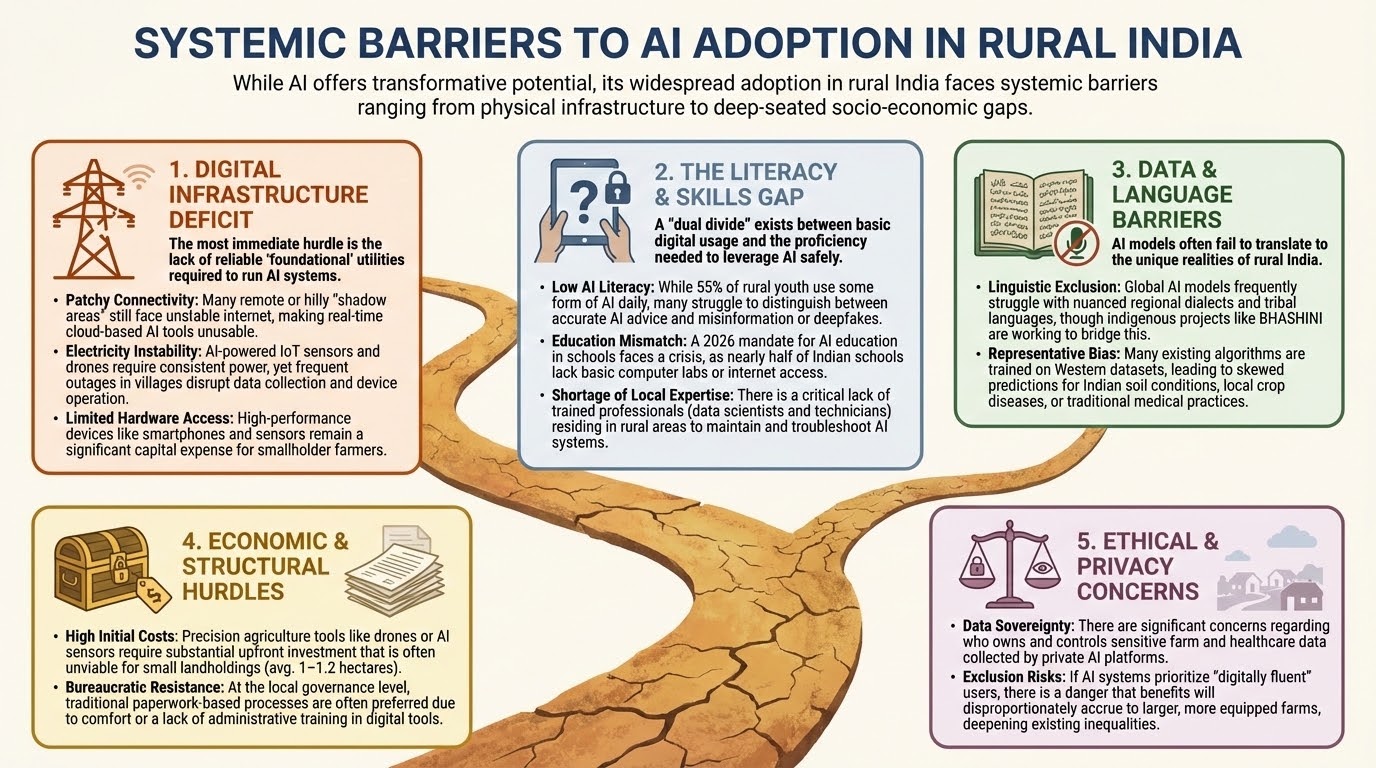 Way Forward
Strengthening the "Digital Commons"
The future lies in expanding Digital Public Infrastructure (DPI). This involves moving from generic models to Small Language Models (SLMs) that run locally on low-cost devices, reducing dependency on high-speed internet and expensive cloud compute.
"Phygital" Delivery Models
Technology cannot replace human trust. The way forward is to utilizes a "Human-in-the-loop" approach:
Localised Innovation & Ownership
Hyper-Local Data: Developing decentralized data hubs at the block level to capture micro-climates and regional soil variations, ensuring AI advice is relevant, not just general.
Community-Led AI: Programs like YUVAI focus on training rural youth to build their own AI solutions, ensuring the technology solves village-specific problems rather than being a "top-down" imposition.
Ethical Safeguards & Incentives
Data Sovereignty: Implementing clear frameworks that ensure farmers own their data and benefit from its insights.
Financial De-risking: Providing Compute Subsidies and "Sandbox" environments for startups specifically targeting rural challenges, making the rural market as lucrative as urban sectors.
Sustainable Infrastructure
Integrating AI with Renewable Energy (like solar-powered IoT sensors) will ensure that technological adoption isn't hindered by rural power fluctuations.
 Conclusion
India is leveraging a people-centric, inclusive, and ethical approach to Artificial Intelligence to accelerate its transformation into a Viksit Bharat @2047, strengthening governance and reducing inequalities.
Source: PIB
|
PRACTICE QUESTION Q. Critically analyze the role of Artificial Intelligence as a tool for strengthening grassroots governance and ensuring last-mile service delivery in rural India. 150 words |
The BHASHINI Mission is an AI-driven language translation platform. Its purpose is to break down language barriers by integrating with government services to provide voice-based and multilingual interfaces, ensuring all citizens can access digital services in their native tongues.
The main challenges include the digital divide (uneven internet and device access), the lack of high-quality local data, the risk of algorithmic bias leading to exclusion, low digital literacy among the rural population, and data privacy and security concerns.
BhuPRAHARI is a collaborative project between the Ministry of Rural Development and IIT Delhi. It uses AI and geospatial technology to monitor assets created under the MGNREGA scheme in real-time, thereby enhancing transparency and accountability in this large-scale rural employment program.
© 2026 iasgyan. All right reserved