Description
Why In News?
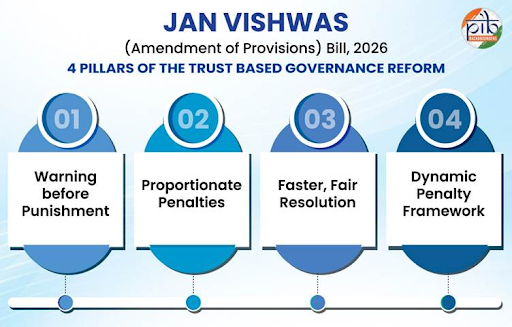
The Parliament has passed the Jan Vishwas (Amendment to Provisions) Bill, 2026. The Act proposes to amend 784 provisions across 79 central laws. Earlier, the Jan Vishwas (Amendment of Provisions) Act, 2023, had amended 183 provisions across 42 laws to improve ease of doing business.
What are the amendments?
The Act amends laws across a broad spectrum of sectors, including business and industry, transportation and infrastructure, and municipal governance, along with colonial-era legislation. Across the 79 laws, the Act proposes four sets of changes:
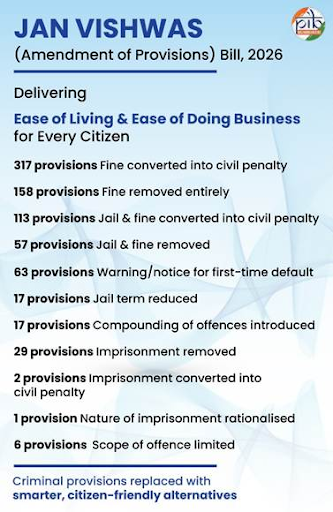
- Decriminalization: The Act decriminalizes a total of 805 offences, removing criminal sanctions such as imprisonment or fines and replacing them with civil mechanisms such as warnings and monetary penalties.
- Omission: The Act omits 125 offences. Redundant or outdated offences have been omitted and effectively decriminalised. Offences already covered under the Bharatiya Nyaya Sanhita, 2023, have also been omitted.
- Compounding: Thirty-five offences have been made compoundable, allowing violators to settle the case paying a prescribed sum, avoiding prolonged litigation.
- Rationalisation: For 53 offences, the Act reduces imprisonment terms, removes disproportionately harsh punishments and revises fines to contemporary standards.
Fines vs Penalties:
The Act makes clear the distinction between fines and penalties. Fines remain court-imposed and often require the full criminal justice process. Penalties are civil in nature and imposed by designated adjudicatory officers, enabling quicker and more efficient enforcement.
Offences being decriminalised:
The decriminalised or rationalised offences largely fall into following categories:
- Outdated Offences: The Act removes minor or obsolete offences that have little to no impact. For instance, it omits offences such as allowing a child under seven to relieve themselves in public lamps. Similarly, the offence of loitering or begging or hawking goods in railway carriages have been decriminalised.
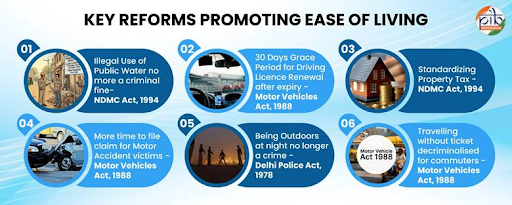
- General Contraventions: Dozens of centrals laws criminalise any non-compliance with any provision of the law, rules or regulations. It makes such provisions a source of criminalisation. Such provisions have been decriminalised for around 17 laws and omitted from around five laws. For example, under the Motor Vehicles Act, 1988, the provision has been decriminalised by providing a warning for the first contravention and a penalty for a second contravention.
- Procedural Defaults: The Act decriminalises minor lapses to improve ease of doing business. For example, under the Tea Act, 1953, it decriminalises failing to furnish returns and furnishing false returns by replacing fine with warning for the first contravention and civil penalty for the subsequent contravention.
- Obstruction: The offence of obstructing a public servant has also been decriminalised. For instance, under the Marine Products Export Development Authority Act, 1972, the offence of obstruction has been omitted.
Why were the reforms needed?
As of December 2024, there were 370 central laws with 7,305 criminal offences in force; 5,333 offences attracted jail terms. More than 74% of these laws were not core criminal justice laws but regulated subject matters such as taxation, municipal governance, corporate governance, etc.
Challenges with the Act
- Replacing jail time with monetary fines might dilute the deterrent effect of the law.
- The Act shifts the power to penalize from Judicial Magistrates to Adjudicating Officers. This blurs the line between the executive and the judiciary.
- The Act introduces a 60-day timeline for appeals to ensure fast resolution. Critics argue that the strength of the new system depends entirely on how well the appellate bodies are operationalised.
- Lack of clear, uniform standards across different laws may create confusion during cross-sectoral compliance.
Way Forward
- Comprehensive training programs must be established for the Adjudicating Officers to ensure natural justice.
- Robust oversight is critical to check administrative power and reduce arbitrariness.
- Modernizing the interface between the state and businesses can reduce administrative hurdles.
- Regular reviews should be conducted to evaluate the impact on ease of doing business.
Conclusion
The Bill marks an important step towards making the criminal law landscape more reasonable. While it may not solve all problems confronting India’s criminal justice system, it is an important step forward.
Source: Indian Express
|
PRACTICE QUESTION
Q. Which of the following is a key feature of the Jan Vishwas Bill, 2026, regarding the nature of penalties?
a) Increasing the minimum imprisonment for all economic offences
b) Replacing criminal imprisonment with civil penalties for minor procedural lapses
c) Converting all civil disputes into non-bailable criminal offences
d) Abolishing monetary fines for first-time corporate offences
Answer: B
Explanation:
The Jan Vishwas Bill, 2026, focuses on the decriminalization of various minor offenses to promote ease of doing business and reduce the burden on the judicial system. It achieves this by converting several imprisonment-based punishments into monetary penalties or administrative fines across numerous central acts, ensuring that technical or procedural defaults are handled through civil mechanisms rather than criminal prosecution.
|