

Tunnel safety in India has become a critical priority as tunnel construction expands rapidly in fragile Himalayan and urban regions. Recent incidents, especially the Silkyara tunnel collapse that trapped 41 workers, exposed gaps in investigation, design and emergency preparedness. In response, the government has introduced comprehensive guidelines focusing on detailed geological studies, geotechnical baseline reporting, risk registers, site-specific design, real-time monitoring, classification of collapse-risk zones and clear emergency response plans. The overall emphasis is on shifting from speed-driven construction to a safety-first, risk-managed approach that protects lives, reduces economic losses and builds public confidence in expanding tunnel infrastructure.
Copyright infringement not intended
Picture Courtesy: Indian Express
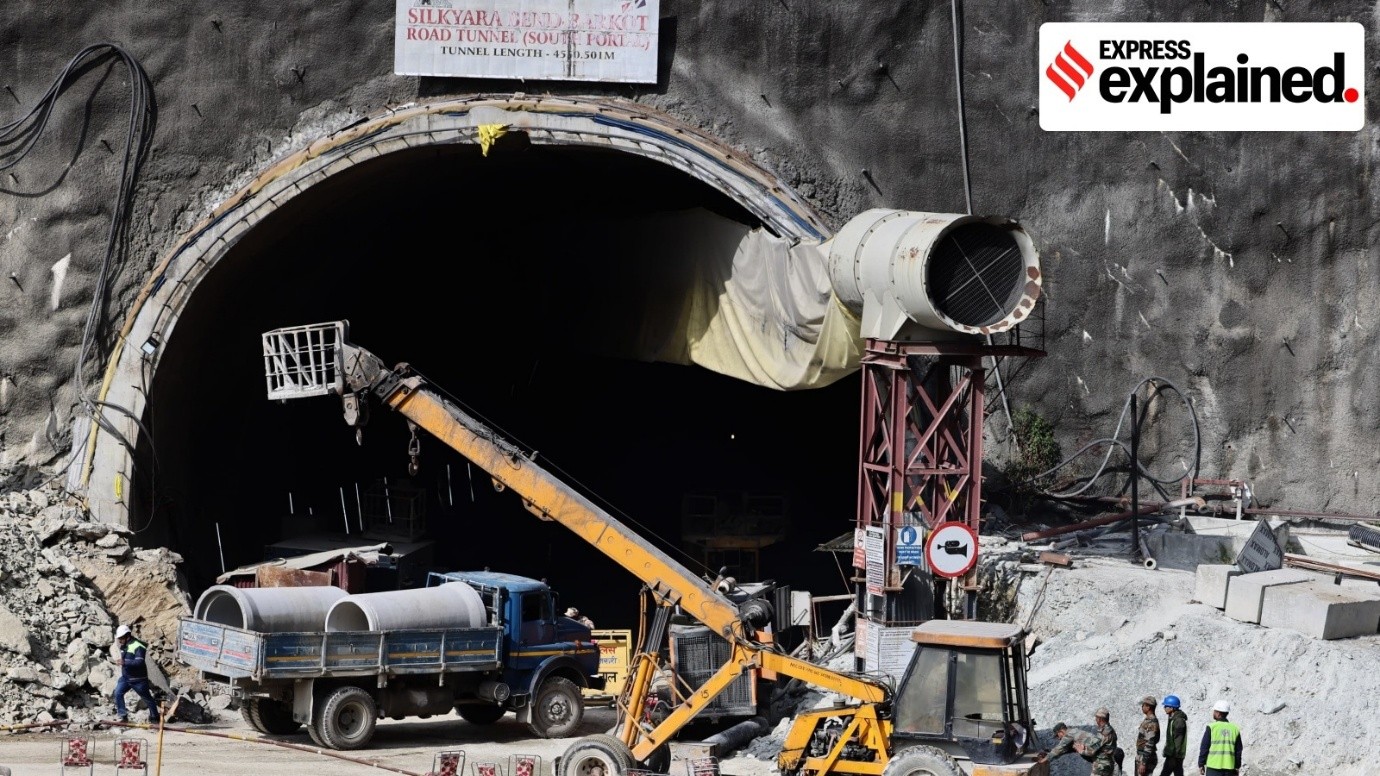
Two years after the Silkyara Bend–Barkot tunnel collapse (Nov 2023) that trapped 41 workers for 17 days, the Ministry of Road Transport and Highways (MoRTH) released comprehensive safety guidelines.
|
Must Read: SHINKU LA TUNNEL | JANASU TUNNEL | SELA TUNNEL | SILKYARA BEND–BARKOT TUNNEL | |
Stronger Planning and Detailed Project Report Stage (DPR): The guidelines state that the DPR must be a serious technical document and not a mere formality, and the project authority must verify all geological and geotechnical investigations. A Geotechnical Baseline Report and a Risk Register are made compulsory so that risks are identified in advance and allocated to the agency best equipped to handle them.
Geological and Geotechnical Investigation: The guidelines emphasise that Himalayan geology is highly variable, so site conditions must be thoroughly investigated before construction. They call for careful study of squeezing and swelling ground, fault and shear zones, hot water ingress, tunnels under rivers and the presence of toxic gases, so design is based on realistic ground conditions.
Design Philosophy: The design of tunnels must be site-specific, responsive to actual geological behaviour and capable of modification during construction. Support systems must be designed for the worst credible ground scenario, and independent design checks are encouraged.
Selection and Control of Construction Method: The guidelines clarify that the choice between the New Austrian Tunnelling Method (NATM) and Tunnel Boring Machine (TBM) must depend on geological conditions. NATM must follow clearly defined procedures with continuous documentation through RESS sheets, while TBM operations must be monitored carefully for face instability, water ingress and roof collapse, and predefined rescue procedures must be in place for TBM-based tunnelling.
Collapse-Risk Classification: Tunnels must be classified into zones based on collapse risk, and high-risk zones require stronger safeguards. These include escape pipes of at least 0.9-metre diameter and rescue containers placed at prescribed intervals, each capable of supporting workers for at least 24 hours.
Monitoring and Record-Keeping: Continuous geological face mapping and real-time monitoring of deformation and support performance are made mandatory. Daily documentation must be maintained to detect early warning signs of failure.
Emergency Preparedness: An Emergency Response Plan must be prepared at project start and updated weekly as excavation progresses. Shift managers must be trained to execute this plan and act as first responders during an incident.
Institutional Roles During Rescue: Clear lines of authority are laid down with the District Magistrate as Incident Commander, and defined roles for construction agencies, local administration, National Disaster Response Force and the State Disaster Response Force. Technical experts must guide rescue operations to prevent secondary accidents.
Worker Safety: The guidelines prioritise worker safety over construction speed, requiring trained manpower, proper ventilation, protective equipment and restrictions on entry into unstable areas.
Protects human life: Tunnel safety is essential because accidents in confined underground spaces can trap many people with limited escape routes.
In the Silkyara Bend–Barkot tunnel collapse of November 2023, 41 workers were trapped for 17 days, showing how quickly lack of safety can become life-threatening.
Prevents large-scale rescue operations and risk to responders: Unsafe tunnels do not just endanger workers but also rescuers who enter unstable structures during emergencies.
The Silkyara rescue required multiple agencies, including specialised drilling teams and rat-hole miners, demonstrating the huge risk and resource burden when safety fails.
Critical for national connectivity and strategic projects: Tunnels are vital in mountains, border areas, and eco-sensitive terrain where surface roads are not feasible.
Several tunnels are part of the Char Dham project and strategic border connectivity, which means collapses can disrupt pilgrimage traffic, defence logistics, and disaster response movement.
Reduces economic loss and cost overruns: Collapse or failure leads to stoppage of work, damage to machinery, litigation, and redesign requirements.
New tunnels worth thousands of crores of rupees are under implementation, such as a ₹4,501 crore six-lane project in Maharashtra including 3.47 km of tunnels, meaning even one collapse can cause massive financial loss.
Ensures public confidence in large infrastructure: Repeated tunnel accidents create fear among commuters and workers and erode trust in engineering projects.
After the Silkyara incident, the central government had to issue new national tunnel safety guidelines, showing how public concern directly drives policy change.
Essential for worker rights and welfare: Most tunnel workers are migrant labourers who face high occupational risk; safety protects their lives and livelihoods.
The Silkyara incident highlighted how dozens of families waited for weeks for news, showing the huge social and psychological impact of tunnel failures.
Challenging and unpredictable geology: A major constraint is highly variable Himalayan geology, which makes prediction of ground behaviour difficult and increases collapse risk.
The government itself noted that multiple tunnel collapses in recent years were linked to inadequate geological investigation, and the Silkyara Bend–Barkot collapse in November 2023 trapped 41 workers for 17 days, highlighting how geological surprises can turn into disasters.
Poor quality of Detailed Project Reports and investigations: Many Detailed Project Reports have lacked depth in geological and geotechnical study, leading to design errors and construction delays.
The Ministry of Road Transport and Highways admitted that several tunnel Detailed Project Reports were reduced to “procedural formalities” rather than proper risk management tools, prompting new rules mandating Geotechnical Baseline Reports and Risk Registers.
Rapidly expanding tunnel network increasing risk exposure: The number of tunnels under construction has grown sharply, stretching technical capacity and safety oversight.
As per Parliamentary reply, 42 tunnels (60.37 km) are completed and 57 tunnels (93.96 km) are currently under construction on national highways, showing the large scale at which safety, manpower and monitoring must now operate.
High risk of cost overruns and delays: Tunnel projects frequently cross original budgets because of unexpected ground conditions, design changes and construction stoppages.
New approvals alone include three tunnels of 9.68 km costing ₹1,962 crore and a ₹4,501-crore six-lane project with two tunnels in Maharashtra, indicating that even modest delays or redesigns cause very large financial implications.
Tunnel safety in India is not just a technical requirement but a human, economic and strategic necessity. As tunnel construction expands rapidly in fragile and mountainous regions, safety must be built into every stage—from investigation and design to construction and emergency response—so that development does not come at the cost of lives, repeated collapses or loss of public trust.
Source: Indian Express
|
Practice Question Q. “With rapid expansion of tunnel infrastructure in fragile Himalayan and urban regions, tunnel safety has emerged as a critical governance challenge in India.” Discuss the major constraints in ensuring tunnel safety and suggest key measures. (250 words) |
Tunnel safety refers to the set of practices that ensure tunnels are planned, designed, constructed and operated in a way that prevents collapses, fires, flooding, toxic gas incidents and other accidents, while also enabling quick rescue and evacuation if emergencies occur.
Tunnel safety is especially important in India because many tunnels are being built in fragile Himalayan terrain with unstable rocks, high seismic activity and heavy rainfall, where even small design or investigation errors can quickly lead to collapse and major loss of life.
The Silkyara Bend–Barkot tunnel collapse in November 2023 highlighted the seriousness of tunnel safety when 41 workers were trapped for 17 days, prompting nationwide concern and policy reform.


© 2026 iasgyan. All right reserved