Retained for 2026–2031, India’s FIT framework mandates the MPC to maintain 4% CPI inflation. While effective at anchoring expectations, its success against supply shocks depends on synchronizing the RBI’s monetary policy with the government’s supply-side reforms.
Why In News?
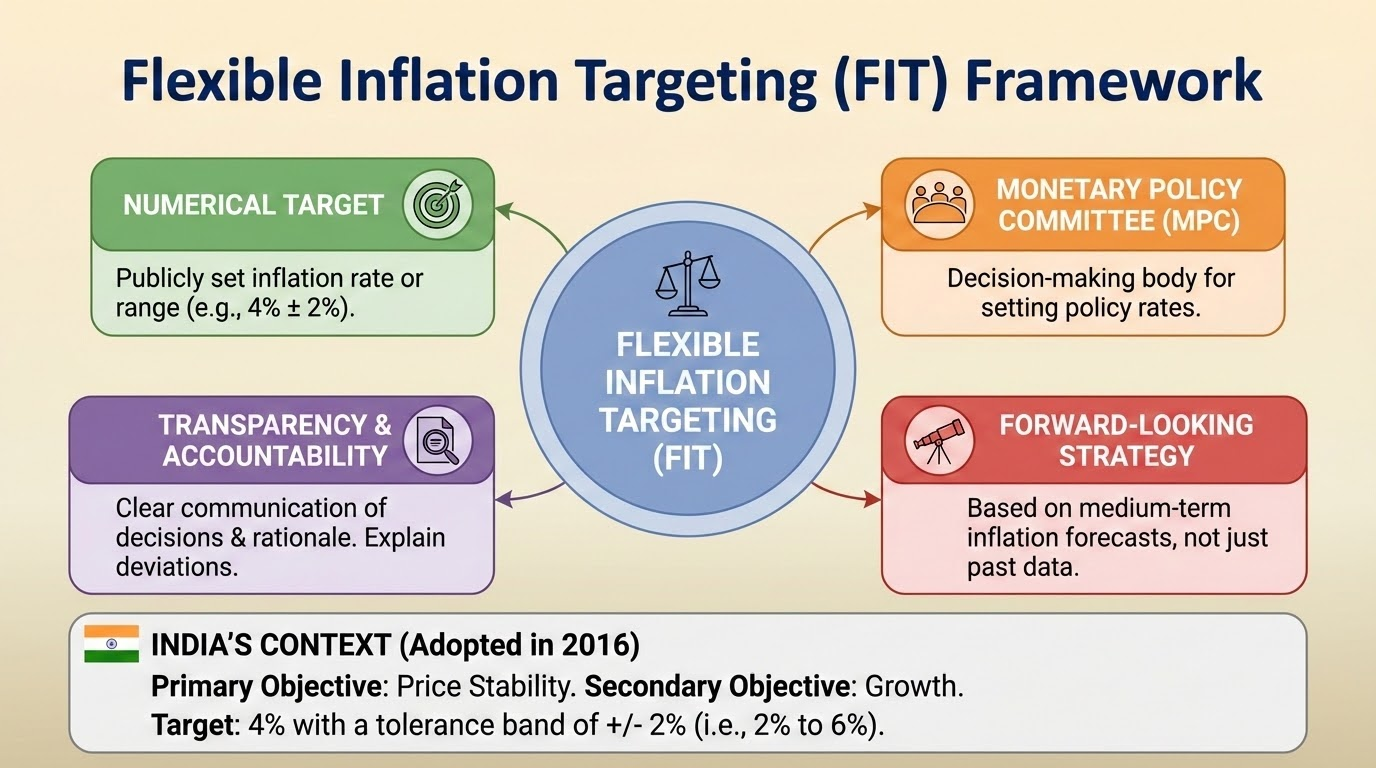
The Government notified the retention of the Flexible Inflation Targeting (FIT) framework with a 4% retail inflation target (within a 2% to 6% tolerance band) for the five-year period from April 1, 2026, to March 31, 2031.
What is Flexible Inflation Targeting (FIT) Framework?
Flexible Inflation Targeting is a monetary policy strategy used by the Central Bank to maintain price stability while keeping growth in mind.
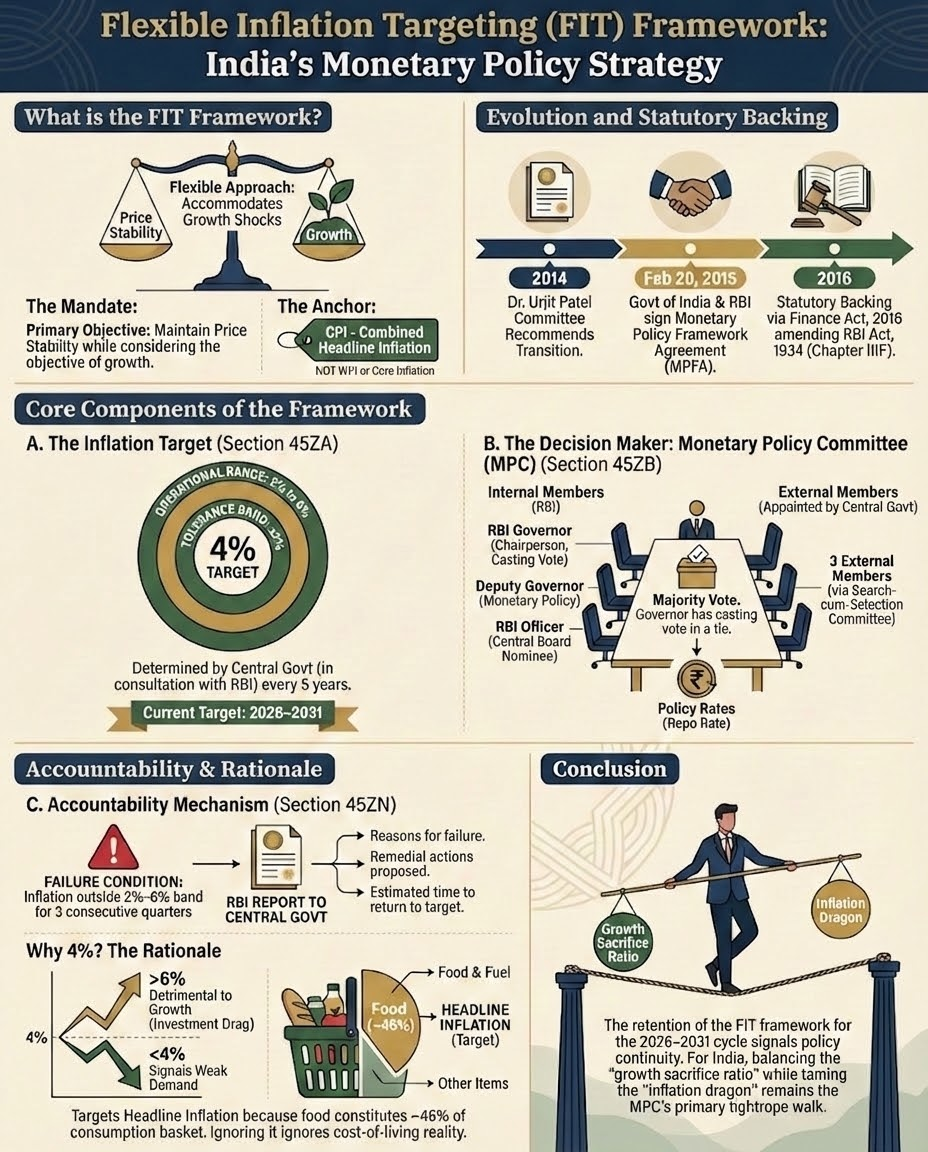
The Mandate: The primary objective of monetary policy is to maintain price stability while considering the objective of growth.
The Anchor: India uses the Consumer Price Index (CPI) - Combined (rural+urban), released by the Ministry of Statistics and Programme Implementation (MoSPI), as headline inflation metric.
Evolution and Statutory Backing
The journey from a "Multiple Indicator Approach" to a rule-based FIT regime is a key evolutionary step in Indian economics.
Core Components of the Framework
The Inflation Target
The Central Government, in consultation with the RBI, determines the inflation target once every five years.
The Decision Maker: Monetary Policy Committee
Policy rates (Repo Rate) are decided by a six-member Monetary Policy Committee (MPC) to ensure collective wisdom.
Accountability Mechanism
The RBI is deemed to have "failed" if inflation remains outside the tolerance band (below 2% or above 6%) for three consecutive quarters.
Why 4%? The Rationale
Threshold Inflation: Studies suggest that for India, inflation above 6% is detrimental to growth (drag on investment), while inflation below a certain threshold (cited as 4%) may signal weak demand.
Headline vs Core: The RBI targets Headline Inflation (which includes volatile food and fuel prices) because food constitutes roughly 46% of the consumption basket for Indian households.
Conclusion
The retention of the FIT framework for the 2026–2031 cycle signals policy continuity. For India, balancing the "growth sacrifice ratio" while taming the "inflation dragon" remains the MPC's primary tightrope walk.
Source: THE HINDU
|
PRACTICE QUESTION Q. Which of the following indices is officially used by the Reserve Bank of India as the nominal anchor for measuring inflation under the Flexible Inflation Targeting (FIT) framework? a) Wholesale Price Index (WPI) b) Consumer Price Index (CPI) - Core c) Consumer Price Index (CPI) - Combined d) Index of Industrial Production (IIP) Answer: c Explanation: The Consumer Price Index (CPI) - Combined (often referred to as Headline Inflation) is the official nominal anchor used by the Reserve Bank of India (RBI) for its Flexible Inflation Targeting (FIT) framework. |
The FIT framework is a monetary policy regime where the Central Bank (RBI) is legally mandated to maintain consumer price inflation within a specific target range while keeping the objective of economic growth in mind. For India, the target is 4%, with a tolerance band of 2% to 6%.
Under Section 45ZA of the RBI Act, the Central Government, in consultation with the Reserve Bank of India, determines the inflation target once every five years. For the 2026–2031 period, the target has been retained at 4%.
The MPC is a six-member statutory committee. It consists of three internal members from the RBI (including the RBI Governor, who acts as the ex-officio Chairperson) and three external members appointed by the Central Government via a Search-cum-Selection Committee.


© 2026 iasgyan. All right reserved