Description
Disclaimer: Copyright infringement not intended.
Context
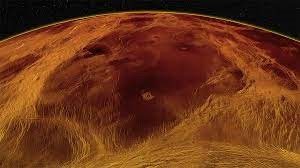
- According to a new study, Venus, often known as Earth's sister planet, may have experienced tectonic activity between 4.5 billion and 3.5 billion years ago.
Details
Key Facts About Venus Planet
- Venus and Earth have similar sizes, masses, densities, and volumes.
- Nonetheless, Venus remains the least understood terrestrial planet.
- It can be seen in the Earth's sky as either a "morning star" or an "evening star" because it is always close to the Sun.
- After the Moon and the Sun, it is the third brightest object in the Earth's sky.
- It has a weak induced magnetosphere and a very thick carbon dioxide atmosphere, which, combined with its worldwide sulfuric acid cloud layer, generates a strong greenhouse effect.
- This results in a mean surface temperature of 737 K (464 °C; 867 °F) and a crushing pressure 92 times that of Earth's at sea level, converting air into a supercritical fluid.
Findings in Venus Planet
- The atmosphere of the planet is mostly made up of carbon dioxide (96.5%) and nitrogen (less than 3.5%).
- Plate tectonics may have played a role in the formation of Venus's carbon dioxide- and nitrogen-rich atmosphere.
- The latest discoveries imply that ancient Venus may have supported microbial life.
- That indicates Earth and Venus may have been more similar than previously assumed.
New Findings
- We most likely had two planets in the same solar system operating in a plate tectonic regime at the same time.
- Plate tectonics would most likely have ended on Venus once it lost water and its atmosphere became too hot and dense.
- This process could have dried up the required elements for tectonic movement.
- The current atmosphere and surface pressure of Venus can only be explained by early plate tectonics.
- This early tectonic action would have occurred on both Earth and Venus at the same time.
- Venus may have changed from limited tectonic action to the static lid model that exists today early in its history. A stationary lid has a single plate on its surface with no movement to release gasses into the atmosphere.
- Instead of being consistently habitable, planets may shift in and out of habitability.
- The National Aeronautics and Space Administration's (NASA) future mission to Venus is called
- India's mission to Venus will be called Shukrayaan-1.
PTT (plate tectonics theory)
- McKenzie and Parker proposed it in 1957, and Morgan proposed it in 1967.
- Both conventional current theory and seafloor spreading theory laid the groundwork for plate tectonics theory.
- It explains how the Earth's lithospheric plates, which make up the planet's outermost shell, move.
- It depicts how the Earth's thin outer shell is broken up into large chunks known as tectonic plates, which float on the planet's mantle.
- Plate tectonics created seas, continents, and mountains, as well as played an important part in sustaining life on Earth.
PTT is founded on four broad geomorphological assumptions
- The lithosphere is separated into multiple vertical columns known geomorphologically as plates sliding kinematically across a semi-molten asthenosphere known as a tectonic.
- The surface area of a continental plate extends over the oceanic lithosphere as well.
- As a result, there is no full separation of the continental and oceanic lithospheres.
- The direction and impulse action of the thermal Convection currents determine the movement or tectonics of the corresponding plates.
- As a result, the plates are converging and diverging away from each other.
- The process of convergence and divergence builds a new crust over the Earth's surface while also disintegrating it.
- The pace of crust development and disintegration has developed an equilibrium profile in which the earth's surface area remains constant.
|
PRACTICE QUESTION
"Venus, often referred to as Earth's 'sister planet,' has long fascinated scientists and space explorers. Discuss the key features and challenges associated with the study of Venus.
|