

Copyright infringement not intended
Picture Courtesy: PIB
Why In News?
The UN's declaration of 2026 as the International Year of the Woman Farmer highlights the urgent need to address gender-based inequalities and empower women in agriculture.
|
Read all about: Feminisation of Agriculture l Land rights for women |
It refers to the increasing percentage of women in the agricultural workforce relative to men. As men migrate to urban areas for higher-paying non-farm work (industry/services), women are left behind to manage cultivation, livestock, and household food security.
Women in Indian Agriculture
Workforce Participation: In the rural sector, 76.9% of working women are engaged in agriculture, compared to only 49.4% of rural men. (Source: Periodic Labour Force Survey)
Rising Trend: The Female Labour Force Participation Rate (FLFPR) in rural India increased from 24.6% in 2017-18 to 47.6% in 2023-24, largely driven by women entering self-employment in agriculture. (Source: PLFS)
Economic Contribution: Women perform 80% of all major farm work (sowing, weeding, harvesting) but remain invisible in the "farmer" definition. (Source: NITI Aayog)
The Ownership Gap: While women constitute a third of the agricultural workforce, they hold only 13.96% of operational land holdings. (Source: Agriculture Census 2015-16)
Area Operated: In terms of actual land area, women manage only 11.72% of the total operated area. (Source: Agriculture Census 2015-16)
Male Out-Migration
Men are increasingly moving to urban areas for higher-paying work in the construction, manufacturing, or service sectors, leaving women to manage the family farms.
Income Shocks & Poverty
In times of agricultural distress or low household income, women enter the workforce as "unpaid family helpers" to save on the cost of hiring external labor.
Gendered Mobility Constraints
While men can migrate for work, social norms, childcare, and domestic responsibilities often tie women to the village, restricting their livelihood options to local agriculture.
Casualisation of Labour
There is an increasing trend of hiring women for seasonal and casual agricultural work because they are often paid lower wages than men for the same tasks.
Growth of Rural Self-Employment
A significant rise in the Female Labour Force Participation Rate (FLFPR) is due to women taking up self-employment in livestock, poultry, and small-scale cultivation as a survival strategy.
Recognition Gap: Legal definition of a "farmer" is tied to land ownership. Since most women do not hold land titles, they are classified as "agricultural laborers" or "unpaid family helpers" rather than "farmers."
Lack of Access to Institutional Credit: Without land as collateral, women are excluded from the formal banking system.
Gender Wage Gap: Despite performing more labor-intensive tasks, women are paid less than men for the same agricultural work.
Mechanisation Bias: Most agricultural machinery (tractors, heavy harvesters) is designed for male physical statures, while women are left with labor-intensive, manual tasks.
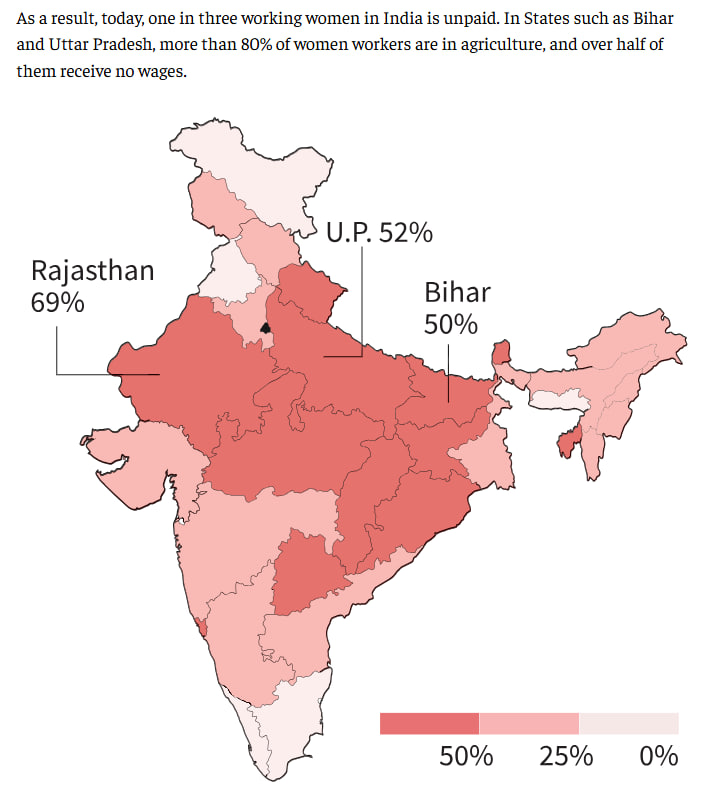
"Invisible" and Unpaid Labour: A large portion of rural women are classified as "Helpers in Household Enterprise," meaning they work on family farms without direct pay, rendering their economic contribution invisible in formal GDP estimates.
 Limited Extension Services and Skilling: Agricultural extension services (technical training, weather updates, seeds) are traditionally "male-centric."
Mahila Kisan Sashaktikaran Pariyojana (MKSP): Sub-component of DAY-NRLM (Deendayal Antyodaya Yojana-National Rural Livelihoods Mission).
Namo Drone Didi Scheme: A Central Sector Scheme designed to modernize rural farming while creating high-value income for women.
Krishi Sakhi Convergence Program: Aims to bridge the "lab-to-land" gap by training rural women as professional Para-Extension Workers.
Gender Budgeting in Agriculture: To ensure that funds actually reach women farmers, the government has mandated specific budgetary allocations.
Pradhan Mantri Kisan Samman Nidhi (PM-KISAN): An income-support scheme for women who hold land titles.
Legal Recognition & Land Rights
Joint Land Titles (Pattas): State governments should promote and incentivize the registration of joint land titles for husbands and wives to ensure women have collateral for credit, as recommended by the M.S. Swaminathan Commission.
Decoupling Rights from Ownership: Niti Aayog recommended to expand the legal definition of a "farmer" to include tenant farmers and women agricultural laborers, enabling them to access Kisan Credit Cards (KCC) and crop insurance without owning land.
Financial Inclusion & Credit Access
Women-Centric Credit Products: Banks should develop micro-credit products specifically for women-led allied activities like poultry, fisheries, and dairy, which provide year-round liquidity.
Interest Subvention: Extending higher interest subventions for women-led Farmer Producer Organizations (FPOs) to encourage collective marketing and bargaining
Gender-Neutral Mechanization
Ergonomic Tool Design: Research institutions must prioritize the R&D of lightweight, ergonomic tools (e.g., adjustable weeders, lighter sickles, and power tillers) specifically designed for women’s bodies to reduce musculoskeletal disorders.
Custom Hiring Centres (CHCs): Expanding women-run CHCs through Self-Help Groups (SHGs) to ensure affordable access to machinery.
Extension Services & Digital Literacy
Gender-Sensitive Extension: Training sessions should be conducted by female extension workers (Krishi Sakhis) at the village level and at times that do not conflict with domestic responsibilities.
Digital Empowerment: Bridging the mobile gender gap to ensure women can use agri-tech apps for weather forecasting, market prices, and direct-to-consumer sales.
Value Addition & Market Linkages
Agro-Processing Hubs: Establishing small-scale processing units (for millets, pulses, or fruits) at the village level managed by women SHGs to increase profit margins.
Direct Marketing: Linking women-led FPOs directly to e-commerce platforms and urban retail chains to bypass middle-men.
Social Security & Safety Nets
Drudgery Reduction: Expanding Anganwadi and crèche facilities near farmlands to reduce the "double burden" of childcare and farm labor.
Wage Parity: Strict enforcement of the Equal Remuneration Act, 1976 in the unorganized agricultural sector to bridge the wage gap.
To truly harness the potential of the feminisation of agriculture, India must transition from merely recognizing women as laborers to empowering them as primary economic agents by dismantling systemic barriers such as the denial of land rights, wage gaps, and restricted access to credit and technology.
Source: PIB
|
PRACTICE QUESTION Q. The 'feminization of agriculture' in India is less a result of empowerment and more a consequence of agrarian distress and male out-migration." Discuss. 150 words |
The United Nations has officially designated 2026 as the International Year of the Woman Farmer to highlight the crucial but historically undervalued role women play in ensuring global food security and promoting sustainable agriculture.
It refers to the increasing participation and expanded responsibilities of women in the agricultural sector. This trend is primarily driven by the migration of men from rural areas to urban centers in search of non-farm employment.
It is a Central Sector scheme aimed at empowering rural women by providing 15,000 agricultural drones to women-led Self Help Groups (SHGs) with an 80% central subsidy. This enables them to transition from manual labor to modern agri-tech service provision.
© 2026 iasgyan. All right reserved