

Copyright infringement not intended
Picture Courtesy: DOWNTOEARTH
The World Trade Organization (WTO), the basis of the multilateral rules-based global trading system, faces an existential crisis as its negotiation, monitoring, and dispute settlement functions are severely strained.
|
Read all about: World Trade Organization (WTO) l WTO Reforms |
The WTO is an intergovernmental organization that regulates and facilitates international trade.
It was established in 1995, succeeding the General Agreement on Tariffs and Trade (GATT).
Its primary mandate is to ensure that global trade flows as smoothly, predictably, and freely as possible.
Its key functions include:
The WTO crisis refers to the paralysis of its Appellate Body, which is the highest court for international trade disputes.
Since 2019, the Appellate Body has been unable to function because the United States has blocked the appointment of new judges, preventing it from reaching the required three-member quorum.
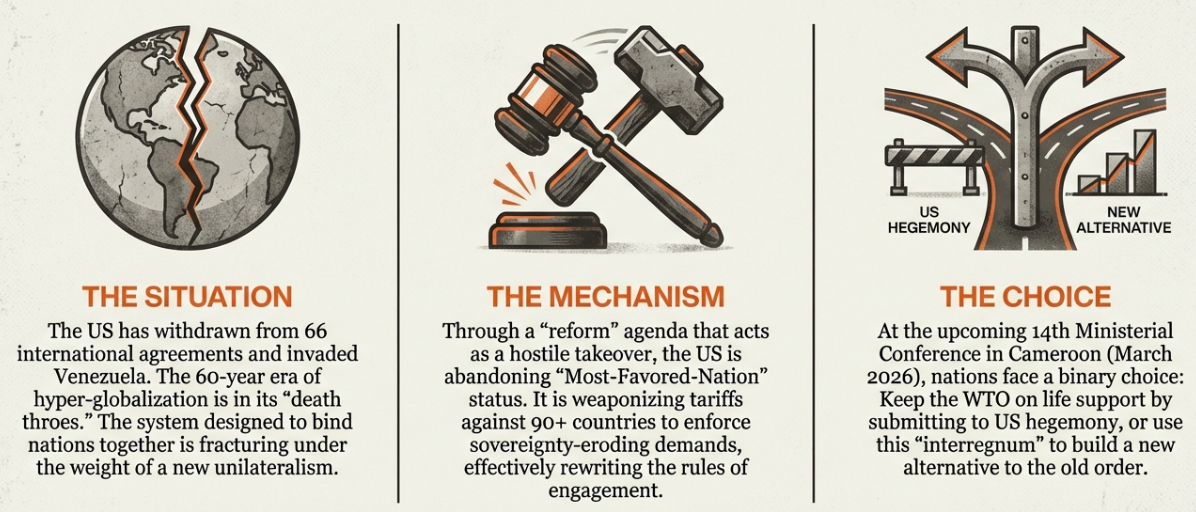 Core Elements of the Current Crisis
Paralysis of Dispute Settlement: Without a functioning Appellate Body, losing parties in trade disputes can appeal "into the void," effectively blocking the enforcement of initial rulings and leaving disputes in legal limbo.
U.S. Objections: The U.S. has blocked appointments citing "judicial overreach," arguing that the court has historically overstepped its mandate by creating new rules rather than just interpreting existing ones.
Stagnation in Negotiations: The WTO's negotiating function has largely stalled. Since the 2001 Doha Round, members have struggled to agree on major new trade rules for the 21st century, such as e-commerce, digital trade, and industrial subsidies.
Rise of Protectionism & Unilateralism: Major economies are increasingly bypassing WTO norms, resorting to unilateral tariffs and retaliatory measures (e.g., the US-China trade war).
Shift to Regionalism: Countries are prioritizing bilateral and regional trade agreements like the CPTPP and RCEP, which fragments the global trading system and marginalizes the WTO's central role.
Institutional Issues: The "consensus rule" (requiring all 164+ members to agree) makes it easy for a single country to block progress on reforms or appointments.
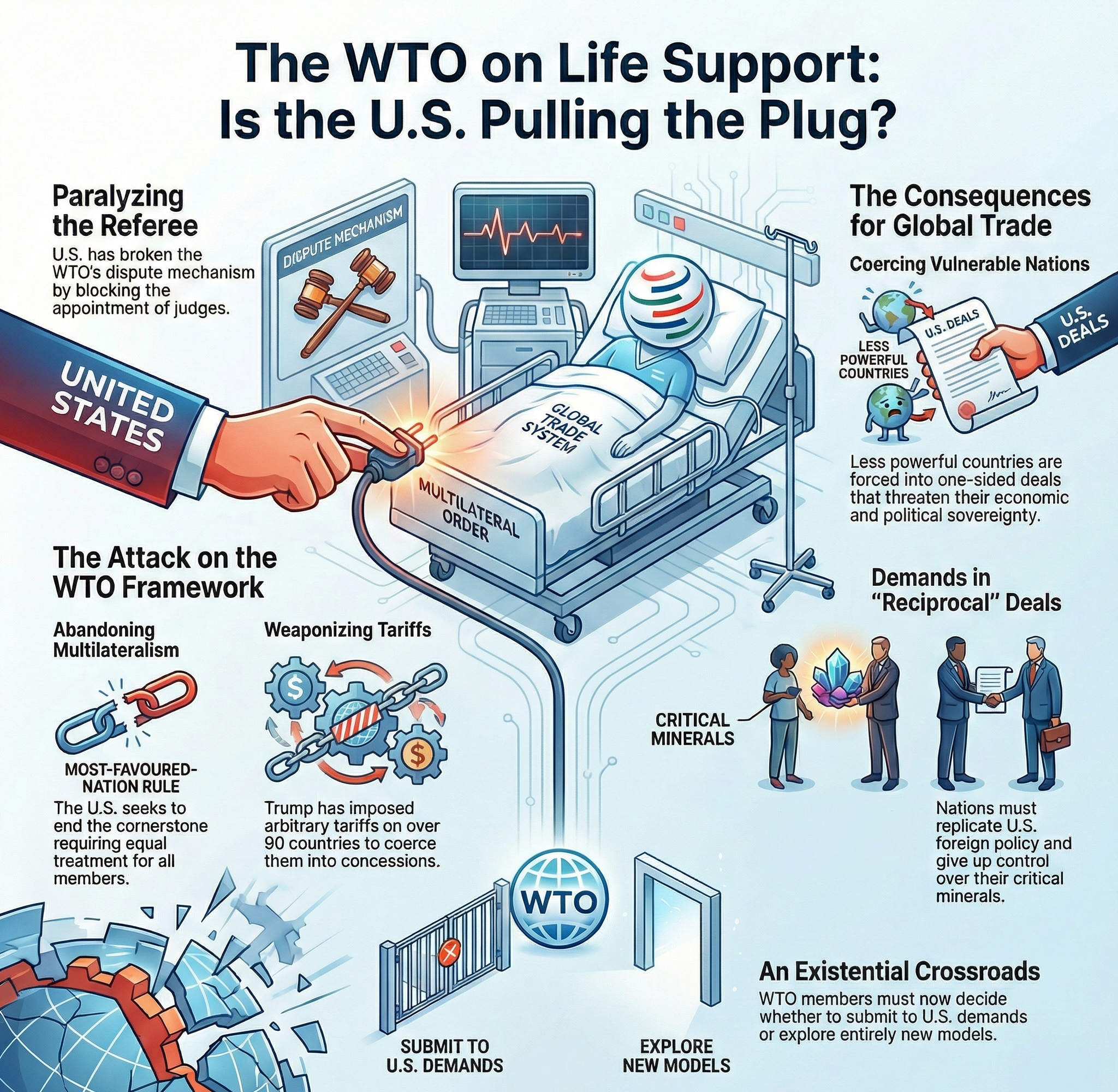 Why is a WTO Crisis a Global Concern?
A weakened WTO threatens global economic stability. It encourages a return to protectionism and power-based trade relations ('might is right'), undermining the predictability that businesses and nations rely on. This can lead to:
A weakened WTO threatens global economic stability, increases the risk of trade wars, and disproportionately harms developing economies that rely on a predictable, rules-based system to protect their interests against larger economic powers.
Institutional Flaws
Consensus-Based Decision Making: The requirement for agreement among all 164 members makes decision-making slow and prone to gridlock. The 'single undertaking' principle (nothing is agreed until everything is agreed) has often paralyzed negotiations.
Special and Differential Treatment (S&DT): The provision allowing developing countries to self-designate for special benefits has become contentious. Developed nations, particularly the US, argue that large emerging economies like China and India should no longer receive these benefits.
Geopolitical Shifts
US-China Rivalry: The US accuses China of unfair trade practices (e.g., industrial subsidies, intellectual property theft, role of State-Owned Enterprises) that it believes are not adequately addressed by existing WTO rules. This rivalry has undermined trust and cooperation within the organization.
Economic Nationalism: A global trend towards inward-looking economic policies has eroded political will for multilateral solutions.
Inadequacy for 21st-Century Issues
Digital Trade: The WTO lacks comprehensive rules for e-commerce, cross-border data flows, and digital taxation, leading countries to enact unilateral measures.
Climate Change: Policies like the EU's Carbon Border Adjustment Mechanism (CBAM) raise concerns about 'green protectionism' and are difficult to reconcile with current WTO principles.
Industrial Subsidies: Existing rules are seen as insufficient to discipline the massive state-led subsidies provided in non-market economies.
Positions of Key Stakeholders
Different members have conflicting priorities, which complicates reform efforts.
|
Stakeholder |
Key Demands and Stance |
|
USA |
|
|
China |
|
|
European Union (EU) |
|
|
India & Developing Countries |
|
Restore the Dispute Settlement System
Address the concerns about judicial overreach by clarifying the mandate of the Appellate Body, setting clear timelines, and preventing judicial activism.
The Multi-Party Interim Appeal Arbitration Arrangement (MPIA), an interim solution by some members, could serve as a model.
Reform the Negotiation Process
Embrace plurilateral agreements or Joint Statement Initiatives (JSIs) on issues like E-commerce and Investment Facilitation, allowing coalitions of willing members to move forward.
Update the WTO Rulebook
Develop new rules for 21st-century challenges, including digital trade, environmental sustainability, and disciplines on industrial subsidies, to ensure the WTO remains relevant to modern commerce.
Find a middle ground by moving from self-declaration to a criteria-based approach for determining developing country status.
Strengthen India's Role
India can play a crucial role as a bridge-builder between developed and developing nations, advocating the interests of the Global South while engaging constructively in reform discussions.
Revitalizing the WTO requires strong political will from major economic powers to compromise and reinvest in a reformed, adaptable, and inclusive multilateral system to avoid a chaotic, power-based global trading environment.
Source: DOWNTOEARTH
|
PRACTICE QUESTION Q. "The paralysis of the WTO Dispute Settlement Body signals a retreat from multilateralism." Critically analyze. 150 words |
The core reason is the breakdown of the post-WWII consensus on multilateralism, accelerated by the geostrategic rivalry between the US and China, a populist backlash against globalization, and the systematic weakening of the WTO's functions, particularly its dispute settlement mechanism, by the United States.
The US has blocked appointments citing concerns of "judicial overreach" and the belief that the Appellate Body infringes on American sovereignty. This action effectively paralyzes the WTO's ability to enforce its rules, as countries can veto rulings by appealing them to a non-functional body.
Without a functional dispute settlement system, developing nations lose their primary tool to challenge the unfair trade practices of more powerful economies. They become more vulnerable to unilateral tariffs and coercive pressure, as they cannot rely on an impartial, rules-based enforcement mechanism.
© 2026 iasgyan. All right reserved