

Severe 2026 summer heatwave triggers acute water shortages across major Indian cities, including Delhi, Bengaluru, and Chennai, exposing the vulnerability of aging urban infrastructure and depleting reservoirs.
Rapid Urbanization: By 2050, 68% of the global population will inhabit urban areas, with one in every two Indians residing in cities, placing unprecedented pressure on strained resources.
Hydrological Limits: NITI Aayog’s Composite Water Management Index (CWMI) warns that Indian cities consistently consume water far beyond their sustainable hydrological limits.
Demand-Supply Gap: The domestic water demand-supply gap will reach approximately 50 Billion Cubic Meters (BCM) by 2030, with total demand projected to double current usage.
Policy Failure: The Mihir Shah Committee (2016) concludes that India’s water policy historically prioritized supply augmentation (dams and pipelines) while neglecting essential demand-side management.
Groundwater Over-Extraction: India remains the world’s largest groundwater extractor, with 52% of monitored wells showing declining levels. In states like Delhi, Haryana, and Punjab, extraction rates exceed 100%, outpacing natural aquifer recharge.
Infrastructure Deficit: Municipalities treat only 28% of urban sewage, and 70% of surface water remains contaminated, rendering physical water presence insufficient for safe consumption. (Source: Centre for Science and Environment)
Distribution Leakage: Dilapidated networks bleed approximately 30% of treated water before it reaches residential taps. (Source: Global Water Intelligence)
Non-Revenue Water (NRW): Water lost to leaks, theft, or poor billing hovers around 40%-50% nationally. Delhi loses nearly 40% of its supply across its 16,634-km network.
Inadequate Metering: Low metering rates—such as 3% in Chennai and 7% in Agra—force reliance on flat-rate tariffs that fail to recover Operation & Maintenance (O&M) costs. (Source: World Bank)
Encroachment: Urban expansion destroys natural environmental sponges—like wetlands, forests, and permeable soils—by paving them over with impervious surfaces like concrete and asphalt.
Fragmented Governance: "Hydroschizophrenia" plagues the sector, as surface water, groundwater, and domestic supply operate in isolated bureaucratic silos.
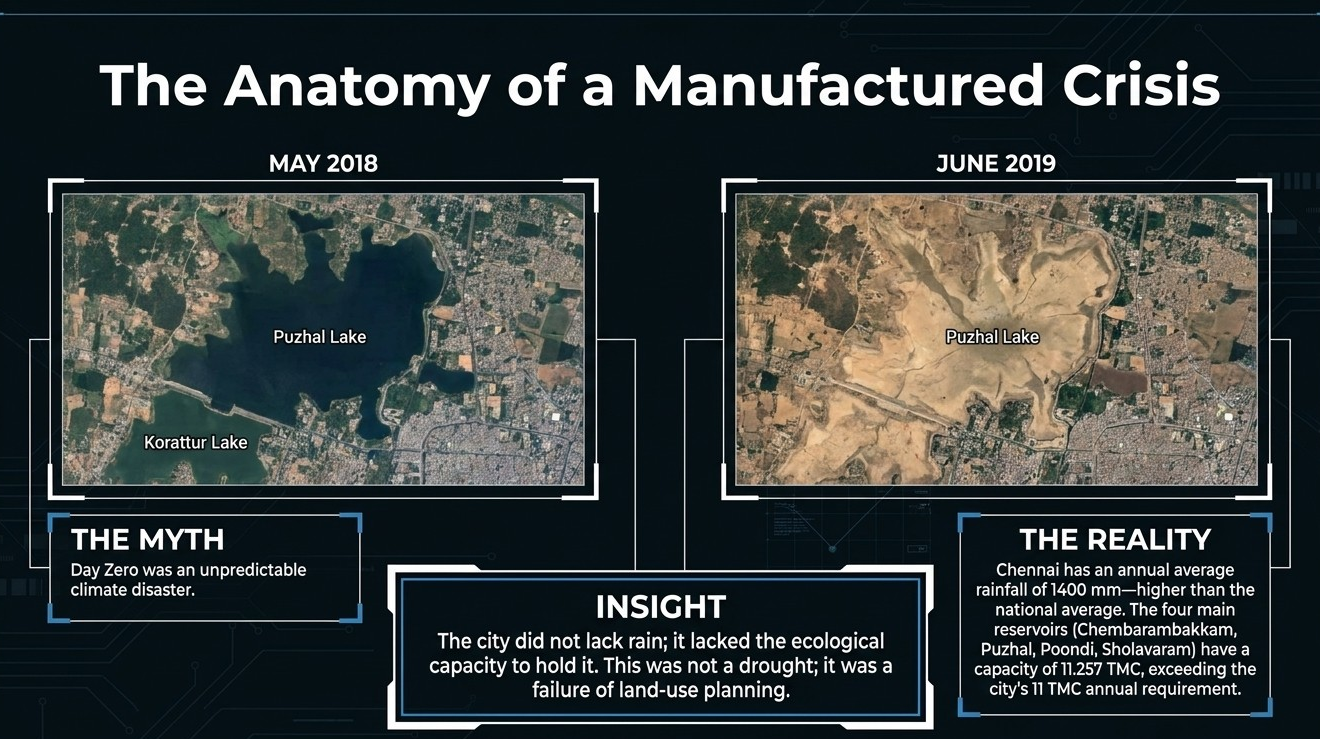 Why the Traditional Approach Fails?
The current urban water framework relies on outdated methodologies that exacerbate scarcity rather than solving it:
Distant-Sourcing Trap: Authorities prioritize the construction of massive pipelines and long-distance river diversions over the maintenance of localized, leaky distribution networks.
Supply-Side Bias: Urban planners maintain a construction-centric obsession with large dams and reservoirs, categorically ignoring the efficiency of existing water usage.
Neglect of Conservation: Municipalities favor artificial grey infrastructure, such as concrete channels and pumping stations, while ignoring the restoration of green infrastructure like wetlands and bioswales.
Top-Down Governance: Massive bureaucracies alienate local stakeholders, failing to incorporate the contextual environmental knowledge previously managed by community-led systems.
Instrumentalization of Rivers: State actors view rivers purely as exploitable resources, ignoring vital ecosystem services such as temperature regulation and biodiversity support.
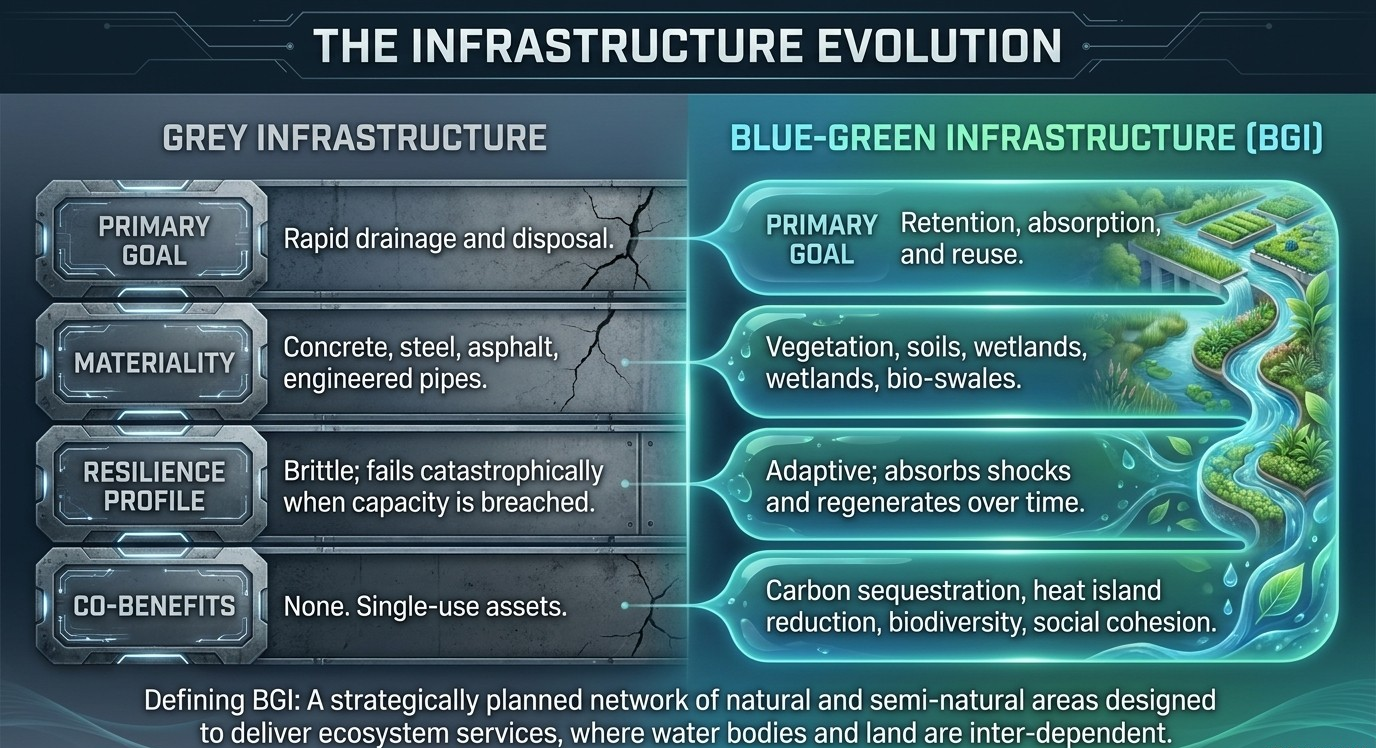
Flood-then-Drought Paradox: Erratic rainfall causes instant urban flooding due to paved surfaces, while the lack of percolation leaves reservoirs parched shortly thereafter.
Temperature Spikes: The Government of India's Assessment of Climate Change highlights that by 2099, average surface temperatures across the Indian subcontinent could rise by 4.4°C.
Heatwave Mortality: Extreme heat causes 3,400 excess deaths per day during peak conditions while simultaneously paralyzing municipal water reserves. (Source: India Energy and Climate Center)
Chemical Toxicity: Falling water tables concentrate naturally occurring minerals, leading to dangerous levels of fluoride, arsenic, and uranium in deep groundwater.
Universal Water Metering: Replace flat tariffs with telescopic (volumetric) pricing to reflect the true cost of service and penalize excessive wastage.
Non-Revenue Water (NRW) Reduction: Conduct aggressive, zone-by-zone "leak hunts" using SCADA and acoustic detection to recover lost water at a fraction of the cost of new dams.
Mandatory Rainwater Harvesting: Enforce municipal building bylaws requiring commercial and residential structures to capture rooftop runoff, reducing the burden on external grids.
Wastewater Recycling: Mandate the sale of tertiary-treated wastewater to industrial clusters, reserving fresh river water exclusively for domestic consumption.
Ecological Restoration: Shift from aesthetic "beautification" to the protection of natural wetland boundaries and native biodiversity to facilitate natural evaporative cooling.
Integrated Planning: Formulate 5-year City Water Action Plans (CWAP) to align master plans with water balances, preventing real estate development over natural stormwater drainages.
Community Participation: Deploy the "Jal Bandhu" (Water Friends) model, utilizing Women SHGs to manage local water audits and drive behavioral change.
Ring-Fenced Water Cess: Levy a protected municipal tax legally locked to fund the physical repair of decaying pipe infrastructure.
|
Circular Water Economy Wastewater Reuse: India shifting toward a circular model—extract, use, treat, and reuse—to convert sewage into an economic resource. Economic Potential: The Council on Energy, Environment and Water (CEEW) projects that wastewater treatment could unlock a ₹1 lakh crore market and generate 1,00,000 jobs by 2047. Industrial Efficiency: Industrial cooling using treated municipal sewage proves 10 to 20 times cheaper than energy-intensive desalination. Zero Liquid Discharge (ZLD): Mandates force industries to recycle 100% of effluent, effectively ending river pollution. Dual-Plumbing: Implementing dual-plumbing systems in residential developments reduces freshwater demand by 30-40% by utilizing greywater for non-potable needs. |
Jal Jeevan Mission (Urban): Targets the provision of 2.68 crore new functional household tap connections across 4,800 statutory towns to achieve universal urban water access.
AMRUT 2.0 Mission: Utilizes an outcome-based funding model to mandate that cities reduce Non-Revenue Water (NRW) below 20% and reuse treated water for 20% of total city demand.
Atal Bhujal Yojana: Prioritizes community-led, sustainable groundwater management in states facing critical aquifer depletion.
National Water Mission: Aims to minimize wastage and boost water use efficiency by 20% through integrated basin-level planning.
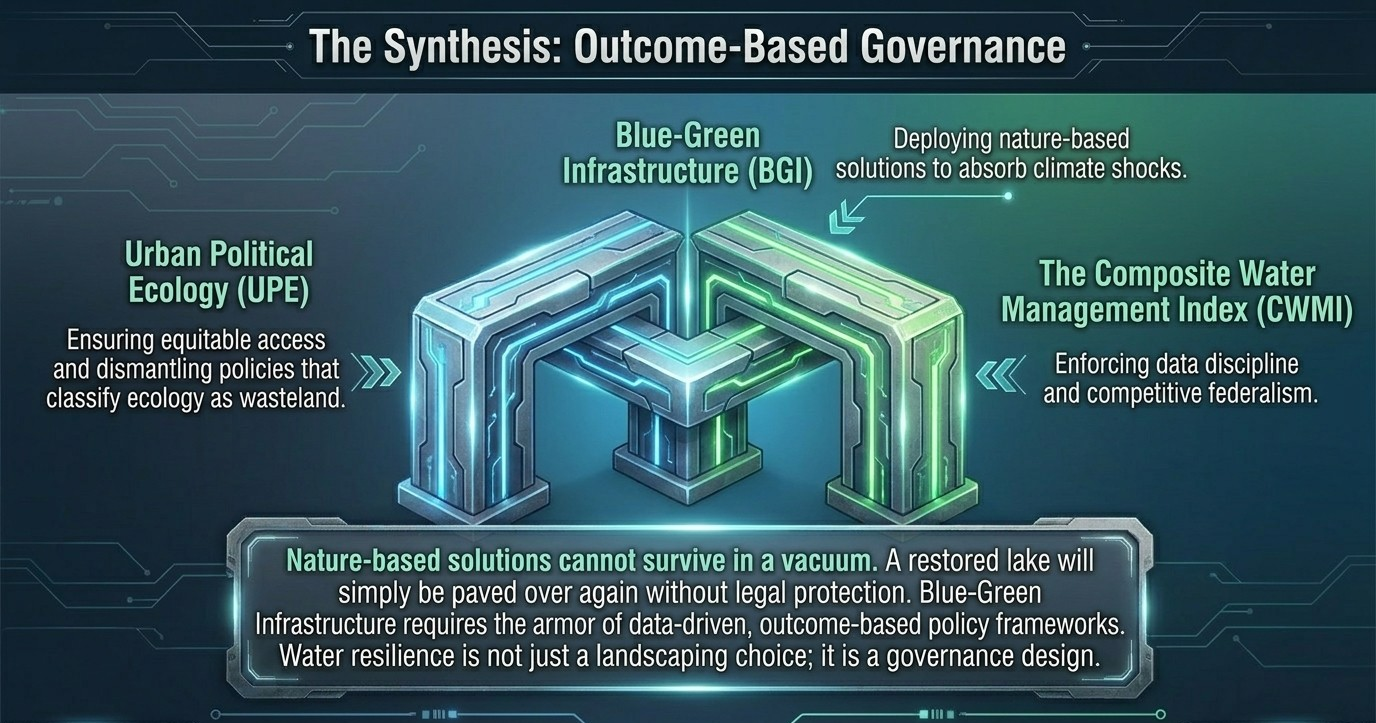
Pey Jal Survekshan: Functions as a robust monitoring tool under AMRUT 2.0 to rank cities based on water quality, supply coverage, and financial health, fostering competitive federalism.
Demand Management: Cease the infinite pursuit of drilling deeper; instead, enforce conservation limits and conduct rigorous efficiency audits.
Climate-Resilient Systems: Deploy Digital Twins and AI-centric platforms, such as the Karnataka Water Intelligence Platform, to predict flood-drought fluctuations.
Circular Economy: Enforce Zero Liquid Discharge (ZLD) across manufacturing hubs to decouple economic growth from freshwater extraction.
Governance Reform: Dismantle siloed departments and establish autonomous Water Resources Regulatory Authorities staffed by interdisciplinary experts.
Sponge City Frameworks: Introduce national guidelines mandating Nature-Based Solutions (NbS), such as permeable pavements and bioswales, into statutory urban master plans.
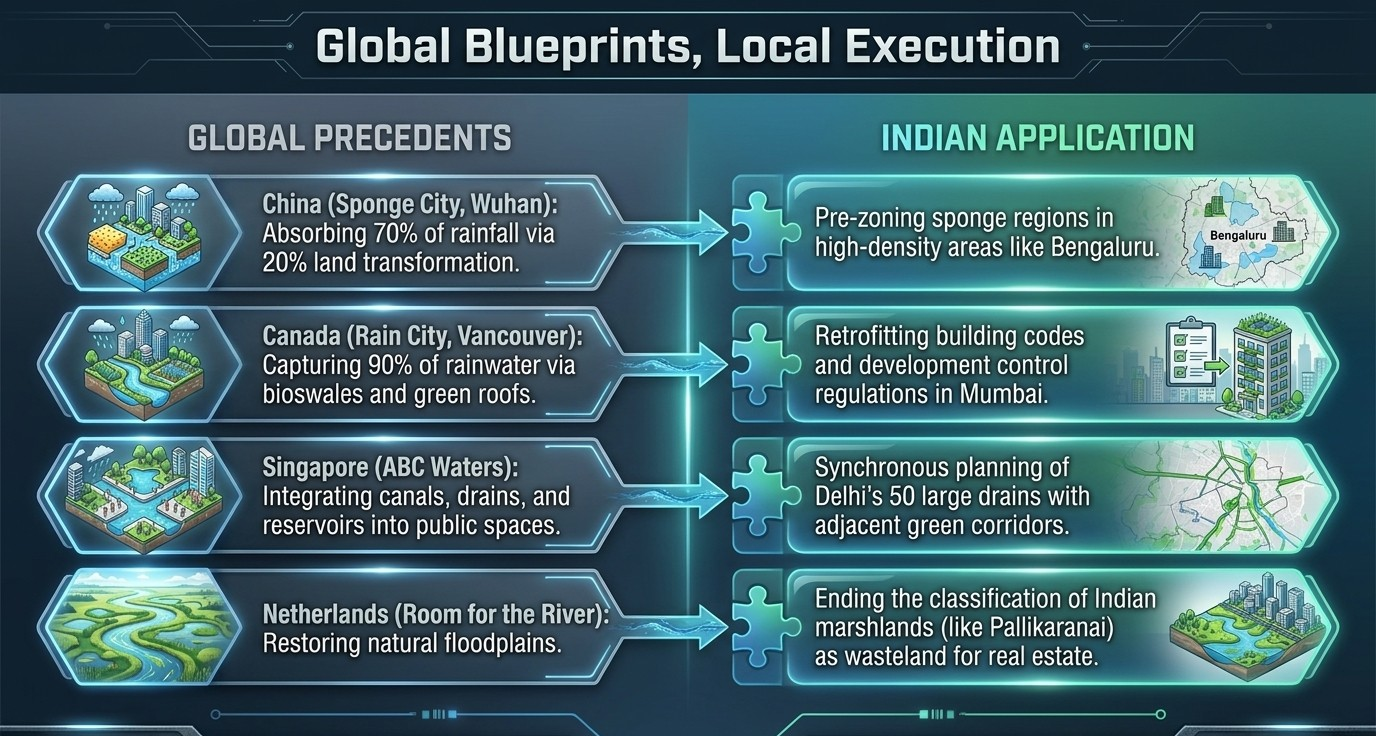
 Learn from International Case Studies
India can leverage successful global models to accelerate its own water reforms:
 Conclusion
Resolving India's urban water crisis necessitates an urgent paradigm shift from reactive, supply-side engineering to AI-driven, demand-side governance. By institutionalizing circular water economies and empowering local communities, India can secure a sustainable and climate-resilient water future.
Source: INDIANEXPRESS
|
PRACTICE QUESTION Q. How can integrating ecologically functional urban water bodies mitigate Urban Heat Island (UHI) effect in Indian metropolises? (150 words) |
Indian cities face severe water scarcity due to rapid, unplanned urbanization, massive destruction of local wetlands, rampant over-extraction of groundwater, and leaky, decaying municipal distribution pipelines.
Recycling wastewater improves water security by treating sewage into high-quality reusable water, which directly reduces the demand for fresh drinking water by powering industrial cooling, construction, and municipal gardening.
Climate change devastates urban water networks by triggering erratic monsoons, prolonging extreme summer heatwaves, and causing short, high-intensity rainstorms that trigger flash floods rather than recharging underground aquifers.
Cities must immediately execute mandatory rooftop rainwater harvesting, aggressively revive seasonal lakes, install decentralized sewage treatment plants, and deploy smart digital meters to stop widespread water distribution leakages.
© 2026 iasgyan. All right reserved