The Union Minister of Housing & Urban Affairs released the report “Moving Towards Effective City Government – A Framework for Million-plus Cities” by NITI Aayog at the India Habitat Centre, New Delhi.
What is Urban Governance?
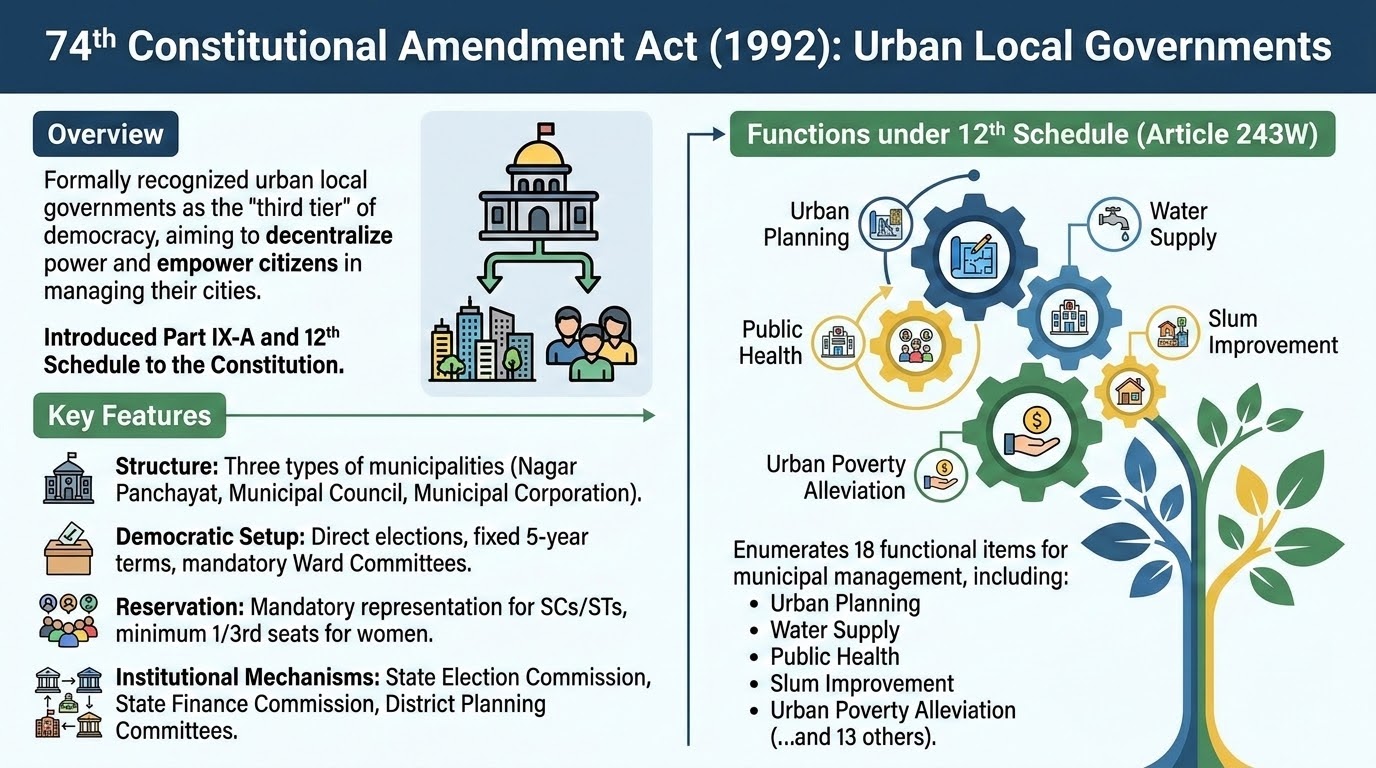
Urban Governance refers to the process by which democratically elected local bodies and state-appointed institutions manage the planning, financing, and delivery of public services in cities.
It is constitutionally mandated by the 74th Constitutional Amendment Act (1992), which aimed to decentralize power to the "third tier" of government—Urban Local Bodies (ULBs)—giving them autonomy to manage functions like water supply, sanitation, roads, and urban planning.
 Why Urban Governance Systems Failed to Deliver Effectively?
The "Weak Mayor" Syndrome
Ceremonial Role: Most Mayors are figureheads with short 1-year terms and no executive power. True authority over budgets and personnel lies with the state-appointed Municipal Commissioner.
Broken Accountability: As per a 2024 Praja Foundation report, Kerala is the only state where Mayors can evaluate Commissioners via Annual Confidential Reports, leaving others unable to penalize poor performance.
Financial Dependence
Financial Infantilisation: Indian ULBs generate under 40% of their revenue, relying on discretionary government grants for basic costs like salaries. (Source: RBI)
Stagnant Revenue: Municipal revenue is merely 1% of GDP, trailing Brazil (7.4%) and South Africa (6%). Property tax collection is hindered by obsolete valuation systems. (Source: RBI)
Fragmentation of Governance
Governance Fragmentation: Key city functions are managed by state-run "Parastatals" (e.g., Development Authorities, Water Boards) that operate independently of Urban Local Bodies (ULBs).
Acute Staffing Shortage
Staffing Shortages: Widespread vacancies in technical and administrative roles hamper ULBs. NITI Aayog reports that 65% of 7,933 urban settlements lack Master Plans due to a shortage of town planners.
Unspecialized Workforce: Most states lack a dedicated "Municipal Cadre." As noted by the 2nd ARC, cities are managed by generalist officers on deputation who lack urban management expertise.
Failure of Decentralization
12th Schedule Decentralization Gap: While the 74th Amendment mandates transferring 18 functions to ULBs, states have only devolved an average of 9 functions, limiting local government powers.
Structural & Institutional Reforms
Constitutional Foundation (74th Amendment): Established the legal framework for city governance by mandating Urban Local Bodies (ULBs), State Election Commissions, and State Finance Commissions.
NITI Aayog’s "Mayor-in-Council" Push: The "Moving Towards Effective City Government" report recommends states amend Municipal Acts to:
Unified Command: Integrating fragmented parastatals under Municipal Corporation oversight to ensure singular accountability.
Financial Reforms
Launch of Urban Challenge Fund (UCF): MoHUA launched this ₹1 lakh crore fund to shift cities from "grant-based" to "market-based" financing.
Credit Repayment Guarantee Sub-Scheme (CRGSS): Provides sovereign debt guarantees to assist Tier-II/III cities in securing bank loans.
Municipal Bonds: Incentives led cities like Indore, Ghaziabad, and Vadodara to issue Green Bonds, promoting financial transparency.
16th Finance Commission (2026-31): Increased urbanization weightage in devolution to boost grants for ULBs managing migration.
Process Reforms
Performance-Linked Grants: Under schemes like AMRUT 2.0 and 15th/16th Finance Commission, funds are no longer "free." They are tied to reforms like:
The "Indore Model" of Waste Management: Through Swachh Bharat Mission 2.0, cities are adopting the "User Fee" model (paying for garbage collection), making sanitation services financially sustainable rather than dependent on state subsidies.
Online Building Permission Systems (OBPS): To reduce corruption and delay, steps have been taken to make building plan approvals 100% automated and online in over 2,500 cities, reducing human interface.
Digital Governance
National Urban Digital Mission (NUDM): Launched to create a shared digital infrastructure for cities.
Integrated Command and Control Centres (ICCCs): Developed in 100 Smart Cities, these war rooms effectively used real-time data for governance during COVID-19 and are now being used for traffic and disaster management.
What Should Be the Way Forward?
Political Empowerment
Directly Elected Mayors: States must amend Municipal Acts to provide for directly elected Mayors with a fixed 5-year tenure to ensure stability and accountability.
Executive Authority: Empower the Mayor-in-Council to manage city budgets and major contracts, shifting the Municipal Commissioner to an implementing officer role.
Financial Sovereignty
Activate the Urban Challenge Fund (UCF): Cities should compete for the ₹1 lakh crore fund by enhancing credit ratings and auditing accounts.
Reform Property Tax: Use GIS mapping and inflation-linked rate adjustments to potentially boost municipal revenue from 1% to 3% of GDP. (Source: RBI)
Leverage Bonds: Promote Green Bonds in Tier-I and Tier-II cities for climate-resilient projects, decreasing reliance on state grants.
Institutional Integration
Unified City Agency: Bring all essential services—water supply, sewage, and urban transport—under the singular command of the elected Municipal Corporation.
Metropolitan Planning Committees (MPCs): For large clusters like NCR, MPCs should be constitutionally activated to plan for the entire region as one economic unit, rather than as separate, disconnected municipalities.
Planning for the "Climate-Century"
Dynamic Master Plans: Move away from rigid "20-year Master Plans" to 5-year rolling plans that use real-time satellite data and AI to manage urban sprawl and protect green zones.
Sponge City Concepts: Mandate "blue-green" infrastructure—protecting urban wetlands and increasing permeable surfaces—to prevent the recurring "urban flooding" seen in cities like Chennai and Bengaluru.
Dedicated "Municipal Cadre"
Specialised Urban Cadre: States should create a dedicated Municipal Service for town planners, urban economists, and waste management experts.
Lateral Entry: Allow lateral entry of private sector professionals into municipal management to bring in modern project management techniques.
Citizen-Centric Governance
Digital Democracy: Use platforms like the National Urban Digital Mission (NUDM) to ensure that 100% of municipal services are available via mobile, reducing corruption and the "middleman" culture.
Area Sabhas: Activate Ward Committees and Area Sabhas to give citizens a direct say in how the "ward-level" budget is spent.
India's shift to an urban-industrial powerhouse requires moving beyond colonial administration. Success depends on establishing "Cities as Growth Hubs"—autonomous, citizen-centric, and climate-resilient entities.
SOURCE: PIB
|
PRACTICE QUESTION Q. Consider the following statements regarding urban governance in India: 1. Under the 74th Constitutional Amendment Act, all Indian cities are legally required to operate under a 'Mayor-centric' executive model. 2. The 12th Schedule of the Indian Constitution enumerates 18 functional domains meant to be devolved to municipalities. Which of the statements given above is/are correct? (a) 1 only (b) 2 only (c) Both 1 and 2 (d) Neither 1 nor 2 Answer: (b) Explanation: Statement 1 is incorrect: The 74th Constitutional Amendment Act (1992) does not mandate a 'Mayor-centric' or a single executive model for all Indian cities. The act leaves the manner of election of the Chairperson (Mayor/President) and their powers entirely to the discretion of the state legislature. Statement 2 is correct: The 74th Constitutional Amendment Act added the 12th Schedule to the Indian Constitution, which enumerates 18 functional domains meant to be devolved to urban local bodies (municipalities). |
The 74th CAA is termed an unfunded mandate because state governments have largely failed to devolve the "3Fs"—Funds, Functions, and Functionaries. This leaves Urban Local Bodies (ULBs) without the financial autonomy or administrative staff required to execute their constitutional duties.
Parastatals are unelected, state-created agencies (such as State Water Boards or Urban Development Authorities) that manage specific city services. They negatively impact governance by bypassing democratically elected municipal councils, fragmenting accountability, and stripping local governments of real operational power.
Cities can improve financial autonomy by shifting to an 'own-source revenue' (OSR) model. This involves widening the property tax net using modern tools like GIS mapping (as successfully done in Pune), implementing appropriate user charges for public utilities, and raising independent capital through the municipal bond market.
© 2026 iasgyan. All right reserved