Copyright infringement not intended
Picture Courtesy: THE HINDU
The "Right to Disconnect" is an emerging legal concept allowing employees to ignore work-related electronic communications outside of working hours without penalty.
|
Read all about: RIGHT TO DISCONNECT FOR BALANCE l GLOBAL TRENDS IN 'RIGHT TO DISCONNECT' LEGISLATION l AUSTRALIA'S "RIGHT TO DISCONNECT" BOOSTS WORK-LIFE BALANCE |
The Right to Disconnect (RTD) refers to an employee's right to not engage in work-related electronic communications, such as emails, calls, or messages, during non-work hours.
In an era of smartphones and remote work, this right aims to prevent "digital overwork" by establishing that:
Proposed Framework in India
The Right to Disconnect Bill, 2025, introduced in the Lok Sabha by MP Supriya Sule, proposes several key mechanisms:
India is following a global trend where nations such as France (2017), Portugal (2021), and Australia (2025) have already enacted similar protections. Within India, Kerala has also moved to propose its own state-level legislation for the private sector in late 2025.
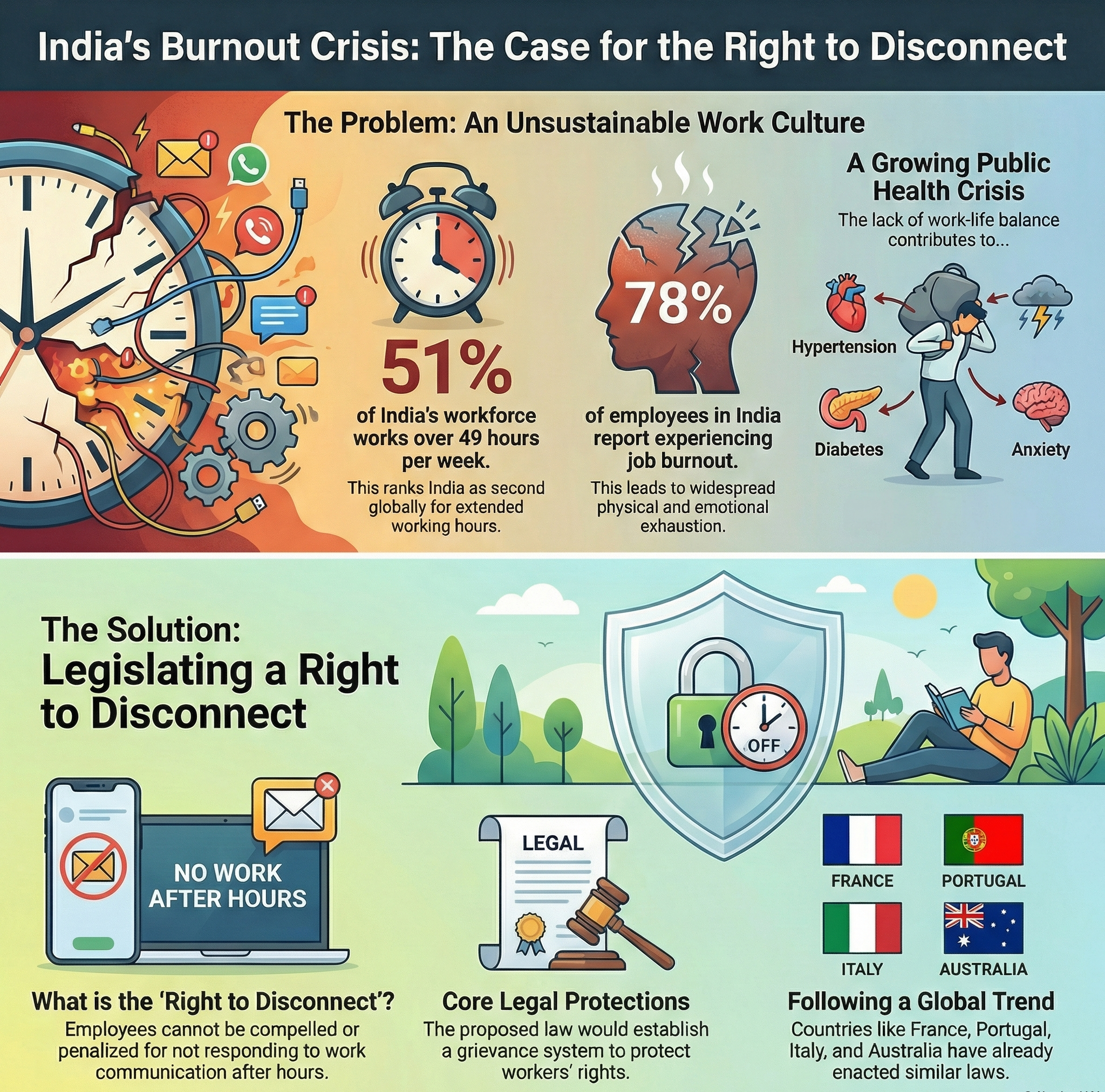 Why is the Right to Disconnect a Necessity?
Post-Pandemic Work Culture
Blurred Boundaries: The rise of remote work has transformed homes into 24/7 offices, leading to an 'always-on' culture where employees feel pressured to be constantly available.
Increased Work Hours: Microsoft's Work Trend Index revealed Indian employees are working longer hours from home, often late, to collaborate globally.
Escalating Mental and Physical Health Concerns
Digital Burnout: Constant connectivity leads to digital fatigue, stress, anxiety, and burnout. About 59% of Indian employees are currently experiencing symptoms of burnout. (Source: McKinsey)
Health Impact: The World Health Organization (WHO) and the International Labour Organization (ILO) have warned that working 55 or more hours per week is a serious health hazard, associated with a 35% higher risk of a stroke and a 17% higher risk of dying from heart disease.
Structure of India's Modern Economy
Dominance of Digital Industries: The Indian economy relies heavily on sectors like IT/ITeS, with the IT industry expected to hit US$350 billion by 2026 and contribute 10% to GDP. These sectors require cross-time-zone collaboration. (Source: IBEF)
Rise of the Gig Economy: India's gig workforce is projected to reach 23.5 million workers by 2029-30, facing vulnerability due to lack of traditional employment protections like defined working hours. (Source: NITI Aayog)
Improved Employee Well-being
Guarantees uninterrupted personal time, crucial for mental recuperation, reducing stress-related illnesses, improving sleep, and directly combating the rising tide of burnout.
Enhanced Productivity
A well-rested and focused workforce is more efficient and innovative, and RTD can reduce 'presenteeism' and absenteeism, leading to higher quality output during defined work hours.
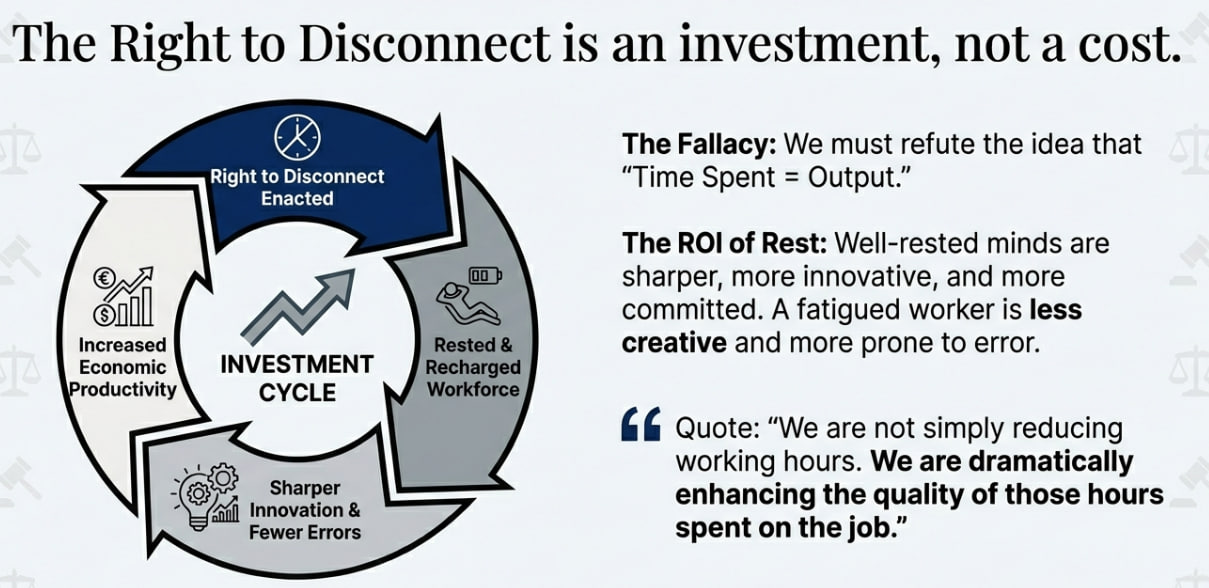 Promotes Gender Equality
Defined work boundaries help alleviate the "double burden" on women by allowing a more equitable distribution of domestic and caregiving responsibilities.
Broader Societal Benefits
Encourages stronger family and community ties by allowing individuals to be more present in their personal lives and reduces public healthcare burden by preventing stress-induced chronic diseases.
Impact on Business Competitiveness
Global Operations: Strict disconnection rules in Indian MNCs and IT firms impede collaboration with teams in different time zones, negatively impacting project delivery and client responsiveness.
MSMEs and Startups: Small and medium enterprises (MSMEs) rely on small teams and tight deadlines, making a rigid RTD law a threat to their productivity and competitive edge.
Implementation and Enforcement Hurdles
Defining "Work": In a digital context, it is difficult to legally define what constitutes "work". Does checking a quick message count? How are on-call duties for essential services managed?
Diverse Workforce: Applying a uniform law across the formal sector, informal sector, and gig economy is difficult due to the immensely varying nature of work, from a factory floor to a delivery agent's route.
Monitoring: Enforcing compliance without infringing on employee privacy is a significant legal and ethical challenge.
Potential Negative Employee Impact
Reduced Flexibility: Some employees prefer flexible schedules, allowing them to attend to personal matters during the day and work in the evening. A strict RTD could remove this autonomy.
Career Progression Fears: Employees might feel pressured to "unofficially" stay connected to demonstrate commitment, creating a shadow work culture and disadvantageous to those who choose to disconnect.
France
The El Khomri Law (2017) mandates companies with over 50 employees to negotiate and define periods when employees are not expected to be connected. The focus is on negotiation rather than a blanket ban.
Portugal
Employers are banned from contacting workers after hours (except in emergencies) and can face penalties. Companies are also required to help pay for home office expenses.
Belgium
Firms with 20 or more employees must include disconnection protocols in collective bargaining agreements. Belgium also officially allows a compressed four-day workweek as part of its labor reforms.
Australia
All businesses, employees have a statutory right to refuse to respond to work contact after hours unless the refusal is "unreasonable." Reasonableness is judged by the Fair Work Commission based on job role, urgency, and compensation.
Legislative Reform
Standalone Legislation vs Amending Labour Codes:
A Phased and Flexible Approach
Sector-Specific Guidelines: Start with sectors like IT and formal services, where the problem is most acute. Develop different guidelines for manufacturing, essential services, and startups.
Company-Level Policies: Encourage companies (above a certain size, e.g., 50+ employees) to formulate their own clear RTD policies through negotiation with employees or unions, similar to the French model.
Promote a "Code of Conduct": Before legislation, the government could issue a national code of conduct, encouraging best practices like no after-hours emails and clear communication expectations.
Encouraging a Cultural Shift
Lead by Example: Management and team leaders must champion the cause by respecting non-work hours themselves.
Awareness and Training: Companies should conduct workshops on the importance of digital wellness, work-life balance, and the negative impacts of an 'always-on' culture.
Leverage Technology: Use HR tech tools and AI to schedule email delivery during work hours, monitor workload without surveillance, and promote efficient task management.
For India, balancing the Right to Disconnect requires a flexible approach combining legislative frameworks, corporate responsibility, and a cultural shift to respect personal time, enhancing both well-being and productivity.
Source: THE HINDU
|
PRACTICE QUESTION Q. "The 'Right to Disconnect' is not merely a labor reform but an extension of the Right to Life under Article 21." Discuss. 250 words |
The 'Right to Disconnect' is a proposed legal protection that allows employees to not engage in work-related electronic communications, such as emails, calls, or messages, outside their specified working hours without facing any adverse consequences from their employer.
The demand stems from the rise of an 'always-on' work culture fueled by smartphones and remote work, especially after the COVID-19 pandemic. This has led to blurred work-life boundaries, increased stress, burnout, and negative health impacts on employees.
Several countries have enacted laws or formal codes. France was a pioneer in 2017, followed by countries like Belgium, Spain, Italy, Portugal, and Australia. The province of Ontario in Canada has also mandated policies on disconnecting from work.
© 2026 iasgyan. All right reserved