

Experts highlighted a metropolitan paradox where India's large cities generate high-quality jobs but fail to provide the safe transport, affordable childcare, and inclusive housing women need to balance work and home
Large Cities Offer Better Employment Prospects
According to the National Statistics Office, 65.1% of employed women in million-plus cities hold regular salaried jobs, compared to just 50.9% across overall urban India.
Large cities consolidate white-collar work, schools, hospitals, and business services, providing formal contracts, paid leave, and predictable hours.
Women in metropolitan centres earn an average monthly salary of ₹23,707, which is at least 10% higher than the broader urban Indian average for women. (Source: NSO)
Female Employment Opportunities Are Concentrated in Cities
Thicker labour markets in metropolitan areas attract skilled workers and large firms, driving demand for service sector roles.
Almost 29.4% of women in big cities possess college-and-above education, allowing them to access these concentrated formal sector opportunities. (Source: PLFS)
Sectors traditionally accessible to women, such as administration, health, and social work, cluster densely in these urban geographies.
Participation Remains Lower Than Potential
Despite higher job quality, the Female Labour Force Participation Rate (LFPR) in million-plus cities stagnates at 25.5%, noticeably lower than the general urban average of 27.7%. (Source: NSO
The Worker Population Ratio (WPR) for women is restricted to 25.5%, displaying a massive gap compared to the 72.6% male WPR in the same cities. (Source: PLFS)
The female unemployment rate in these cities stands at 9.81%, against 6.49% for men, proving that women actively seeking work face severe matching constraints.
Greater Access to Formal Employment
Urbanization shifts labour from informal agriculture to formal firms, offering legal protections, maternity benefits, and social security.
Larger companies in cities are statistically more likely to supply critical amenities like safe transport and crèche facilities.
Higher Educational Opportunities
Cities host premium educational ecosystems, narrowing the gender education gap and equipping women with specialized, market-aligned skills.
Urban centres report a higher average number of years in formal education for women (10.9 years) compared to rural areas (9.2 years) (Source: MoSPI).
Better Professional Networks
Metropolitan hubs foster dense professional ecosystems, allowing women to access industry networks, mentorship, and leadership pipelines.
Proximity to diverse industries allows women to transition into Non-Traditional Livelihoods (NTL), such as tech and advanced manufacturing.
Financial Independence and Asset Creation
Higher urban salaries empower women to control their household bargaining power and direct investments into health and child education
Cities offer advanced financial inclusion tools, enabling independent savings and wealth accumulation.
Increased Social Mobility
Cities provide anonymity and distance from rigid patriarchal village structures, allowing women greater social freedom and lifestyle choices.
Urban environments dilute traditional caste and gender norms, promoting workplace egalitarianism
Reduced Dependence on Traditional Occupations
Urban expansion reduces reliance on low-productivity agricultural work, where 61% of Indian working women are currently trapped.
It shift women towards the modern service economy and high-growth technology sectors.
Safety and Mobility Constraints
According to a World Bank study, 45% of Indian women walk to work due to unsafe or unaffordable motorized transport.
A "Pink Tax" on mobility exists; women in Delhi willingly travel 27 minutes longer daily to secure a route perceived as safe. (Source: World Bank)
Fear of harassment and violence restricts a woman's "job radius", cutting off access to distant employment nodes
Burden of Unpaid Care Work
According to the NSO, 69% of urban women remain outside the labour force specifically due to childcare and household chores.
Indian women suffer from severe time poverty, spending roughly 5 to 6 hours daily on unpaid care, compared to under one hour for men. (Source: Time Use Survey)
This invisible infrastructure subsidizes the formal economy but structurally bars women from demanding 9-to-5 roles.
Lack of Affordable Childcare Facilities
The absence of workplace crèches generates a massive motherhood penalty, triggering an immediate decline in women's employment post-childbirth.
Nuclear family structures in cities remove the traditional family care net, making paid childcare unaffordable for moderate-income earners.
Social and Cultural Norms
Conservative expectations categorize women primarily as caregivers, linking family honour to their confinement within domestic spaces
Landlords impose moral gatekeeping; single working women face an average 7.8% rental premium ("Pink Tax" on housing) to secure safe, restriction-free accommodations.
Informal Employment and Job Insecurity
Even among paid urban women, 60% operate in informal arrangements lacking contracts, paid leave, or social protections. (Source: PLFS)
The "flexibility penalty" forces women juggling care duties into part-time or home-based work that pays 40-60% less than formal equivalents.
Gender Wage Gaps
A severe gender wage gap persists; urban women in regular salaried jobs earn 22.8% less than men (₹23,707 vs ₹30,707). (Source: NSO)
This pay disparity diminishes the opportunity cost of staying home, making it economically irrational for women to pay for commuting and childcare.
Limits Demographic Dividend Benefits
A 67% of urban women aged 30–59 fall into the NEET (Not in Employment, Education, or Training) category, wasting immense human capita. (Source: NSO)
Failing to employ working-age women squanders the narrow window of demographic advantage as India's fertility rates plummet.
Reduces Household Income Growth
Households excluding women from paid work forfeit dual-income stability. Families with employed women record 25% higher consumption and drastically lower poverty risks.
Unpaid care work, valued at 15% to 17% of GDP, remains entirely unmonetized, suppressing actual household wealth metrics.
Constrains Productivity Gains
Occupational segregation creates a sub-optimal allocation of talent, where highly educated women withdraw from the market, reducing Total Factor Productivity (TFP).
The World Bank calculates that raising female participation to match male levels could boost economic output by 12%.
Slows Inclusive Economic Development
Excluding women costs the national economy heavily; McKinsey estimates that bridging gender gaps could inject $770 billion into India's GDP by 2025. (Source: McKinsey)
Low participation sustains intergenerational poverty, as working women are likelier to channel capital directly into child nutrition and education.
Weakens Progress Towards Gender Equality
Lack of financial autonomy traps women in cycles of economic dependence, making them vulnerable to domestic violence and diminishing their household bargaining power.
Systemic absence of women in corporate pipelines creates a "broken rung," resulting in a critical lack of female leadership and role models.
Maternity Benefit Act, 1961 (Amended 2017)
Provides 26 weeks of paid maternity leave, up from 12 weeks, ensuring income security post-childbirth.
Mandates establishing crèche facilities for establishments employing 50 or more workers.
Working Women Hostel Scheme
Implemented via the Sakhi Niwas framework under Mission Shakti, providing safe and affordable urban accommodations.
The 2024-25 government budget explicitly earmarks ₹5,000 crore under the Scheme for Special Assistance to States for Capital Investment to build greenfield hostels.
PM Vishwakarma and Skill India Initiatives
Targets the integration of women into Non-Traditional Livelihoods (NTL), such as drone operation, electronics, and solar PV installation.
The Pradhan Mantri Kaushal Vikas Yojana (PMKVY) focuses heavily on market-aligned vocational training for women.
National Creche Scheme
Rebranded under the Palna Scheme (part of Mission Shakti), it aims to deploy 17,000 Anganwadi-cum-crèches to deliver quality daycare, freeing mothers for formal work.
DAY-NULM and Urban Livelihood Missions
Empowers urban women through Self-Help Groups (SHGs), providing microcredit access, market linkages, and entrepreneurial support
Creates female-led micro-enterprises in solid waste management, digital services, and decentralized urban planning.
Women-Led Development Initiatives Under G20 and SDG Frameworks
Under India’s G20 Presidency, the government committed to mobilizing public-private investments for robust Care Economy infrastructure to redistribute unpaid care work.
Improve Urban Safety Infrastructure
Scale up the Safe City Project using AI-integrated CCTVs, enhanced street lighting, and dedicated panic buttons in public transit to eliminate mobility fears.
Adopt gender-inclusive urban planning by ensuring mixed-use neighbourhoods and well-lit pedestrian pathways.
Expand Affordable Childcare Networks
Transform standard Anganwadis into full-day Early Childhood Development Centres (8+ hours) to accommodate standard corporate work shifts.
Subsidize private and community-run crèches through targeted government grants and corporate tax credits.
Promote Flexible Work Arrangements
Legally formalize part-time employment and flexible working hours with proportionate social security benefits.
Enforce structured Returnship programs to securely reintegrate women into corporate pipelines after maternity breaks.
Increase Women's Access to Skill Development
Eradicate gendered occupational segregation by heavily incentivizing female enrollment in STEM, green energy, and advanced manufacturing.
Mandate the inclusion of safe residential facilities and gender-sensitive infrastructure at industrial training institutes (ITIs).
Encourage Female Entrepreneurship
Expand the Women Entrepreneurship Platform (WEP) to provide localized mentorship, seed funding, and digital literacy down to tier-2 urban clusters
Incentivize women-led MSMEs supplying care services via preferential public procurement clauses.
Strengthen Workplace Gender Equality Measures
Drive strict compliance with the Sexual Harassment of Women at Workplace (POSH) Act, 2013, utilizing portals like SHe-Box 2.0 for seamless grievance redressal.
Audit algorithmic hiring mechanisms to prevent AI-driven recruitment bias that disproportionately filters out female resumes
Improve Availability of Affordable Urban Housing Near Employment Centres
Eradicate the "Pink Tax" on shelter by rapidly scaling Industrial Housing for Workers through Public-Private Partnerships.
India requires over 3,500 new industrial hostels by 2030 to house the 7 million women projected to enter urban manufacturing and services.
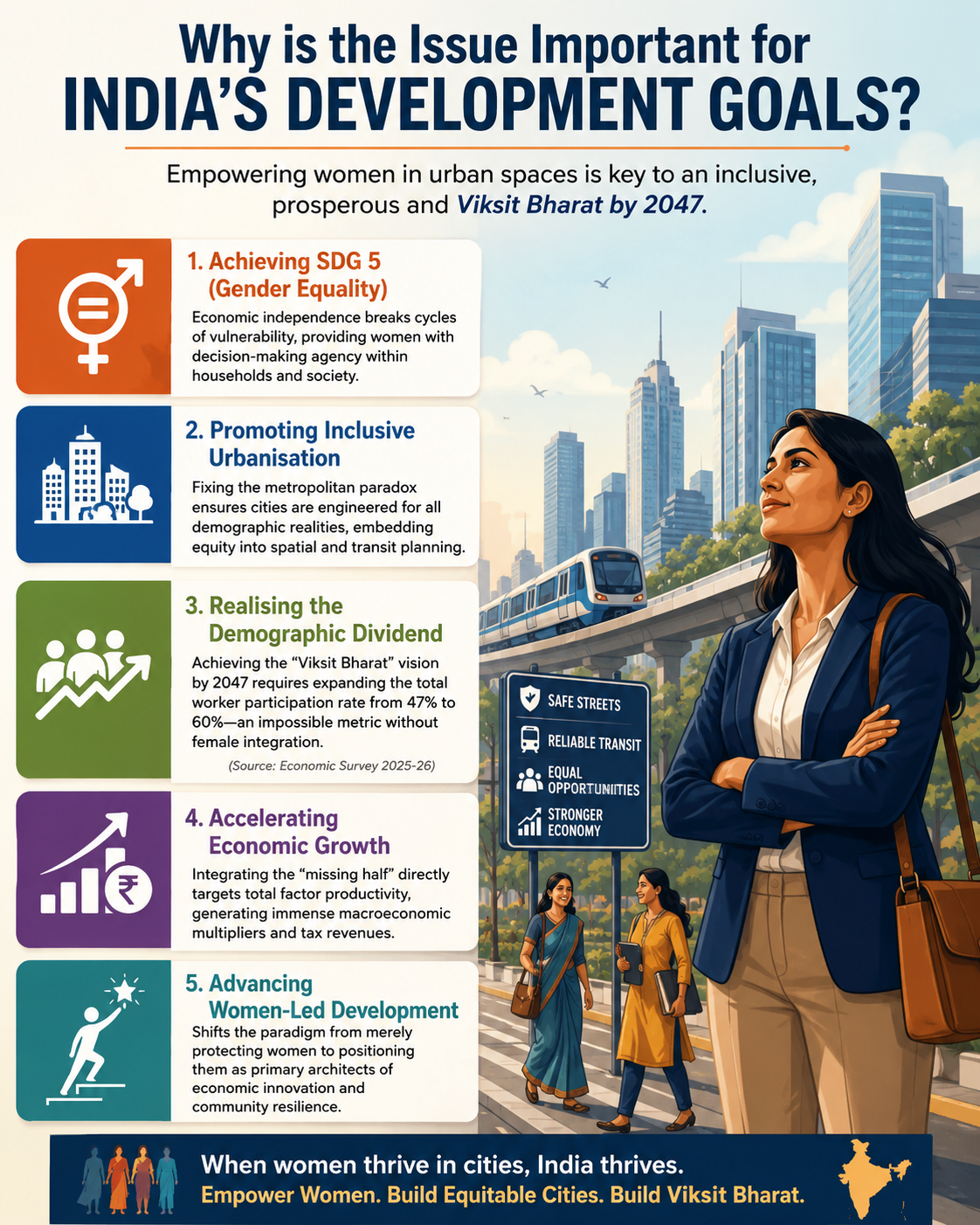
To dismantle the urban paradox, India must shift from treating female employment as a social byproduct to enforcing massive, targeted investments in public safety, urban housing, and the care economy.
Source: INDIANEXPRESS
|
PRACTICE QUESTION Q. "Indian cities provide greater economic opportunities for women, yet structural barriers continue to limit female labour force participation." Examine the challenges faced by women in accessing urban employment and suggest measures to build gender-inclusive cities. (250 Words, 15 Marks) |
The urban paradox refers to the phenomenon where India's million-plus cities generate high-quality, regular salaried jobs, yet female labour force participation (25.5%) remains lower than the national urban average (27.7%). Better job availability does not equal higher participation due to structural barriers.
According to NSO data, 69% of women outside the workforce in million-plus cities cite childcare and household responsibilities as their primary constraint. This burden of "unpaid care work" causes severe time poverty.
The "Pink Tax" applies to the extra costs women bear for safety, such as paying a 7.8% premium on rental housing in safe neighbourhoods and spending more money and time to access secure public transportation. This reduces their net economic gain from working.
The motherhood penalty is the systemic disadvantage women face in the workforce post-childbirth. It leads to career breaks, reduced lifetime earnings, and mid-career drop-offs due to a lack of flexible working arrangements and affordable crèche infrastructure.
© 2026 iasgyan. All right reserved